F-22 Raptor vs J-20 Mighty Dragon
F-22 Raptor vs J-20 Mighty Dragon at a glance — top speed 2,414 vs 2,130 km/h, range 3,000 vs 5,500 km, max takeoff weight 38,000 vs 37,000 kg, built 195 vs 300 units.
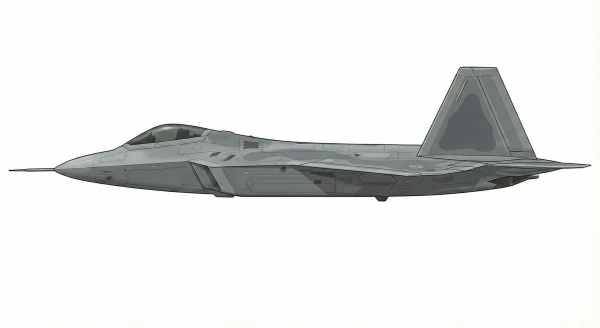
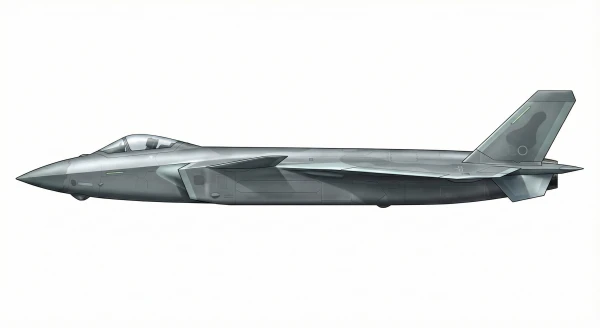
| F-22 Raptor | J-20 Mighty Dragon | |
|---|---|---|
| Origin country | 🇺🇸 United States | 🇨🇳 China |
| Category | Combat Aircraft | Combat Aircraft |
| Manufacturer | Lockheed Martin | Chengdu |
| First flight | 7 September 1997 | 11 January 2011 |
| Year introduced | 2005 | 2017 |
| Number produced | 195 units | 300 units |
| Average unit price | $150 million | $110 million |
| Wing area | 78.0 m² | 73.0 m² |
| Wingspan | 13.6 m | 13.0 m |
| Height | 5.1 m | 4.7 m |
| Length | 18.9 m | 21.2 m |
| Maximum speed | 2414 km/h | 2130 km/h |
| Operational range | 3,000 km | 5,500 km |
| Service ceiling | 19,812 m | 20,000 m |
| Max. takeoff weight | 38,000 kg | 37,000 kg |
| Empty weight | 19,700 kg | 17,000 kg |
| Total thrust | 2 x 15,876 kgf | 2 x 14,480 kgf |
Detailed Comparison
The F-22 Raptor, a product of the US Advanced Tactical Fighter program, is a specialized air superiority platform designed for unmatched stealth and kinematic performance. In contrast, the J-20 Mighty Dragon is a more recent Chinese design emphasizing long-range interception and precision strike, reflecting different strategic priorities. The F-22’s production was capped at 195 units, while the J-20 fleet has reportedly surpassed 300 aircraft and continues to grow, indicating a fundamental difference in strategic quantity and industrial base sustainment.
Development and Design
The F-22 was conceived to counter advanced Soviet fighters, prioritizing all-aspect stealth and maneuverability. Its design incorporates thrust-vectoring nozzles and the ability to supercruise (sustain supersonic flight without afterburners) with its mature Pratt & Whitney F119 engines. This resulted in a peerless within-visual-range and beyond-visual-range air-to-air combatant. The J-20's development began decades later, aiming to create a stealthy platform for China’s anti-access/area denial (A2/AD) strategy. Its design features a long fuselage, delta wings, and canards, an aerodynamic configuration optimized for high-speed performance and transonic maneuverability. While its all-aspect stealth is considered less comprehensive than the F-22's, particularly from the rear, its avionics suite, including an AESA radar and integrated electro-optical targeting systems, is designed for advanced sensor fusion. Its engine development has been incremental, with the WS-15 intended to provide performance on par with the F-22's F119.
Specifications and Performances
A direct comparison of specifications reveals differing mission profiles. The F-22’s higher maximum speed (2414 km/h vs. the J-20's 2130 km/h) and lighter empty weight (19,700 kg vs. 17,000 kg) point towards an advantage in raw kinematic performance and agility. However, the J-20's stated specifications indicate a significant advantage in reach and payload. Its maximum range is listed as 5,500 km, far exceeding the F-22's 759 km combat range, highlighting its role as a long-range interceptor. The J-20 also boasts a larger internal weapons bay and a maximum weapon payload of 11,000 kg, allowing it to carry a greater number of long-range missiles like the PL-15 or precision-guided bombs. The F-22's internal loadout is primarily focused on air-to-air munitions (six AMRAAMs) or a smaller ground-attack load (two 1,000-lb JDAMs).
Deployment and usage
The F-22's operational history has been constrained by its small fleet size and high operating costs. It serves as a high-value asset, used for strategic signaling (deployments to Europe and the Pacific) and limited combat roles, such as its 2014 debut against ISIS. Its primary function remains deterrence through technological superiority. The J-20, in contrast, is being rapidly integrated across all of China's military theater commands. It conducts regular combat patrols over the East and South China Seas, directly challenging air assets in the region. A USAF general confirmed a 2022 encounter between F-35s and J-20s, noting the professionalism of the PLAAF operation. This indicates the J-20 is not just a technology demonstrator but a core component of China's operational military posture.
Conclusion
The F-22 Raptor remains a benchmark for stealth and air-to-air kinematic performance, a highly specialized fighter born from Cold War requirements. Its operational utility is limited by its small numbers and the premature termination of its production line. The J-20 Mighty Dragon represents a different, more contemporary approach. It is a long-range, multi-role interceptor and strike aircraft designed specifically for China's strategic objectives in the Pacific. While it may not match the F-22 in certain performance metrics like all-aspect stealth or thrust vectoring, its greater range, larger payload, ongoing production, and rapid operational integration make it a formidable and evolving system. The F-22 is a dominant but finite asset, whereas the J-20 is a growing force shaping the strategic balance through numbers and reach.