J-20 Mighty Dragon vs Su-57 Felon
J-20 Mighty Dragon vs Su-57 Felon at a glance — top speed 2,130 vs 2,135 km/h, range 5,500 vs 4,500 km, max takeoff weight 37,000 vs 35,000 kg, built 300 vs 32 units.
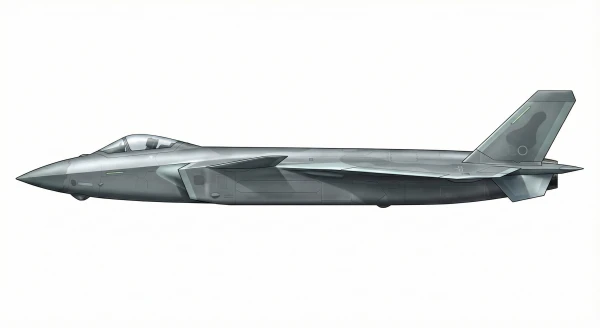
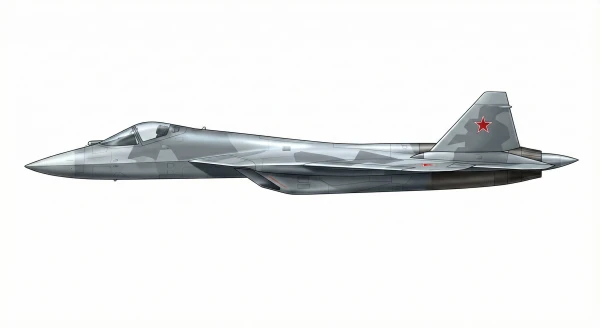
| J-20 Mighty Dragon | Su-57 Felon | |
|---|---|---|
| Origin country | 🇨🇳 China | 🇷🇺 Russia |
| Category | Combat Aircraft | Combat Aircraft |
| Manufacturer | Chengdu | Sukhoi |
| First flight | 11 January 2011 | 29 January 2010 |
| Year introduced | 2017 | 2020 |
| Number produced | 300 units | 32 units |
| Average unit price | $110 million | $42 million |
| Wing area | 73.0 m² | 78.8 m² |
| Wingspan | 13.0 m | 14.1 m |
| Height | 4.7 m | 4.6 m |
| Length | 21.2 m | 20.1 m |
| Maximum speed | 2130 km/h | 2135 km/h |
| Operational range | 5,500 km | 4,500 km |
| Service ceiling | 20,000 m | 20,000 m |
| Max. takeoff weight | 37,000 kg | 35,000 kg |
| Empty weight | 17,000 kg | 18,500 kg |
| Total thrust | 2 x 14,480 kgf | 2 x 14,500 kgf |
Detailed Comparison
China's J-20 and Russia's Su-57 were developed to provide their respective air forces with fifth-generation capabilities, but their design priorities, development trajectories, and production scales differ significantly. The J-20, with over 300 units built, has become a cornerstone of the PLAAF's modernization, designed primarily as a stealthy air superiority fighter for operations in the Western Pacific. In contrast, the Su-57, with approximately 32 aircraft in service, is a multirole platform emphasizing supermaneuverability alongside stealth, but its program has been constrained by a protracted development, economic limitations, and the loss of its Indian co-development partner.
Development and Design
The J-20's design philosophy prioritizes frontal-aspect stealth, high-speed performance, and advanced sensor fusion. Its long fuselage, canard-delta configuration, and diverterless supersonic inlets are optimized for sustained supersonic flight and reduced radar cross-section from the front. The absence of an internal cannon reinforces its focus on beyond-visual-range (BVR) engagements, relying on long-range missiles like the PL-15 housed in a large main weapons bay. Its development has seen a methodical progression from Russian-supplied engines to indigenous WS-10C turbofans, with the more powerful WS-15 now entering production.
The Su-57 balances stealth with extreme maneuverability. Its airframe incorporates unique features like leading-edge vortex controllers (LEVCONs) and its interim AL-41F1 engines are equipped with three-dimensional thrust vectoring, granting it exceptional agility at low speeds and high angles of attack. While it incorporates stealth features like internal weapons bays and planform alignment, its design is considered less optimized for all-aspect low observability compared to the J-20. The inclusion of a 30mm cannon and a wide array of air-to-ground ordnance underscores its multirole intent from the outset.
Specifications and Performances
A critical performance differentiator is range. The J-20's stated range of 5,500 km far exceeds the Su-57's 3,500 km, reflecting its strategic role in projecting power over vast maritime distances. While both aircraft have a similar service ceiling and maximum speed, the J-20's aerodynamic layout is geared toward superior transonic and supersonic turn performance. The Su-57 has a larger wing area (78.8 m² vs 73.0 m²), which aids its maneuverability. The J-20 claims a higher maximum weapon payload of 11,000 kg compared to the Su-57's 7,500 kg, though this likely includes external stores that would compromise stealth for both platforms.
Deployment and usage
The J-20 is fully integrated into the PLAAF, with combat units operational across all five of China's theater commands. It conducts regular patrols over the East and South China Seas and has had confirmed, professional interactions with USAF F-35s. This indicates a mature operational status and routine use in contested airspace. The Su-57's combat deployment has been more cautious and limited. It has been used during the invasion of Ukraine, but primarily to launch long-range cruise missiles from the relative safety of Russian airspace. This risk-averse employment, coupled with low production numbers, suggests the platform is not being used to contest air superiority and is being preserved as a high-value asset.
Conclusion
The Chengdu J-20 represents a more mature and strategically significant fifth-generation program. It has achieved mass production and is operationally deployed in a manner that directly challenges peer-adversary air assets. The Sukhoi Su-57, while aerodynamically formidable, remains a technologically impressive but numerically limited asset. Its development issues and constrained operational use reflect broader industrial and economic challenges, confining it to a niche role rather than serving as the widespread replacement for legacy fighters it was intended to be. The J-20 is a dedicated air superiority platform built for a specific geopolitical context, whereas the Su-57 is a multirole successor struggling to achieve scale.