F-35 Lightning II vs J-20 Mighty Dragon
F-35 Lightning II vs J-20 Mighty Dragon at a glance — top speed 1,960 vs 2,130 km/h, range 2,800 vs 5,500 km, max takeoff weight 27,216 vs 37,000 kg, built 965 vs 300 units.
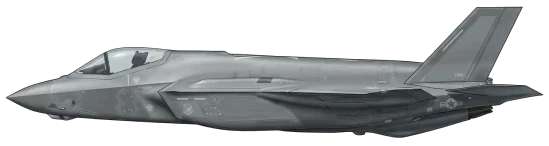
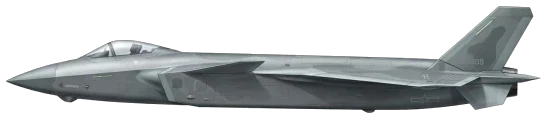
| F-35 Lightning II | J-20 Mighty Dragon | |
|---|---|---|
| Origin country | 🇺🇸 United States | 🇨🇳 China |
| Category | Combat Aircraft | Combat Aircraft |
| Manufacturer | Lockheed Martin | Chengdu |
| First flight | 15 December 2006 | 11 January 2011 |
| Year introduced | 2013 | 2017 |
| Number produced | 965 units | 300 units |
| Average unit price | $103 million | $110 million |
| Wing area | 43.0 m² | 73.0 m² |
| Wingspan | 11.0 m | 13.0 m |
| Height | 4.4 m | 4.7 m |
| Length | 15.6 m | 21.2 m |
| Maximum speed | 1960 km/h | 2130 km/h |
| Operational range | 2,800 km | 5,500 km |
| Service ceiling | 15,000 m | 20,000 m |
| Max. takeoff weight | 27,216 kg | 37,000 kg |
| Empty weight | 14,651 kg | 17,000 kg |
| Total thrust | 1 x 19,500 kgf | 2 x 14,480 kgf |
Detailed Comparison
The F-35 Lightning II and the Chengdu J-20 Mighty Dragon are both fifth-generation combat aircraft, but they originate from profoundly different strategic requirements. The F-35 is a single-engine, multirole platform designed for a global coalition, emphasizing all-aspect stealth, unparalleled sensor fusion, and network-centric warfare. In contrast, the J-20 is a larger, twin-engine aircraft developed for China's PLAAF, focusing on air superiority, long-range interception, and high-speed performance, seemingly optimized for the Indo-Pacific theater.
Development and Design
The F-35 emerged from the U.S. Joint Strike Fighter (JSF) program, an ambitious multinational effort to create a common platform with three distinct variants (CTOL, STOVL, Carrier) to replace a wide array of legacy aircraft. Its design prioritizes low-observability and information dominance. The integration of the AN/APG-81 AESA radar, the Distributed Aperture System (DAS), and the Electro-Optical Targeting System (EOTS) provides the pilot with exceptional situational awareness.
The J-20’s development under the J-XX program was a more secretive, state-directed effort. Its design, featuring a canard-delta wing configuration, prioritizes kinematic performance such as speed, altitude, and transonic maneuverability. While also a stealth aircraft, its large size and canards may suggest a focus on frontal-aspect radar cross-section reduction over the all-aspect stealth of the F-35. The development of a twin-seat J-20S variant indicates a focus on complex missions like manned-unmanned teaming or electronic warfare command.
Specifications and Performances
A comparison of performance metrics highlights their differing design philosophies. The J-20's twin-engine configuration gives it a distinct advantage in raw kinematics, with a higher maximum speed (2130 km/h vs. the F-35’s 1930 km/h) and service ceiling (20,000 m vs. 15,000 m). The J-20's internal weapons bay is designed to carry a larger load of long-range air-to-air missiles, such as the PL-15, reinforcing its role as a long-range interceptor. The F-35's design trades some kinematic performance for versatility and survivability. Its smaller airframe and highly advanced sensor suite make it a formidable multirole asset, capable of penetrating contested airspace for strike, reconnaissance, and electronic attack missions. The F-35A model is also one of the few stealth fighters to feature an internal cannon, a capability the J-20 reportedly lacks.
Deployment and usage
The F-35 has a significant lead in operational maturity and global deployment. It has been combat-proven by multiple nations, including Israel, and is a central component of NATO and allied air power, with over 965 units built and integrated into a vast network. This widespread adoption provides a substantial advantage in interoperability and shared tactical development. The J-20's operational history is currently confined to the PLAAF. It has been deployed for regular patrols over the East and South China Seas and has participated in domestic exercises. A confirmed encounter between USAF F-35s and J-20s over the East China Sea in 2022 demonstrated the platform's operational status, but it lacks the extensive combat record and multinational integration of its American counterpart.
Conclusion
The F-35 Lightning II is a versatile, combat-proven, and highly networked multirole fighter that functions as an information-gathering and strike node for a broad coalition of forces. Its primary strengths are its advanced sensor fusion, all-aspect stealth, and interoperability. The J-20 Mighty Dragon is a specialized air superiority fighter and interceptor, built for speed, range, and altitude to project power and enforce anti-access/area denial (A2/AD) strategies. While its production is accelerating and its capabilities are evolving, it remains a platform largely tailored to a specific regional context and lacks the global footprint and combat seasoning of the F-35. The two aircraft are not direct equivalents but reflections of the differing military-strategic doctrines of the United States and China.
-
 United States
724
United States
724
-
 Australia
72
Australia
72
-
 Italy
57
Italy
57
- All 20 operators →
