M-346 Master vs T-7 Red Hawk
M-346 Master vs T-7 Red Hawk at a glance — top speed 1,092 vs 1,300 km/h, range 1,925 vs 1,830 km, max takeoff weight 9,500 vs 5,500 kg, built 92 vs 2 units.
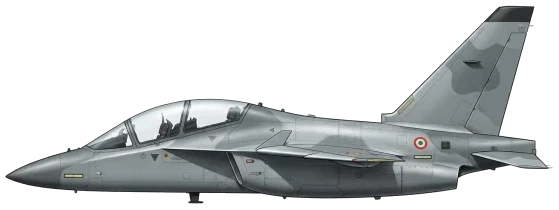
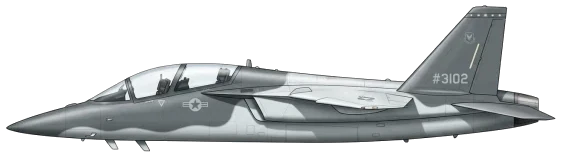
| M-346 Master | T-7 Red Hawk | |
|---|---|---|
| Origin country | 🇮🇹 Italy | 🇺🇸 United States |
| Category | Military Training Aircraft | Military Training Aircraft |
| Manufacturer | Aermacchi | Boeing |
| First flight | 15 July 2004 | 20 December 2016 |
| Year introduced | 2015 | 2028 |
| Number produced | 92 units | 2 units |
| Average unit price | $40 million | $22 million |
| Wing area | 23.5 m² | -- m² |
| Wingspan | 9.7 m | 10.0 m |
| Height | 4.8 m | 4.0 m |
| Length | 11.5 m | 15.2 m |
| Maximum speed | 1092 km/h | 1300 km/h |
| Operational range | 1,925 km | 1,830 km |
| Service ceiling | 13,716 m | 15,240 m |
| Max. takeoff weight | 9,500 kg | 5,500 kg |
| Empty weight | 4,610 kg | 3,250 kg |
| Total thrust | 2 x 2,835 kgf | 1 x 8,029 kgf |
Detailed Comparison
The Aermacchi M-346 Master enters the advanced jet trainer market with a decade-long service record and twin-engine redundancy, while the Boeing-Saab T-7 Red Hawk relies on lower acquisition costs and a clean-sheet digital engineering approach to replace the USAF's T-38 Talon. The M-346 evolved from a failed 1990s joint venture with Yakovlev into a fully westernized platform. The T-7 was built specifically to win the USAF's T-X competition, prioritizing single-engine economy and a high-angle-of-attack twin-tail design mimicking fifth-generation fighters.
Development and Design
Aermacchi diverged from its Russian partner Yakovlev in 2000, replacing the planned Lotarev DV-2S engines with twin Honeywell F124 turbofans and integrating a quadruplex fly-by-wire system. The resulting M-346 heavily utilizes an Embedded Tactical Training System (ETTS) that simulates radar, electronic warfare, and weapons without external pods. Boeing and Saab developed the T-7 using model-based systems engineering—the "Digital Thread"—to move from concept to first flight in 36 months. The T-7's twin-tail architecture and single General Electric F404 engine replicate the handling characteristics of the F-22 and F-35 at a fraction of the operating cost.
Specifications and Performances
The T-7 outperforms the M-346 in raw kinematic metrics, driven by its lighter empty weight (3,250 kg versus 4,610 kg). It achieves a top speed of 1,300 km/h and a climb rate of 170 m/s, compared to the M-346's 1,092 km/h and 127 m/s. This directly supports the T-7's mandate to bridge the gap to high-thrust fifth-generation fighters. The M-346 trades outright speed for payload capacity and redundancy. Equipped with seven hardpoints, the M-346 carries a 3,000 kg external payload, accommodating AIM-9 missiles, AGM-65 Mavericks, and targeting pods. The T-7 currently lacks external hardpoints in its baseline configuration.
Deployment and usage
The M-346 has accumulated thousands of flight hours since entering service in 2015. It operates across multiple air forces:
- Israel utilizes the platform (designated "Lavi") to train F-35I pilots.
- The Italian Air Force and Leonardo operate the International Flight Training School servicing allied nations like Qatar.
- Poland operates the "Bielik" variant, though a fatal crash in July 2024 resulted in the death of a pilot.
The M-346FA variant has found a secondary market as a light attack aircraft. The T-7 remains in testing, with its initial operational capability pushed to 2028. While its digital design accelerated prototyping, the program faced delays related to the Collins ACES 5 ejection seat qualification and flight control software integration, exposing the limitations of relying entirely on simulated testing environments.
Conclusion
The T-7 Red Hawk is the superior platform for high-volume, pure advanced flight training pipelines leading to fifth-generation fighters. Its twin-tail aerodynamics, high climb rate, and lower $22.0 million unit cost directly address the USAF's requirement for an economical T-38 replacement. Conversely, the M-346 Master wins in the export market for air forces requiring a dual-role trainer and light combat aircraft. Its $40.0 million price tag buys twin-engine redundancy, mature simulation software, and a 3,000 kg payload capacity that the baseline T-7 cannot match.


