F-22 Raptor
American fifth-generation stealth tactical fighter used primarily by the U.S. Air Force, notable for its role in the Afghanistan War. Key figures: top speed 2,414 km/h, range 3,220 km, service ceiling 19,812 m, max takeoff weight 38,000 kg, unit price $150M, built 195. In service with 1 air force as of 2026 — United States (183).
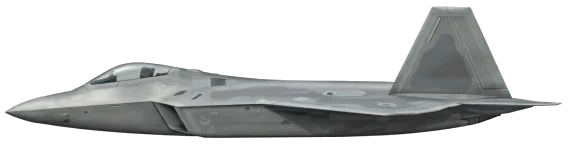

| Crew | 1 |
| Length | 18.9 m (62.0 ft) |
| Wingspan | 13.6 m (44.5 ft) |
| Height | 5.1 m (16.7 ft) |
| Wing area | 78.0 m² (840.0 sqft) |
| Empty weight | 19,700 kg (43,431 lbs) |
| Max. takeoff weight | 38,000 kg (83,776 lbs) |
| Powerplant | 2 × turbofans Pratt & Whitney F119-PW-100 15,876 kgf each |
| Ejection seat | McDonnell Douglas ACES II |
| Maximum speed | 2414 km/h (Mach 2.3) |
| Operational range | 3,220 km (2,001 mi) |
| Service ceiling | 19,812 m (65,000 ft) |

- Air-to-Air Medium-Range AIM-120 AMRAAM
- Air-to-Air Short-Range Raytheon AIM-9 Sidewinder


Description
The Lockheed Martin F-22 Raptor is a twin-engine, single-seat stealth air superiority fighter operated only by the United States Air Force. A product of the 1980s Advanced Tactical Fighter programme, it first flew in 1997 and entered service in December 2005 as the first fighter to combine stealth, supercruise, thrust vectoring and fused sensors in one airframe. Production was capped at 187 operational aircraft in 2009 and ended in 2012; about 180 remain in the inventory as of 2026, and the Boeing F-47 is to replace the type from the 2030s.
Development
The USAF launched the Advanced Tactical Fighter (ATF) programme in 1981 to replace the F-15 Eagle against the Su-27, the MiG-29 and new Soviet air defence networks, with stealth, supersonic cruise and manoeuvrability as the governing requirements. In October 1986 Lockheed, teamed with Boeing and General Dynamics, and Northrop, teamed with McDonnell Douglas, were chosen to fly two demonstrators each. The YF-22 first flew on 29 September 1990 and on 23 April 1991 it and the Pratt & Whitney F119 engine were selected over the YF-23 and the General Electric F120: the Northrop design was judged stealthier and faster, the Lockheed one more manoeuvrable, cheaper and less risky.
Full-scale development began in August 1991, with final assembly at Marietta, Georgia, and Boeing building the wings and aft fuselage; the avionics, some 1.7 million lines of Ada code, paced the whole programme. Two F-22B two-seaters were cancelled in 1996. The first aircraft was named Raptor on 9 April 1997 and flew on 7 September 1997. From September 2002 to December 2005 the type was designated F/A-22 to underline its planned strike role. Full-rate production was approved in March 2005.
The buy shrank with the Cold War: 750 aircraft in 1985, 648 in 1990, 442 in 1993, a USAF requirement of 381, then 183 in 2004 as the Pentagon turned to counter-insurgency; Congress added four in 2008. In April 2009 the Defense Department called for production to end at 187, and after President Obama threatened a veto both houses accepted the cap in July 2009. The 195th and last aircraft (8 test and 187 production) was completed in December 2011 and delivered on 2 May 2012. Tooling was mothballed at the Sierra Army Depot. Asked by Congress to cost a restart, the USAF reported on 9 June 2017 that 194 more aircraft would cost about $50 billion, with first deliveries only in the late 2020s, and declined in favour of what became Next Generation Air Dominance.
Export has been prohibited by a clause in every defence appropriations act since fiscal year 1998; Japan, Australia and Israel all examined the type in the 2000s before turning to the F-35.
Design
The F-22 is 62 ft 1 in (18.9 m) long with a span of 44 ft 6 in (13.56 m) and a maximum takeoff weight of 83,500 lb (38,000 kg). Stealth comes first from shape — aligned edges, curved surfaces, serpentine inlet ducts, internal weapons — and only second from radar-absorbent material, used more sparingly than on earlier stealth aircraft; the rectangular nozzles flatten and cool the exhaust plume against infrared seekers.
Two Pratt & Whitney F119-PW-100 afterburning turbofans in the 35,000 lbf (156 kN) class drive two-dimensional thrust-vectoring nozzles moving ±20 degrees in pitch, integrated into the triplex fly-by-wire controls. The aircraft supercruises at about Mach 1.8 without afterburner and reaches Mach 2.25 (2,414 km/h) at altitude with it. It is rated for 9 g with its full 18,000 lb (8,165 kg) of internal fuel; with two 600 US gal (2,270 l) external tanks its ferry range is 1,740 nmi (3,220 km).
The avionics fuse the AN/APG-77 active electronically scanned array radar, the AN/ALR-94 electronic warfare system and the AN/AAR-56 missile launch detector into one tactical picture. The APG-77 has an estimated range of 125–150 mi (200–240 km) against a 1 m² target; the APG-77(V)1, fitted from Lot 5, added air-to-ground modes. The ALR-94's 30-plus antennas geolocate emitters beyond 250 nmi, and a directional data link connects Raptors without betraying emissions.
Armament
An M61A2 20 mm cannon with 480 rounds sits in the right wing root behind a retractable door. The main ventral bay holds six AIM-120 AMRAAM and each side bay one AIM-9 Sidewinder. For strike, four launchers give way to racks for two 1,000 lb (450 kg) GBU-32 JDAM or eight 250 lb (110 kg) GBU-39 Small Diameter Bombs alongside two AMRAAM; the aircraft cannot designate laser-guided weapons. Four underwing hardpoints take fuel tanks or missile launchers at the cost of stealth; the outboard pair is now reserved for stealthy sensor pods.
Upgrades
Increment 2 added JDAM in 2005 and Increment 3.1 the Small Diameter Bomb in 2011. Increment 3.2, released in two parts from 2013 and 2019, turned back to air combat with AIM-9X, AIM-120D, Link 16 receive and electronic warfare improvements. A MIDS-JTRS terminal with Link 16 transmit and Mode 5 IFF was fitted from 2021, and the same year the mission computers received open-mission-systems processors, with annual software releases replacing the Increment cycle. Under test are an infrared search and track sensor in stealthy wing pods, the AIM-260 JATM and low-drag stealthy external tanks; the Multifunction Advanced Data Link was cancelled over delays. By 2020 the Common Configuration Plan had raised the Block 30/35 fleet to 149 aircraft, leaving 37 Block 20 trainers.
Operational History
Entry into service
Initial operational capability was declared in December 2005 with the 94th Fighter Squadron of the 1st Fighter Wing at Langley AFB, and full operational capability in December 2007. The 27th Fighter Squadron made the first overseas deployment, to Kadena, in February 2007, and in November 2007 the 90th Fighter Squadron at Elmendorf flew the type's first NORAD intercept, of two Tu-95MS bombers.
Oxygen problems
Pilots reported hypoxia-like symptoms in the type's early years, culminating in the fatal Alaska crash of November 2010 and a four-month grounding in 2011. A faulty pressure-vest valve and oxygen-generator fluctuations under g were identified in 2012; an automatic backup oxygen system was fitted and altitude restrictions were lifted in April 2013.
Combat
The first combat sorties were among the opening strikes of Operation Inherent Resolve in Syria on 22 September 2014, with 1,000 lb GPS-guided bombs on Islamic State targets. To July 2015 the F-22 flew 204 sorties over Syria and dropped 270 bombs, while mainly providing reconnaissance and keeping Syrian, Iranian and Russian aircraft away from US-backed forces. In November 2017 Raptors bombed Taliban opium facilities in Afghanistan, and on 7 February 2018 they took part in the strikes that broke a pro-regime and Wagner Group assault near Khasham in eastern Syria. The Rapid Raptor concept — two to four F-22s and one C-17 operating from an austere field — was tested from 2013 and folded into the USAF's Agile Combat Employment doctrine.
Kills and the 2025–2026 wars
On 4 February 2023 a 1st Fighter Wing F-22 shot down a suspected Chinese surveillance balloon at 60,000–65,000 ft off South Carolina, the type's first air-to-air kill; further high-altitude objects were downed off Alaska on 10 February and over Yukon on 11 February. On 22 June 2025, according to US officials, F-22s and F-35As flying from Middle East bases drew Iranian surface-to-air fire ahead of the B-2 strikes on Iran's nuclear sites. In January 2026 the type helped suppress Venezuela's air defences in the raid that captured President Nicolás Maduro. On 28 February 2026 F-22s deployed to Israel with KC-135 and KC-46 tankers and joined Operation Epic Fury, the US-Israeli campaign against Iran.
Accidents
Five F-22s have been lost: at Nellis on 20 December 2004 (flight-control fault, pilot ejected); near Edwards on 25 March 2009, fatal after the test pilot lost consciousness under high g; in Alaska on 16 November 2010, fatal after a bleed-air malfunction shut down the oxygen system; and without injury at Tyndall on 15 November 2012 and Eglin on 15 May 2020.
Future and Replacement
The USAF expects to begin retiring the F-22 in the 2030s as the Boeing F-47, the crewed NGAD fighter expected to enter service around 2030, takes over, and keeps the Block 30/35 fleet among its top modernisation priorities until then. The Block 20 trainers are contested: in 2022 the service asked to divest all but three of them, judging them obsolescent and a $3.5 billion upgrade to combat standard unaffordable, but Congress refused and barred divestment through fiscal year 2026. In September 2025 Lockheed Martin set out a plan to bring 35 Block 20 aircraft to Block 30/35 combat configuration.
Variants
- F-22A: Single-seat production version, designated F/A-22A from 2002 to 2005; 195 built, 8 test and 187 operational.
- F-22B: Two-seat version with full combat capability, cancelled in 1996 to cut development costs; the two test aircraft became F-22As.
- NATF-22 / F-22N: Carrier-borne derivative for the Navy Advanced Tactical Fighter, with variable-sweep wings; cancelled in 1991.
- FB-22: Early-2000s regional bomber proposal with much larger delta wings, carrying up to 30 Small Diameter Bombs over 1,600 nmi (3,000 km); dropped after the 2006 Quadrennial Defense Review in favour of what became the B-21 Raider.
- F-22/F-35 hybrid: 2018 offer to Japan of an enlarged-wing F-22 with F-35 avionics; not taken up.
Frequently Asked Questions
What type of aircraft is the F-22 Raptor?
What is the maximum speed of the F-22 Raptor?
What is the range of the F-22 Raptor?
When did the F-22 Raptor first fly?
How many F-22 Raptor have been built?
Which countries operate the F-22 Raptor?
How much does a F-22 Raptor cost?
What is the service ceiling of the F-22 Raptor?
- OCT 222026 Updated Entry into service dated to the first delivery to the training squadron at Tyndall
- OCT 52026 Updated Description overhauled: production history, upgrades, 2023 balloon kill, 2025–2026 operations and the F-47 succession
- OCT 52026 Updated Range set to the ferry range with external tanks
- AUG 52026 Updated Thrust updated
- JUL 232026 Updated Sources and cross-references refreshed
- JUN 262026 Updated Bombs updated
- APR 72026 Updated Sources and cross-references refreshed