T-7 Red Hawk
American advanced trainer jet, designed in the 21st century, with no current deployments or operational history. Key figures: top speed 1,300 km/h, range 1,830 km, service ceiling 15,240 m, max takeoff weight 5,500 kg, unit price $22M, built 2. In service with 1 air force as of 2026 — United States (3).
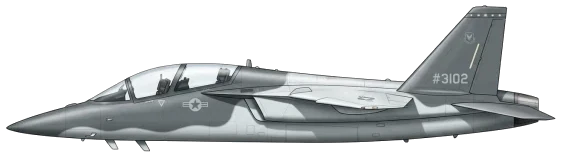
| Crew | 2 |
| Length | 15.2 m (49.7 ft) |
| Wingspan | 10 m (32.8 ft) |
| Height | 4 m (13.1 ft) |
| Empty weight | 3,250 kg (7,165 lbs) |
| Max. takeoff weight | 5,500 kg (12,125 lbs) |
| Powerplant | 1 × turbofan General Electric F404-GE-402 8,029 kgf each |
| Ejection seat | Collins ACES 5 |
| Maximum speed | 1300 km/h (Mach 1.2) |
| Operational range | 1,830 km (1,137 mi) |
| Service ceiling | 15,240 m (50,000 ft) |
| Climb rate | 170.0 m/s (557.7 ft/s) |

Recent Events — T-7 Red Hawk
3 events →
Description
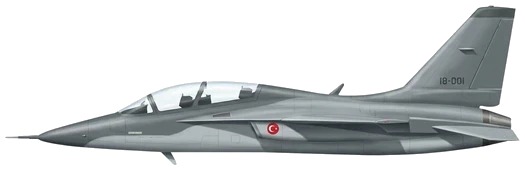
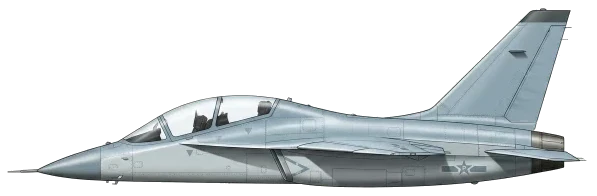
The Boeing–Saab T-7 Red Hawk is an American–Swedish transonic advanced jet trainer built by Boeing in partnership with Saab. Selected by the United States Air Force in September 2018 under the T-X programme to replace the Northrop T-38 Talon, it is a single-engine, twin-tailed tandem-seat aircraft known for its digital engineering and model-based production methods, which took the design from development to first flight in 36 months.
Development
Air Education and Training Command began framing requirements for a T-38 replacement in 2003, initially targeting service entry around 2020. A fatigue failure that destroyed a T-38C and killed its crew in 2008 prompted the USAF to advance initial operational capability to 2017, but budget pressure pushed it to FY2020, then to FY2023–24. Boeing and Saab unveiled two prototypes on 13 September 2016; the first flew on 20 December 2016. The September 2018 award, valued at up to US$9.2 billion, covered 351 aircraft, 46 simulators, maintenance training and support, with options for 475 airframes; Boeing took a $691 million pre-tax charge that quarter partly because of the programme. Saab announced a US plant at West Lafayette, Indiana, in May 2019, and the USAF named the aircraft T-7A Red Hawk in September 2019 after the Tuskegee Airmen and the Curtiss P-40 Warhawk flown by the 99th Fighter Squadron. Engineering and Manufacturing Development began in February 2021, with Saab delivering the first aft section to Boeing's St. Louis plant in April 2021. The first aircraft was rolled out on 28 April 2022 and flew in June 2023 with Major Bryce Turner of the 416th Flight Test Squadron and Boeing chief test pilot Steve Schmidt. Five EMD aircraft were allocated to the test programme; APT-2 shipped to Edwards AFB on 21 September 2023. A GAO report in May 2023 cited software and safety-system problems, delaying the production decision to February 2025. Low-rate initial production was approved in May 2026, but a July 2026 GAO report moved the full-rate decision from 2027 to 2029 owing to delays in developmental testing.
Design
The T-7A is powered by a single General Electric F404-GE-103 afterburning turbofan rated at 11,000 lbf dry and 17,200 lbf with afterburner, producing three times the total thrust of the twin-engine T-38. It is stressed to 8 g and designed for high-angle-of-attack manoeuvring and night operations, with maintainability and growth toward aggressor and light attack roles built into the airframe. Maximum speed is Mach 0.975, service ceiling 50,000 ft and range 990 nmi. Saab produces the aft fuselage; Qarbon Technologies supplies wing sections. The digital build process allows the aft section to be spliced to the wings in 30 minutes with minimal tooling and drilling.
Operational History
Aircraft 21-7005 was delivered to the 12th Flying Training Wing at Joint Base San Antonio-Randolph on 5 December 2025, with a formal ceremony on 9 January 2026. In May 2026, 99th Flying Training Squadron leaders became the first AETC pilots qualified on the type. Boeing is marketing the aircraft to Serbia, Australia, Brazil, Japan and the United Kingdom.
Variants
- BTX-1: Two prototypes, N381TX and N382TX, built for the T-X evaluation.
- T-7A Red Hawk: USAF production aircraft, designated eT-7A prior to delivery.
- T-7B: Proposed for the US Navy Tactical Surrogate Aircraft programme, up to 64 aircraft.
- T-7 UJTS: Non-carrier-capable proposal for the US Navy Undergraduate Jet Training System, up to 145 aircraft.
- F/T-7X: Armed variant offered for the USAF Advanced Tactical Trainer programme, 100–400 aircraft.
Frequently Asked Questions
What type of aircraft is the T-7 Red Hawk?
What is the maximum speed of the T-7 Red Hawk?
What is the range of the T-7 Red Hawk?
When did the T-7 Red Hawk first fly?
How many T-7 Red Hawk have been built?
Which countries operate the T-7 Red Hawk?
How much does a T-7 Red Hawk cost?
What is the service ceiling of the T-7 Red Hawk?
- AUG 302026 Updated Description updated
- AUG 142026 Updated Per-engine thrust corrected against the engine variant the entry names
- AUG 62026 Updated Description updated
- AUG 12026 Updated Manufacturer updated
- JUL 232026 Updated Sources and cross-references refreshed
- APR 192026 Updated Service entry year added
- APR 72026 Updated Sources and cross-references refreshed