B-52 Stratofortress vs M-4 Bison
B-52 Stratofortress vs M-4 Bison at a glance — top speed 1,000 vs 947 km/h, range 14,200 vs 5,600 km, max takeoff weight 220,000 vs 181,500 kg, built 744 vs 123 units.
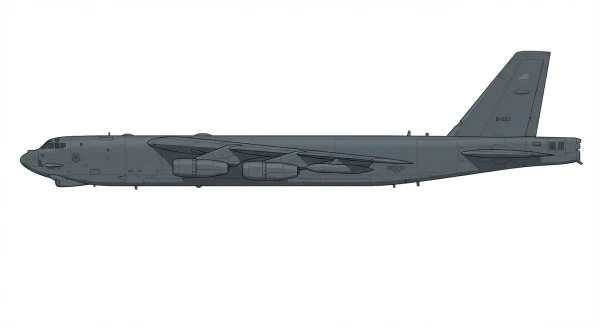

| B-52 Stratofortress | M-4 Bison | |
|---|---|---|
| Origin country | 🇺🇸 United States | 🇷🇺 Ex-USSR |
| Category | Bombers | Bombers |
| Manufacturer | Boeing | Myasishchev |
| First flight | 15 April 1952 | 20 January 1953 |
| Year introduced | 1955 | 1953 |
| Number produced | 744 units | 123 units |
| Average unit price | $9.3 million | $8 million |
| Wing area | 370.0 m² | 326.4 m² |
| Wingspan | 56.4 m | 50.5 m |
| Height | 12.4 m | 14.1 m |
| Length | 48.5 m | 47.2 m |
| Maximum speed | 1000 km/h | 947 km/h |
| Operational range | 14,200 km | 5,600 km |
| Service ceiling | 15,000 m | 11,000 m |
| Max. takeoff weight | 220,000 kg | 181,500 kg |
| Empty weight | 83,250 kg | 79,700 kg |
| Total thrust | 8 x 7,747 kgf | 4 x 9,525 kgf |
Detailed Comparison
Developed concurrently in the early 1950s as intercontinental nuclear delivery platforms, the Boeing B-52 Stratofortress and the Myasishchev M-4 Bison represent contrasting outcomes in the Cold War strategic bomber race. While the B-52 achieved its design goals and remains in service, the M-4 was fundamentally hampered by a critical performance shortfall that relegated it to secondary roles. The B-52’s success stems from a design that prioritized range and payload, whereas the M-4, despite its powerful engines, failed to achieve the intercontinental reach required for its primary mission.
Development and Design
The design philosophies of the two aircraft diverged on key principles. Boeing’s B-52 incorporated a highly efficient high-aspect-ratio swept-wing design and eight smaller turbojet (later turbofan) engines. This configuration provided the necessary combination of speed, altitude, and, most importantly, a range of 13,900 km, which met the US requirement for intercontinental nuclear strike capability. Its large airframe was also inherently adaptable, allowing for continuous modernization with new avionics, engines, and a vast array of munitions, from gravity bombs to standoff cruise missiles.
Conversely, the Myasishchev M-4 Bison was a direct Soviet response, but its design made a critical trade-off. It used four powerful but fuel-thirsty Mikulin AM-3 turbojets, which, despite a large internal fuel capacity, initially limited its range to a strategically insufficient 8,000 km. Later variants with more efficient engines and refueling capabilities improved this, but the platform never fully overcame its range limitations for two-way missions against the continental US. The M-4 also featured heavy defensive armament with multiple 23mm cannon turrets, reflecting a Soviet doctrine that relied more on onboard defense, whereas the B-52 increasingly depended on high altitude and advanced electronic countermeasures for survival.
Specifications and Performances
A comparison of specifications reveals the B-52's inherent advantages for its intended role. Its 220,000 kg maximum takeoff weight significantly exceeds the M-4's 181,500 kg, allowing for a greater combination of fuel and payload. This weight advantage, coupled with a more efficient powerplant configuration, is the primary reason for its superior range. Furthermore, the B-52's service ceiling of 15,000 m provided a significant survivability advantage over the M-4's 11,000 m ceiling, allowing it to operate above the effective envelope of many early-Cold War air defense systems. While the M-4’s individual engines produced more thrust (9,525 kgf vs. 7,747 kgf for the B-52H's TF33s), the B-52's eight-engine configuration proved to be a more effective and reliable solution for long-endurance missions.
Deployment and usage
The operational histories of the two aircraft reflect their design success and failures. The B-52 has a storied and continuous combat record spanning from the Vietnam War to modern-day conflicts, demonstrating its remarkable evolution. It transitioned from a high-altitude nuclear bomber to a conventional "bomb truck" and is now a sophisticated standoff platform for precision-guided munitions and cruise missiles. This longevity is a direct result of its adaptable airframe.
The M-4's career as a strategic bomber was short-lived. Its inability to perform its primary mission led to its rapid replacement in the strategic role by the Tupolev Tu-95. The M-4 fleet was repurposed for other duties, primarily serving as maritime reconnaissance aircraft and, most notably, as aerial refueling tankers. A few were uniquely modified as heavy-lift transports (3M-T "Atlant") for the Soviet space program. The bomber variants were retired in the 1980s, while the tankers served until 1994.
Conclusion
The comparison between the B-52 and the M-4 is a lesson in strategic design priorities. The B-52 is an unqualified success because its initial design correctly prioritized range, payload, and adaptability, creating an airframe that could be continuously upgraded to remain relevant for over 70 years. The M-4 Bison, while an impressive piece of aeronautical engineering, was a strategic failure. It fell short on the single most critical parameter for an intercontinental bomber—range—and was consequently unable to fulfill the mission for which it was created. Its legacy is that of a capable but flawed aircraft repurposed for secondary missions, while the B-52 remains a symbol of enduring strategic airpower.