Mi-1 Hare vs UH-1 Iroquois "Huey"
Mi-1 Hare vs UH-1 Iroquois "Huey" at a glance — top speed 185 vs 222 km/h, range 430 vs 510 km, max takeoff weight 2,330 vs 4,309 kg, built 2,594 vs 16,000 units.
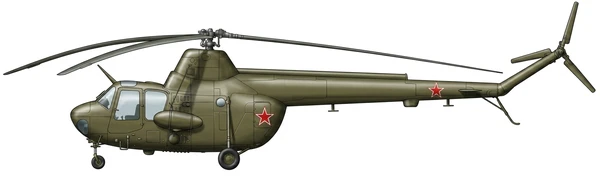
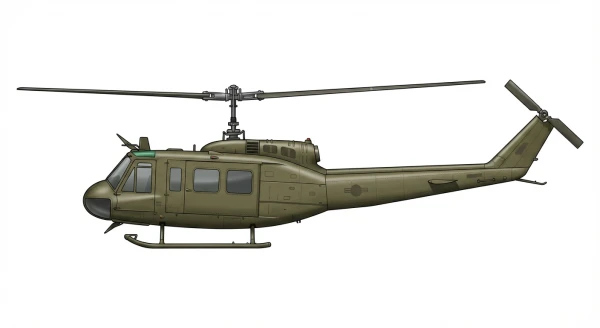
| Mi-1 Hare | UH-1 Iroquois "Huey" | |
|---|---|---|
| Origin country | 🇷🇺 Ex-USSR | 🇺🇸 United States |
| Category | Military Helicopters | Military Helicopters |
| Manufacturer | Mil | Bell |
| First flight | 20 September 1948 | 22 October 1956 |
| Year introduced | 1950 | 1959 |
| Number produced | 2594 units | 16000 units |
| Average unit price | $100K | $1.3 million |
| Wingspan | 14.4 m | 14.6 m |
| Height | 3.3 m | 4.5 m |
| Length | 12.1 m | 12.7 m |
| Maximum speed | 185 km/h | 222 km/h |
| Operational range | 430 km | 510 km |
| Service ceiling | 3,500 m | 5,910 m |
| Max. takeoff weight | 2,330 kg | 4,309 kg |
| Empty weight | 1,700 kg | 2,087 kg |
| Total thrust | 1 x 423 kW | 1 x 820 kW |
Detailed Comparison
The Mil Mi-1 Hare serves as the foundational rotary-winged aircraft for the Soviet Union, entering service in 1950 as a light utility platform powered by a radial piston engine. In contrast, the Bell UH-1 Iroquois, entering service in 1959, represents a significant technological leap as the first US military turbine-powered helicopter. While the Mi-1 established the viability of Soviet helicopter operations, the UH-1 revolutionized tactical doctrine through turbine reliability and heavy lifting capacity, creating a distinct capability gap between the two generations of aircraft.
Development and Design
Developed under Mikhail Mil, the Mi-1 was the USSR's first mass-produced helicopter. It utilized a radial piston engine (Ivchenko-Progress AI-26V) and a rotor hub with spaced hinges to resolve early control efficiency issues. The design philosophy prioritized basic utility, pilot training, and light transport, evolving from a three-seat design to the Mi-1M, which could accommodate side-mounted capsules for medical transport.
Conversely, the UH-1 ushered in the turbine era, utilizing a Lycoming T53 turboshaft engine. This powerplant shift allowed for a spacious, modular cabin capable of accommodating up to 12 troops or multiple medical litters, a significant departure from the Mi-1's cramped quarters. The Huey's all-metal semi-monocoque construction provided the durability required for sustained combat operations and field maintenance, differing from the Mi-1’s lighter, general-purpose airframe.
Specifications and Performances
The performance metrics illustrate the decisive advantage of turbine propulsion over piston technology. The UH-1 possesses a Maximum Takeoff Weight (MTOW) of 4,309 kg, nearly double the Mi-1's 2,330 kg. With 820 kW of power compared to the Mi-1's 423 kW, the Iroquois achieves a service ceiling of 5,910 m, far exceeding the Hare's 3,500 m limit. This high-altitude capability was critical for the UH-1's operations in diverse geographical theaters, whereas the Mi-1 was limited to lower-altitude logistical roles. Additionally, the UH-1 maintains a speed advantage (222 km/h vs. 185 km/h) and greater operational range, enabling it to conduct deep insertion missions that were beyond the Mi-1's operational envelope.
Deployment and usage
Operational history underscores the doctrinal differences between the two platforms. The Mi-1 served primarily in liaison, reconnaissance, and training roles across Warsaw Pact nations. An attempt to weaponize the platform (the Mi-1MU) with anti-tank missiles was conducted in 1961 but failed to enter production due to payload limitations.
The UH-1, however, became the backbone of air assault doctrine. In Vietnam, it facilitated rapid troop deployment, "Dustoff" medical evacuations, and pioneered the armed gunship role (UH-1B/C) using rockets and machine guns. Its versatility allowed the US military to bypass terrain obstacles, fundamentally changing infantry warfare. While the Mi-1 remained a rear-echelon support asset, the UH-1 was a frontline combat multiplier.
Conclusion
The Mi-1 Hare deserves recognition as a foundational platform that proved the feasibility of Soviet rotary-wing aviation, paving the way for the heavier Mi-4 and Mi-8. However, the UH-1 Iroquois is a superior combat system that defined the modern utility helicopter. The Huey’s turbine engine provided the power reserve necessary for true versatility—acting as a transport, ambulance, and gunship—a level of multi-mission capability that the piston-engined Mi-1 could not match. While the Mi-1 is a historical footnote of the 1950s, the UH-1's lineage remains active in modern military service.