Mi-2 Hoplite vs UH-1 Iroquois "Huey"
Mi-2 Hoplite vs UH-1 Iroquois "Huey" at a glance — top speed 200 vs 222 km/h, range 440 vs 510 km, max takeoff weight 3,700 vs 4,309 kg, built 5,497 vs 16,000 units.
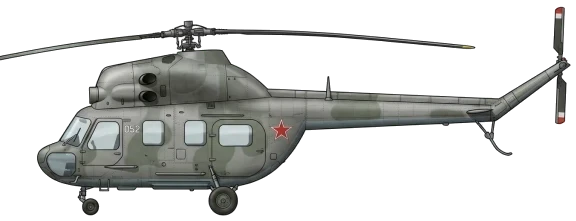
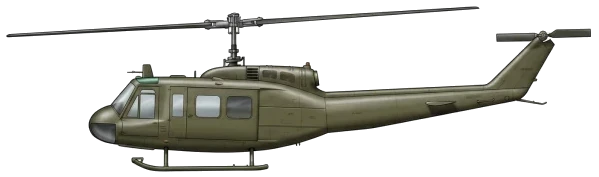
| Mi-2 Hoplite | UH-1 Iroquois "Huey" | |
|---|---|---|
| Origin country | 🇷🇺 Ex-USSR | 🇺🇸 United States |
| Category | Military Helicopters | Military Helicopters |
| Manufacturer | Mil | Bell |
| First flight | 22 September 1961 | 22 October 1956 |
| Year introduced | 1965 | 1959 |
| Number produced | 5497 units | 16000 units |
| Average unit price | -- | $1.3 million |
| Wingspan | 14.5 m | 14.6 m |
| Height | 3.8 m | 4.5 m |
| Length | 11.4 m | 12.7 m |
| Maximum speed | 200 km/h | 222 km/h |
| Operational range | 440 km | 510 km |
| Service ceiling | 4,000 m | 5,910 m |
| Max. takeoff weight | 3,700 kg | 4,309 kg |
| Empty weight | 2,372 kg | 2,087 kg |
| Total thrust | 2 x 294 kW | 1 x 820 kW |
Detailed Comparison
The Mil Mi-2 Hoplite and the Bell UH-1 Iroquois emerged during the shift to turbine-powered rotorcraft in the mid-20th century, serving as foundational light and medium utility platforms for the Eastern Bloc and the United States, respectively. While the UH-1 defined the concept of air mobility through mass deployment in high-intensity conflict, the Mi-2 focused on light, multi-purpose utility roles, bridging military and agricultural requirements in Soviet satellite states.
Development and Design
The Mi-2 represents a unique Soviet procurement strategy; designed by Mil in the USSR, production was transferred entirely to PZL-Świdnik in Poland. It utilized two overhead-mounted Isotov GTD-350 turbines, a rarity for light helicopters of that era, providing a 40% power increase over the piston-engined Mi-1. Conversely, the Bell UH-1 was the first US turbine-powered military helicopter, featuring a robust semi-monocoque metal fuselage and a distinctive two-blade teetering rotor system. The UH-1's design emphasized a spacious, modular cabin for rapid reconfiguration between medevac and troop transport (up to 12 troops in the UH-1D), whereas the Mi-2's compact fuselage limited its internal capacity but allowed for versatile external configurations.
Specifications and Performance
Analytically, the UH-1 Iroquois demonstrates superior kinematic performance suited for combat assault. Powered by a single Lycoming T53 (up to 820 kW in the L-11A variant), the Huey achieves a service ceiling of 5,910 m and a climb rate of 8.9 m/s, nearly double the Mi-2’s 4.5 m/s climb rate. The Mi-2’s twin-turbine setup yields only 294 kW per engine, restricting its maximum takeoff weight to 3,700 kg compared to the UH-1’s 4,309 kg. The American platform also maintains a speed advantage (222 km/h vs. 200 km/h). The Mi-2's performance envelope reflects its utilization as a light liaison and training aircraft, while the UH-1's metrics support tactical transport and air assault profiles under hot-and-high conditions.
Deployment and Usage
The UH-1 functioned as the backbone of US air mobility, flying 7 million sorties in Vietnam alone. Its variants ranged from the UH-1D troop carrier to dedicated gunships (UH-1B/C) armed with rockets, grenade launchers, and miniguns for close air support. The Mi-2, while fielded by the Soviet Air Force and widely exported to the Eastern Bloc, North Korea, and Myanmar, often served in secondary roles such as training, chemical reconnaissance, and medical liaison. However, Polish forces developed specialized armed variants like the Mi-2URP Salamandra, featuring AT-3 Sagger missiles and 23mm cannons for anti-tank duties. Recently, both platforms remain active; the modernized UH-1Y serves the US Marine Corps, while Mi-2s have seen combat with Ukrainian forces during the 2022 invasion, with Motor Sich modernizing units with anti-MANPADS defenses.
Conclusion
The Bell UH-1 Iroquois and Mil Mi-2 Hoplite occupy different tactical tiers. The UH-1 proved to be a versatile combat multiplier capable of defining theater doctrine through massed air assault. The Mi-2, constrained by size and power, excelled as a cost-effective, multi-role light helicopter for support and specialized tasks. While the Huey’s legacy is defined by heavy combat utility, the Hoplite remains a testament to the efficient adaptation of turbine technology for light aviation within the Warsaw Pact.


-
 Turkey
172
Turkey
172
-
 Greece
112
Greece
112
-
 Japan
93
Japan
93
- All 39 operators →