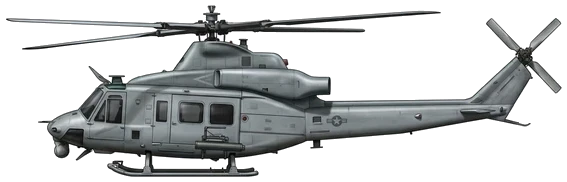
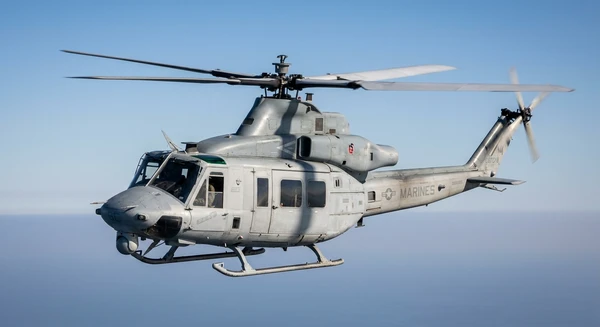
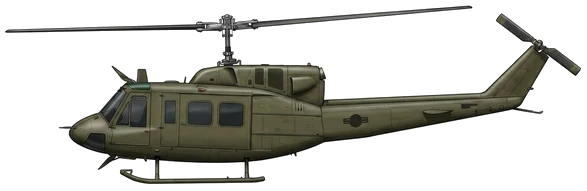
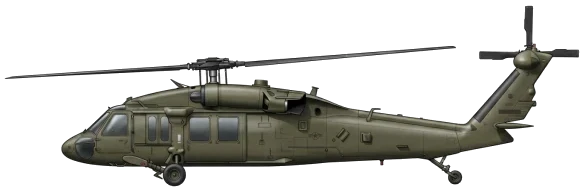
The Bell UH-1Y Venom, also designated "Yankee" or "Super Huey," is a twin-engine, four-blade, medium-sized utility helicopter manufactured by Bell Textron. Developed under the United States Marine Corps (USMC) H-1 upgrade program initiated in 1996, the UH-1Y was designed alongside the AH-1Z Viper to achieve 84% component commonality, sharing the tail boom, engines, rotor system, drivetrain, and avionics. While initially planned as a remanufacturing program for the UH-1N, the USMC approved all-new production airframes in April 2005. The helicopter completed its first flight on 20 December 2001. Developmental testing concluded in early 2006, followed by operational evaluation at NAS Patuxent River. The USMC certified the UH-1Y as operationally capable in August 2008, and full-rate production began in September 2009. Bell delivered 160 UH-1Y helicopters to the USMC, completing deliveries in January 2019. Production restarted in 2021 to fulfill an export order.
Design
The UH-1Y features a 21-inch (530 mm) fuselage extension forward of the main door, a longer cabin, and larger twin engine exhausts than the UH-1N. Its propulsion system consists of two General Electric T700-GE-401C turboshaft engines, each providing 1,828 shp for 2.5 minutes and 1,546 hp continuous power. This drives a four-blade, all-composite main rotor system designed to withstand ballistic impacts up to 23 mm. The digital glass cockpit features flat-panel multifunctional displays. Mission equipment includes a forward-looking infrared system and the AN/ALQ-231(V)3 Intrepid Tiger II electronic warfare pod, which provides communications jamming and signals intelligence capabilities. The helicopter has an empty weight of 11,840 lb (5,371 kg) and a maximum takeoff weight of 18,500 lb (8,391 kg), with a payload capacity of 6,660 lb (3,021 kg). It has a cruise speed of 158 knots and a combat range of 130 nmi with a 2,182 lb payload.
Armament
Armament is carried on two external stations and two pintle mounts. The external hardpoints support 70 mm Hydra 70 or APKWS II rockets, utilizing LAU-68, LAU-61, M260, or M261 launchers with Mk 66 rockets. The pintle mounts accommodate 7.62 mm M240D machine guns, GAU-17A Gatling guns, GAU-16, or 12.7 mm GAU-21 machine guns.
Operational History
The USMC first deployed the UH-1Y in January 2009 with the 13th Marine Expeditionary Unit. UH-1Y helicopters deployed to Afghanistan starting in 2009, providing close air support during the September 2012 Taliban raid on Camp Bastion. In August 2014, the UH-1Y became the USMC's standard utility helicopter following the retirement of the UH-1N. In August 2016, the 22nd Marine Expeditionary Unit operated the UH-1Y in strikes against ISIL during the Battle of Sirte in Libya. The Czech Republic is the sole export customer, ordering eight UH-1Ys in December 2019, with the first delivery in 2023; two additional airframes are scheduled for transfer under the Excess Defense Articles program. One Czech UH-1Y crashed on 23 July 2026.