Mi-24 Hind vs Mi-28 Havoc
Mi-24 Hind vs Mi-28 Havoc at a glance — top speed 330 vs 324 km/h, range 450 vs 1,100 km, max takeoff weight 11,500 vs 12,000 kg, built 2,648 vs 126 units.
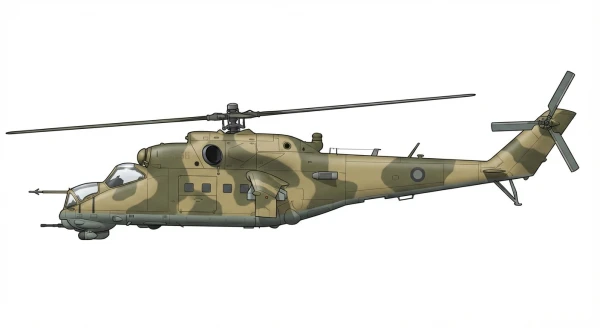
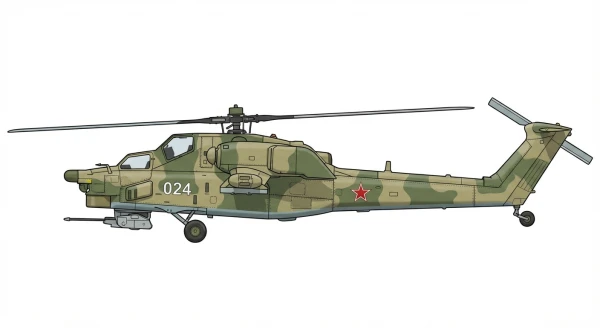
| Mi-24 Hind | Mi-28 Havoc | |
|---|---|---|
| Origin country | 🇷🇺 Ex-USSR | 🇷🇺 Ex-USSR |
| Category | Military Helicopters | Military Helicopters |
| Manufacturer | Mil | Mil |
| First flight | 19 September 1969 | 10 November 1982 |
| Year introduced | 1972 | 2006 |
| Number produced | 2648 units | 126 units |
| Average unit price | $12 million | $15 million |
| Wingspan | 6.5 m | 17.2 m |
| Height | 5.5 m | 4.7 m |
| Length | 21.4 m | 17.0 m |
| Maximum speed | 330 km/h | 324 km/h |
| Operational range | 450 km | 1,100 km |
| Service ceiling | 5,120 m | 5,700 m |
| Max. takeoff weight | 11,500 kg | 12,000 kg |
| Empty weight | 7,792 kg | 8,590 kg |
| Total thrust | 2 x 1,641 kW | 2 x 1,641 kW |
Detailed Comparison
The Mil Mi-24 Hind and its successor, the Mi-28 Havoc, illustrate the shift in Soviet and Russian doctrine from brute-force air assault to precision anti-armor operations. While the Mi-24 defined the "flying infantry fighting vehicle" concept, the Mi-28 abandoned this hybrid utility to focus strictly on hunting armor in high-threat environments, mirroring the western AH-64 Apache.
Development and Design
The Mi-24's defining characteristic is its dual nature; the fuselage accommodates a squad of eight troops, a feature that dictated its large size and heavy weight. Mil designed it to act as a high-speed breakthrough vehicle, suppressing landing zones and deploying infantry immediately. However, combat experience showed that the large airframe was a magnet for ground fire, and the troop transport role was rarely used in high-intensity combat due to the risk to passengers.
Consequently, the Mi-28 represents a total departure from the "flying IFV" philosophy. Mil shed the troop compartment to prioritize survivability and lethality. The Havoc integrates a heavy titanium "bathtub" cockpit and energy-absorbing landing gear, addressing the Hind's vulnerability to catastrophic crew loss during hard landings. The Mi-28 also introduced an X-tail rotor to reduce noise and improve tail authority, a persistent aerodynamic issue in the Mi-24’s service life.
Specifications and Performances
Performance metrics favor the Mi-24 in straight-line speed, hitting 330 km/h due to its streamlined profile and retractable gear, compared to the Mi-28’s 324 km/h. However, the Mi-28 offers superior static ceiling (5,700 m vs 5,120 m) and climb rates, essential for "pop-up" attacks in mountainous terrain.
Weaponry reflects the generational gap. The widely used Mi-24P utilizes a fixed side-mounted 30mm cannon, requiring the pilot to aim the entire aircraft—a significant limitation in urban or complex terrain. The Mi-28 corrects this with a chin-mounted Shipunov 2A42 30mm cannon with wide traverse, linked to the gunner’s helmet sight. Furthermore, the Havoc carries the Ataka missile system with a range of 8 km, supported by millimeter-wave radar on the 'N' and 'NM' variants, providing true all-weather, night-attack capability that the base Mi-24 lacks.
Deployment and Usage
The Mi-24’s operational doctrine was defined in the Soviet-Afghan War. It provided devastating area suppression but suffered heavily against MANPADS due to its high thermal signature and lack of standoff precision. Despite this, with 2,648 units built and a unit cost of only $12 million, it remains the standard for asymmetric warfare in Africa and the Middle East.
The Mi-28’s combat debut occurred much later, during the Russian intervention in Syria and Iraqi operations against ISIS. In these theaters, the Havoc demonstrated effective night-fighting capabilities and survivability against small arms that would have grounded a Hind. However, the Mi-28 has faced export challenges; its complexity and higher cost ($15 million) make it less attractive to nations with limited maintenance infrastructure compared to the rugged Mi-24/35.
Conclusion
The Mi-28 Havoc is the superior platform for modern, high-intensity conflict against near-peer adversaries. Its dedicated anti-armor focus, advanced sensors, and crew protection outweigh the utility of the Mi-24 in a contested battlespace. However, the Mi-24 Hind remains unrivaled in cost-effectiveness for counter-insurgency and paramilitary operations. No other airframe successfully combines heavy fire support with troop extraction capabilities. If the mission requires tank-killing in varying weather, the Havoc is required; for general suppression and air mobility in permissive environments, the Hind remains the logical procurement choice.