MiG-15 Fagot vs MiG-17 Fresco
MiG-15 Fagot vs MiG-17 Fresco at a glance — top speed 1,075 vs 1,145 km/h, range 2,520 vs 2,020 km, max takeoff weight 6,105 vs 6,069 kg, built 17,310 vs 10,649 units.
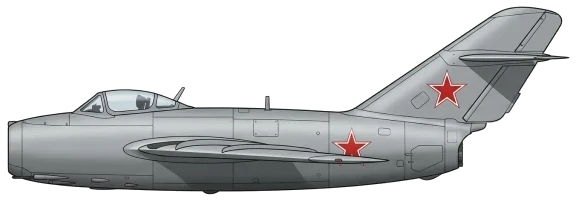
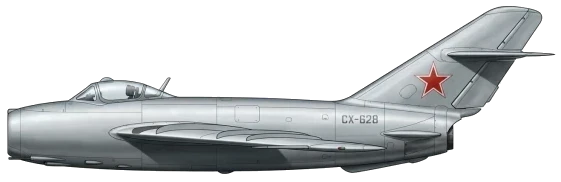
| MiG-15 Fagot | MiG-17 Fresco | |
|---|---|---|
| Origin country | 🇷🇺 Ex-USSR | 🇷🇺 Ex-USSR |
| Category | Combat Aircraft | Combat Aircraft |
| Manufacturer | Mikoyan-Gurevich | Mikoyan-Gurevich |
| First flight | 19 December 1947 | 14 January 1950 |
| Year introduced | 1949 | 1952 |
| Number produced | 17310 units | 10649 units |
| Average unit price | $200K | $600K |
| Wing area | 20.6 m² | 22.6 m² |
| Wingspan | 10.1 m | 9.6 m |
| Height | 3.7 m | 3.8 m |
| Length | 10.1 m | 11.3 m |
| Maximum speed | 1075 km/h | 1145 km/h |
| Operational range | 2,520 km | 2,020 km |
| Service ceiling | 15,500 m | 16,600 m |
| Max. takeoff weight | 6,105 kg | 6,069 kg |
| Empty weight | 3,580 kg | 3,919 kg |
| Total thrust | 1 x 2,700 kgf | 1 x 3,447 kgf |
Detailed Comparison
The Mikoyan-Gurevich MiG-15 and its direct evolutionary successor, the MiG-17, formed the tactical core of Soviet and Warsaw Pact air forces during the early Cold War. While the MiG-15 represented a disruptive leap in propulsion and swept-wing technology during the Korean War, the MiG-17 was developed to refine that airframe, correcting aerodynamic instabilities to extend the design's operational relevance into the Vietnam era.
Development and Design
The MiG-15 was engineered as a high-subsonic interceptor, utilizing swept wings and aluminum alloys to approach Mach 1. Its design prioritized heavy firepower for bomber interception, mounting one 37mm Nudelman N-37 and two 23mm NS-23 cannons. However, the platform suffered from poor control at high speeds and primitive avionics.
The MiG-17 (NATO: Fresco) was developed specifically to mitigate the handling limitations of the MiG-15. While visually similar, the MiG-17 featured a lengthened, streamlined fuselage, a redesigned tail, and improved wing sweep. These changes enhanced aerodynamic efficiency and high-speed stability. The cockpit was redesigned for better ergonomics, and the engine was integrated more effectively to reduce drag. Later variants, such as the MiG-17PF, introduced limited radar capabilities and air-to-air missiles, attempting to bridge the gap toward all-weather interception.
Specifications and Performance
Performance metrics highlight the aerodynamic maturity of the MiG-17 over its predecessor. The MiG-17 achieved a maximum speed of 1193 km/h, surpassing the MiG-15's 1075 km/h. This speed advantage was critical for engaging faster Western fighters. While the provided data indicates the MiG-15 possessed a greater maximum range (2520 km vs 2020 km), the MiG-17 maintained a slight advantage in service ceiling at 15,600 m.
Both aircraft remained remarkably lightweight—3580 kg for the MiG-15 and 3705 kg for the MiG-17—preserving a high thrust-to-weight ratio. Despite the MiG-17's aerodynamic improvements, both airframes relied on heavy cannon armament rather than precision munitions, a doctrine that eventually limited their effectiveness as missile technology matured.
Deployment and Usage
The MiG-15 defined the aerial engagements of the Korean War, where its rapid climb rate and high-altitude performance challenged UN air superiority in "MiG Alley." It was strictly an air-superiority asset, flown by North Korean, Chinese, and covert Soviet pilots against B-29 bombers and F-86 Sabres.
The MiG-17 saw broader global proliferation and a more diverse operational history. In the Vietnam War, the North Vietnamese Air Force utilized the MiG-17's agility to drag heavier US fighters like the F-4 Phantom II into low-speed dogfights where the Fresco's turning radius was superior. Unlike the MiG-15, the MiG-17 was also adapted for ground-attack roles in conflicts such as the Nigerian Civil War and the Six-Day War, although its lack of specialized targeting computers limited its precision.
Conclusion
The distinction between these aircraft is one of revolution versus evolution. The MiG-15 was a foundational platform that forced a paradigm shift in aerial combat tactics. The MiG-17 was the necessary optimization of that platform, resolving critical stability issues to create a competent dogfighter. While the MiG-15 faded after Korea, the MiG-17's robust airframe and heavy gun armament allowed it to remain a threat in asymmetrical conflicts decades after its introduction.


