MiG-21 Fishbed vs MiG-23 Flogger
MiG-21 Fishbed vs MiG-23 Flogger at a glance — top speed 2,175 vs 2,500 km/h, range 793 vs 2,360 km, max takeoff weight 10,400 vs 17,800 kg, built 11,496 vs 5,047 units.
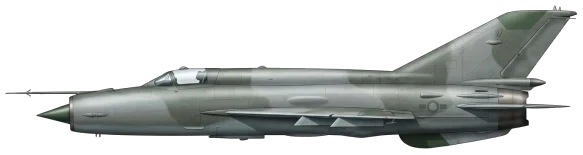
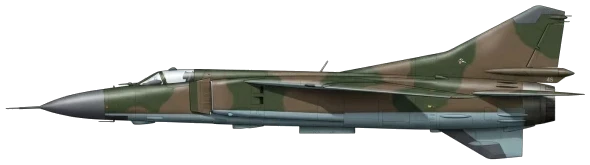
| MiG-21 Fishbed | MiG-23 Flogger | |
|---|---|---|
| Origin country | 🇷🇺 Ex-USSR | 🇷🇺 Ex-USSR |
| Category | Combat Aircraft | Combat Aircraft |
| Manufacturer | Mikoyan-Gurevich | Mikoyan-Gurevich |
| First flight | 16 June 1955 | 10 June 1967 |
| Year introduced | 1958 | 1970 |
| Number produced | 11496 units | 5047 units |
| Average unit price | $2 million | $4 million |
| Wing area | 23.0 m² | 37.0 m² |
| Wingspan | 7.2 m | 14.0 m |
| Height | 4.1 m | 4.8 m |
| Length | 14.7 m | 16.7 m |
| Maximum speed | 2175 km/h | 2500 km/h |
| Operational range | 793 km | 2,360 km |
| Service ceiling | 17,500 m | 18,000 m |
| Max. takeoff weight | 10,400 kg | 17,800 kg |
| Empty weight | 4,871 kg | 10,230 kg |
| Total thrust | 1 x 7,095 kgf | 1 x 12,996 kgf |
Detailed Comparison
The Mikoyan-Gurevich MiG-21 Fishbed and MiG-23 Flogger illustrate the rapid evolution of Soviet aerial doctrine from the mid-1950s to the late 1960s. While the MiG-21 was designed as a lightweight, agile, point-defense interceptor optimized for visual range combat, the MiG-23 was developed to address its predecessor's limitations in range, payload, and radar capabilities. The shift represents a move from mass-producible simplicity to a more complex, heavier platform capable of beyond-visual-range (BVR) engagements and high-speed interdiction.
Development and Design
The MiG-21 utilizes a classic delta wing configuration, prioritizing high-speed performance and minimal drag. This design choice, while enabling Mach 2 flight on a relatively low-thrust engine, resulted in poor low-speed handling and required long takeoff runs. Conversely, the MiG-23 introduced variable-geometry wings, allowing sweep adjustments for different flight regimes. This innovation significantly improved short-field performance and loiter time compared to the Fishbed. However, the complex swing-wing mechanism and larger airframe increased the Flogger's weight and maintenance burden. Structurally, the MiG-23 moved the air intakes to the fuselage sides to accommodate a large nose radar, a necessary design change to facilitate BVR engagements, a capability absent in early MiG-21 variants.
Specifications and Performances
The performance gap is most visible in power and mass. The MiG-23 is a significantly heavier platform, with an empty weight of 10,230 kg, more than double the MiG-21's 4,871 kg. To compensate, the Flogger's Tumansky R-35F-300 delivers 12,996 kgf of thrust, dwarfing the MiG-21's 4,689 kgf. This power advantage pushes the MiG-23 to a higher maximum speed of 2,500 km/h compared to the Fishbed's 2,125 km/h. Critically, the MiG-23 addresses the MiG-21's primary operational weakness: endurance. The Flogger nearly doubles the operational range to 1,150 km, whereas the MiG-21 is limited to 660 km, restricting the latter primarily to defensive roles near airbases. Furthermore, the MiG-23's climb rate of 240 m/s reflects its superior energy characteristics.
Deployment and usage
With over 11,496 units built, the MiG-21 became the backbone of Eastern Bloc and allied air forces. In conflicts like the Vietnam War, its small radar cross-section and agility allowed it to effectively ambush heavier US fighters using hit-and-run tactics. The MiG-23, entering service in 1970, saw extensive combat in the Middle East and Afghanistan. While it provided superior avionics and BVR capabilities with missiles like the R-23 (AA-7 Apex), it lacked the close-in dogfighting agility of the Fishbed. Interestingly, the MiG-21's simplicity allowed for extensive modernization programs (e.g., MiG-21 Bison, LanceR), keeping it in service decades longer than the more complex and expensive MiG-23 in many air forces.
Conclusion
Ultimately, the MiG-21 represents a pinnacle of point-defense efficiency, prioritizing low cost, high quantity, and maneuverability. The MiG-23, while technically superior in range, speed, and sensor integration, suffered from the complexity inherent in third-generation variable-geometry designs. The Fishbed remains a testament to the effectiveness of lightweight simplicity, while the Flogger served as a necessary, albeit transitional, heavy interdictor bridging the gap to fourth-generation fighters like the MiG-29.


