MiG-21 Fishbed vs Mirage F1
MiG-21 Fishbed vs Mirage F1 at a glance — top speed 2,125 vs 2,350 km/h, range 660 vs 3,300 km, max takeoff weight 8,625 vs 15,200 kg, built 11,496 vs 726 units.
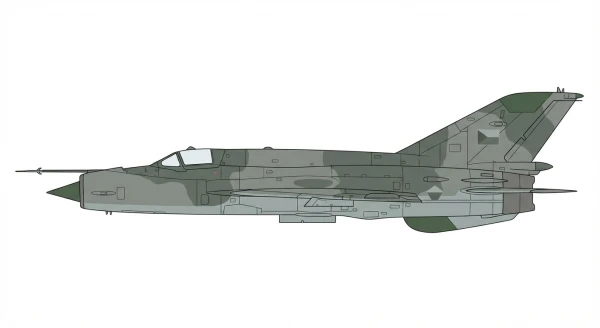
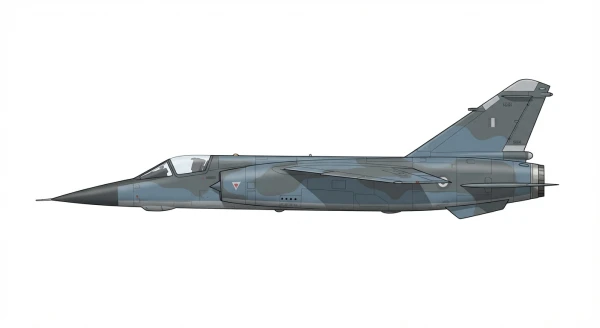
| MiG-21 Fishbed | Mirage F1 | |
|---|---|---|
| Origin country | 🇷🇺 Ex-USSR | 🇫🇷 France |
| Category | Combat Aircraft | Combat Aircraft |
| Manufacturer | Mikoyan-Gurevich | Dassault |
| First flight | 16 June 1955 | 23 December 1966 |
| Year introduced | 1958 | 1973 |
| Number produced | 11496 units | 726 units |
| Average unit price | $2 million | $8 million |
| Wing area | 23.0 m² | 25.0 m² |
| Wingspan | 7.2 m | 8.5 m |
| Height | 4.1 m | 4.6 m |
| Length | 13.5 m | 15.5 m |
| Maximum speed | 2125 km/h | 2350 km/h |
| Operational range | 660 km | 3,300 km |
| Service ceiling | 19,000 m | 20,000 m |
| Max. takeoff weight | 8,625 kg | 15,200 kg |
| Empty weight | 4,871 kg | 8,024 kg |
| Total thrust | 1 x 4,689 kgf | 1 x 7,199 kgf |
Detailed Comparison
The Soviet Mikoyan-Gurevich MiG-21 and the French Dassault Mirage F1 exemplify diverging Cold War fighter philosophies separated by a decade of technological evolution. The MiG-21, a lightweight second-generation interceptor, emphasized speed, simplicity, and mass production, whereas the Mirage F1 adopted a conventional swept-wing configuration to address the endurance and runway limitations inherent in earlier delta-wing designs.
Development and Design
The MiG-21's design centers on a tailed delta wing and a nose intake, optimizing the airframe for supersonic acceleration and high-altitude maneuverability. Developed to counter Western aircraft like the F-104, its small fuselage minimized drag but severely restricted internal fuel capacity and avionics space. Conversely, Dassault broke from its delta-wing tradition with the Mirage F1, utilizing shoulder-mounted swept wings. This design choice, coupled with the SNECMA Atar 9K-50 engine, allowed for superior low-speed handling, shorter takeoff runs, and increased internal fuel volume. The Mirage F1 also integrated more sophisticated avionics, such as the Cyrano IV monopulse radar, providing terrain avoidance and mapping capabilities that early MiG variants lacked.
Specifications and Performances
Performance metrics highlight the Mirage F1's advantage in raw power and weight class. With a Maximum Takeoff Weight (MTOW) of 15,200 kg, the F1 is nearly double the weight of the MiG-21 (8,625 kg MTOW). While the MiG-21 is lighter, utilizing a Tumansky R-11F-300 engine (4,689 kgf thrust) to achieve 2,125 km/h, the Mirage F1 utilizes superior aerodynamics and thrust (5,550 kgf) to reach a higher top speed of 2,350 km/h. The F1's service ceiling of 20,000 m slightly exceeds the MiG's 19,000 m. While the provided data indicates a shorter specific range for the F1, the aircraft's structural design allows for a significantly higher practical payload—up to 4,000 kg—compared to the MiG-21's limited armament load, making the F1 a far more effective strike platform.
Deployment and Usage
The MiG-21 holds a massive quantitative advantage in operational history, with over 11,000 units built and exports to over 60 nations. It served primarily as a point-defense interceptor in Vietnam and the Middle East, leveraging high availability and ease of maintenance to overwhelm opponents or conduct "hit-and-run" tactics. The Mirage F1 saw specialized use in prolonged campaigns, notably by Iraq for anti-shipping and strike missions during the Iran-Iraq War, and by South Africa in the Border War. While the MiG-21 often relied on ground control interception (GCI) due to limited onboard sensors, the Mirage F1 was capable of conducting autonomous all-weather interception and complex ground attack sorties.
Conclusion
The MiG-21 represents a triumph of cost-effective engineering, offering accessible supersonic capability that remains in service through extensive upgrades like the MiG-21 Bison. The Mirage F1 stands as a more sophisticated, multi-role platform, bridging the gap between specialized interceptors and modern strike fighters. While the MiG-21 offered strategic value through sheer numbers and agility, the Mirage F1 provided operators with a versatile avionics suite and payload capacity suitable for complex, expeditionary warfare.