MiG-21 Fishbed vs Mirage III / 5 / 50
MiG-21 Fishbed vs Mirage III / 5 / 50 at a glance — top speed 2,125 vs 2,350 km/h, range 660 vs 3,335 km, max takeoff weight 8,625 vs 12,000 kg, built 11,496 vs 1,422 units.
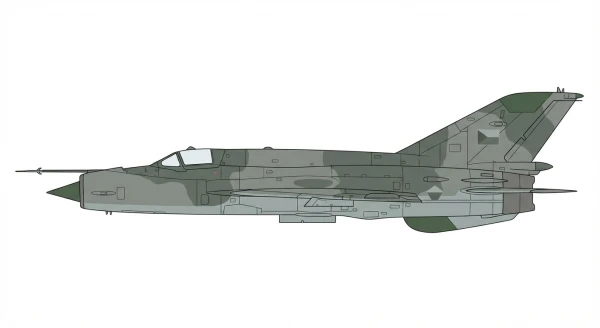
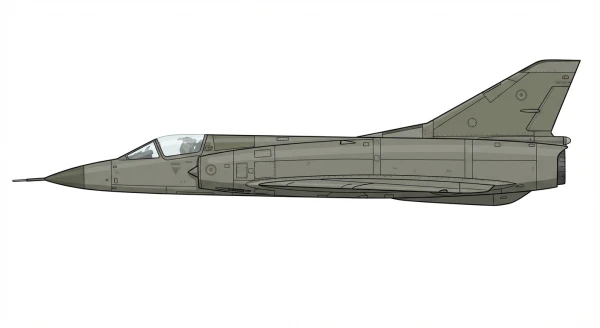
| MiG-21 Fishbed | Mirage III / 5 / 50 | |
|---|---|---|
| Origin country | 🇷🇺 Ex-USSR | 🇫🇷 France |
| Category | Combat Aircraft | Combat Aircraft |
| Manufacturer | Mikoyan-Gurevich | Dassault |
| First flight | 16 June 1955 | 17 November 1956 |
| Year introduced | 1958 | 1961 |
| Number produced | 11496 units | 1422 units |
| Average unit price | $2 million | $5 million |
| Wing area | 23.0 m² | 34.8 m² |
| Wingspan | 7.2 m | 8.2 m |
| Height | 4.1 m | 4.5 m |
| Length | 13.5 m | 15.3 m |
| Maximum speed | 2125 km/h | 2350 km/h |
| Operational range | 660 km | 3,335 km |
| Service ceiling | 19,000 m | 17,000 m |
| Max. takeoff weight | 8,625 kg | 12,000 kg |
| Empty weight | 4,871 kg | 6,740 kg |
| Total thrust | 1 x 4,689 kgf | 1 x 6,200 kgf |
Detailed Comparison
Emerging in the mid-1950s, the Soviet MiG-21 Fishbed and the French Mirage III share a defining reliance on delta-wing configurations to achieve Mach 2 speeds. While the MiG-21 was mass-produced as a lightweight frontline interceptor to counter Western designs like the F-104, the Mirage III established Dassault’s reputation for exporting sophisticated, high-performance multi-role platforms. Both airframes evolved significantly through variants like the MiG-21bis and Mirage 5/50, extending their operational relevance decades beyond their projected service lives.
Development and Design
The MiG-21 utilized a tailed delta configuration with a shock-cone air intake, prioritizing structural simplicity and high-speed interception. Its design philosophy emphasized ease of manufacture and maintenance, resulting in a lightweight fuselage ideal for point defense but restricted by limited internal volume. Conversely, the Mirage III featured a tailless delta design, optimizing high-altitude stability and internal fuel volume at the cost of higher landing speeds. Dassault later refined this platform into the Mirage 5, removing the radar to create a simplified, cost-effective ground-attack variant with increased hardpoints, and the Mirage 50, which integrated advanced avionics and uprated engines to maintain competitiveness against fourth-generation fighters.
Specifications and Performances
Performance metrics highlight the divergence in doctrinal requirements. The Mirage III offers superior endurance with a maximum range of 2400 km, significantly overshadowing the MiG-21’s limited 660 km combat radius, a notorious tactical handicap for the Soviet fighter. While the Mirage holds a top speed advantage at 2350 km/h compared to the MiG's 2125 km/h, the lighter MiG-21 (Empty Weight: 4871 kg) excels in vertical performance, reaching a service ceiling of 19,000 m. The MiG's Tumansky R-11 engine provided the necessary thrust for rapid climbs, whereas the Mirage's larger wing area (34.8 m²) allowed for heavier weapon payloads, essential for its strike role.
Deployment and usage
Operational history places these aircraft on opposite sides of major conflicts, particularly in the Middle East. The Mirage III achieved legendary status during the Six-Day War, where Israeli pilots utilized its multi-role capacity for both decisive preemptive airstrikes and air superiority. The MiG-21 saw extensive service in Vietnam, effectively using "hit-and-run" tactics against heavier US fighters, and in the Indo-Pakistani wars. While the MiG-21 struggled with situational awareness due to restricted cockpit visibility, its agility made it a dangerous adversary in close-in dogfights. The Mirage 5/50 variants found a niche in export markets for nations requiring dedicated ground-attack platforms, such as in the Falklands War and various African conflicts.
Conclusion
Ultimately, the MiG-21 and Mirage III demonstrate how distinct doctrinal requirements shape engineering. The MiG-21 succeeded as a prolific, disposable point-defense interceptor, offering an unmatched cost-to-capability ratio ($2.0 million vs $5.0 million). The Mirage III, however, proved superior as a standalone multi-role system, offering the range and payload flexibility necessary for offensive campaigns. While the MiG-21 dominated in sheer production numbers, the Mirage III lineage successfully bridged the gap between pure interception and deep strike capabilities.