MiG-21 Fishbed vs Su-9 / Su-11 Fishpot
MiG-21 Fishbed vs Su-9 / Su-11 Fishpot at a glance — top speed 2,125 vs 2,135 km/h, range 660 vs 1,800 km, built 11,496 vs 1,150 units.
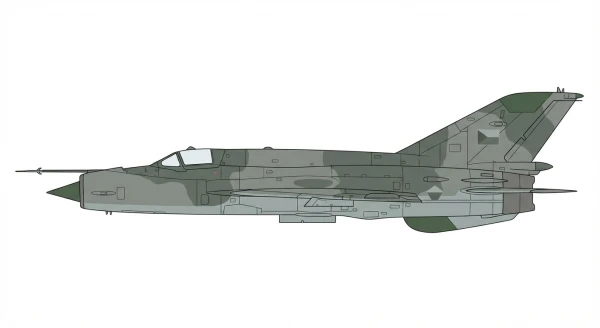
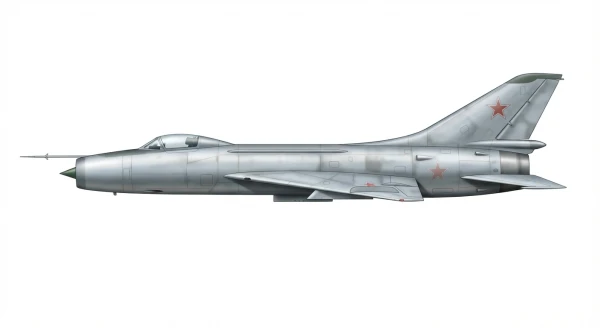
| MiG-21 Fishbed | Su-9 / Su-11 Fishpot | |
|---|---|---|
| Origin country | 🇷🇺 Ex-USSR | 🇷🇺 Ex-USSR |
| Category | Combat Aircraft | Combat Aircraft |
| Manufacturer | Mikoyan-Gurevich | Sukhoi |
| First flight | 16 June 1955 | 24 June 1956 |
| Year introduced | 1958 | 1959 |
| Number produced | 11496 units | 1150 units |
| Average unit price | $2 million | $5 million |
| Wing area | 23.0 m² | 26.3 m² |
| Wingspan | 7.2 m | 8.4 m |
| Height | 4.1 m | -- m |
| Length | 13.5 m | 16.7 m |
| Maximum speed | 2125 km/h | 2135 km/h |
| Operational range | 660 km | 1,800 km |
| Service ceiling | 19,000 m | 16,800 m |
| Max. takeoff weight | 8,625 kg | -- kg |
| Empty weight | 4,871 kg | 8,750 kg |
| Total thrust | 1 x 4,689 kgf | 1 x 9,060 kgf |
Detailed Comparison
Developing concurrently in the late 1950s, the MiG-21 and Su-9 shared superficial aerodynamic similarities—specifically the tailed delta-wing configuration—but served fundamentally different strategic doctrines. While the Mikoyan design focused on a lightweight, tactical air superiority role for Frontal Aviation, the Sukhoi aircraft was engineered as a heavier, high-speed interceptor specifically for the Soviet Anti-Air Defense forces (PVO), leading to divergent operational histories despite their common technological lineage.
Development and Design
Both airframes emerged from TsAGI aerodynamic studies suggesting the delta wing and nose intake configuration as optimal for Mach 2 flight. The MiG-21 was designed as a "lightweight fighter," prioritizing maneuverability, simplicity, and ease of manufacturing. It maintained a small airframe with short-range capabilities, eventually evolving into a versatile platform capable of carrying cannons, missiles, and ground munitions.
In contrast, the Su-9 "Fishpot" was developed alongside the swept-wing Su-7 "Fitter," sharing its fuselage and tail surfaces but adopting a 53° delta wing. The design philosophy for the Su-9 was strictly singular: high-speed interception. Consequently, it eliminated cannons entirely in favor of a missile-only armament (K-5 beam riders), reflecting a doctrinal shift towards ground-controlled interception (GCI). While the MiG-21 emphasized agility, the Su-9 was essentially a missile platform built around a massive engine.
Specifications and Performances
Performance characteristics highlight the significant weight class disparity between the two. The Su-9 is nearly twice the mass of the MiG-21, with an empty weight of 8,750 kg compared to the Mikoyan's 4,871 kg. To compensate for this mass, the Su-9 utilized the powerful Lyulka AL-7F engine, generating 9,060 kgf of thrust—almost double the output of the MiG-21's Tumansky R-11F-300 (4,689 kgf).
Despite the power difference, top speeds were comparable, with both aircraft capable of exceeding 2,100 km/h. However, the MiG-21's smaller airframe and lower wing loading offered superior service ceilings (19,000 m versus the Su-9's 16,800 m) and vastly better handling characteristics. The Su-9 was known for difficult low-speed handling and high landing speeds, while the MiG-21, despite having a short range (660 km), offered a more balanced flight envelope.
Deployment and Usage
The operational footprint of these aircraft is vastly different. The MiG-21 became the most produced supersonic jet in history (over 11,000 units), serving in over 60 air forces. It saw extensive combat in Vietnam, the Middle East, and South Asia, proving effective in close-range dogfights against technically superior Western aircraft.
Conversely, the Su-9 and Su-11 were never exported, serving exclusively with the Soviet PVO. Their service life was defined by routine border patrols and GCI missions, including the failed interception of Francis Gary Powers' U-2 in 1960. The Su-9/11 series acted as a pure component of the integrated air defense network rather than an independent combatant.
Conclusion
Ultimately, the MiG-21 achieved longevity through its adaptability, evolving from a day interceptor to a multi-role platform that remains in service with upgraded avionics. The Su-9 and Su-11 represent a specific era of Soviet interceptor philosophy: heavy, fast, and reliant on ground control. While the Su-9 was a critical step leading to the more advanced Su-15 "Flagon," it was a specialized tool with limited utility, whereas the MiG-21 proved to be a versatile, ubiquitous combat asset.