Mirage 2000 vs Mirage F1
Mirage 2000 vs Mirage F1 at a glance — top speed 2,336 vs 2,350 km/h, range 3,335 vs 3,300 km, max takeoff weight 17,500 vs 15,200 kg, built 601 vs 726 units.
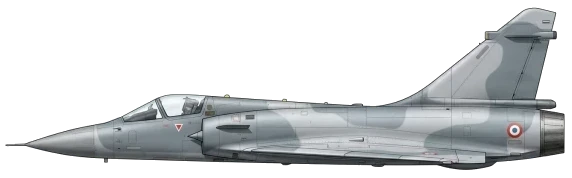
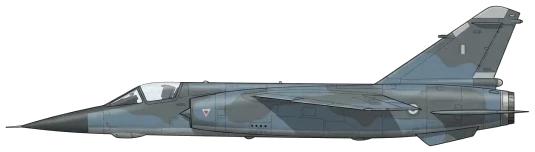
| Mirage 2000 | Mirage F1 | |
|---|---|---|
| Origin country | 🇫🇷 France | 🇫🇷 France |
| Category | Combat Aircraft | Combat Aircraft |
| Manufacturer | Dassault | Dassault |
| First flight | 1 March 1978 | 23 December 1966 |
| Year introduced | 1983 | 1973 |
| Number produced | 601 units | 726 units |
| Average unit price | $23 million | $8 million |
| Wing area | 41.0 m² | 25.0 m² |
| Wingspan | 9.1 m | 8.5 m |
| Height | 5.2 m | 4.6 m |
| Length | 14.4 m | 15.5 m |
| Maximum speed | 2336 km/h | 2350 km/h |
| Operational range | 3,335 km | 3,300 km |
| Service ceiling | 18,300 m | 20,000 m |
| Max. takeoff weight | 17,500 kg | 15,200 kg |
| Empty weight | 7,500 kg | 8,024 kg |
| Total thrust | 1 x 9,697 kgf | 1 x 7,199 kgf |
Detailed Comparison
Dassault’s transition from the Mirage F1 to the Mirage 2000 marks a shift from conventional aerodynamic conservatism to relaxed-stability dominance. While the F1 was designed to rectify the short-field limitations of the Mirage III via a swept-wing configuration, the Mirage 2000 returned to the delta planform, leveraging Fly-By-Wire (FBW) technology to negate the delta’s traditional low-speed handling vices while maximizing high-speed interception characteristics.
Development and Design
The Mirage F1, entering service in 1973, utilized a shoulder-mounted swept wing and tailplane assembly. This configuration prioritized shorter takeoff runs and lower approach speeds compared to the earlier Mirage III. It relied on the SNECMA Atar 9K-50 turbojet, a rugged but fuel-inefficient engine derived from 1950s technology.
Conversely, the Mirage 2000, fielded in 1983, incorporated negative static stability managed by quadruplex FBW. This allowed the aircraft to retain the low drag and high internal fuel volume of the delta wing while achieving turn rates that outclassed the F1. The switch to the SNECMA M53 turbofan offered a significant leap in specific fuel consumption and thrust-to-weight ratio compared to the Atar-powered F1. The 2000 also introduced extensive composite materials to reduce airframe weight, contrasting with the F1's all-metal construction.
Specifications and Performance
The performance gap is generational. The Mirage 2000 boasts a climb rate of 305 m/s, significantly outpacing the F1’s 242 m/s, a critical metric for the interceptor role. While both aircraft achieve speeds exceeding Mach 2.2, the Mirage 2000 sustains energy better in high-G maneuvers due to its delta aerodynamics and higher thrust output (6626 kgf dry vs approximately 5000 kgf on the F1's Atar).
Avionics further widen the gap. The F1’s Cyrano IV monopulse radar lacks the look-down/shoot-down capabilities essential for modern BVR combat. The Mirage 2000C’s RDI and later RDY radars provide this capability, along with simultaneous multi-target tracking. In terms of armament, while the F1 carries a practical load of 4,000 kg, the Mirage 2000 integrates heavier, precision-guided stand-off munitions like the SCALP cruise missile and AASM Hammer.
Deployment and Usage
The Mirage F1 served as a workhorse for export clients, seeing high-intensity combat with the Iraqi Air Force during the Iran-Iraq War. Iraqi F1EQs were instrumental in anti-shipping roles using Exocet missiles and air-to-air engagements against Iranian F-14s. South African F1s similarly saw extensive action in the Angolan Border War, valued for their ruggedness in austere conditions.
The Mirage 2000’s operational record emphasizes precision and air superiority. During the 1999 Kargil War, Indian Mirage 2000s executed high-altitude strikes with laser-guided bombs, a capability the F1 lacked. In Greek service, the Mirage 2000-5 is frequently pitted against Turkish F-16s, where its instantaneous turn rate and electronic warfare suite have proven decisive in dogfight simulations and border incursions.
Conclusion
The Mirage 2000 is objectively the superior combat platform, rendering the F1 obsolete in air-to-air engagements. The F1’s mechanical flight controls and older radar leave it vulnerable in modern BVR environments where the Mirage 2000 excels. While the F1 found a niche as a cost-effective ground attack and anti-shipping platform for export nations, the Mirage 2000 provides a true multirole capability comparable to the F-16 Block 50, combining interception speed with precision strike capabilities that the F1 architecture could never support.


