MiG-29 Fulcrum vs Mirage 2000
MiG-29 Fulcrum vs Mirage 2000 at a glance — top speed 2,450 vs 2,336 km/h, range 2,100 vs 3,335 km, max takeoff weight 18,000 vs 17,500 kg, built 1,600 vs 601 units.
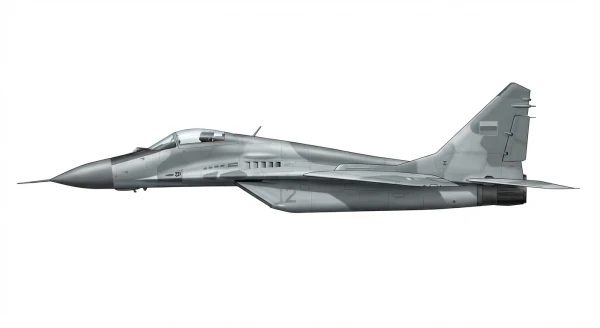

| MiG-29 Fulcrum | Mirage 2000 | |
|---|---|---|
| Origin country | 🇷🇺 Ex-USSR | 🇫🇷 France |
| Category | Combat Aircraft | Combat Aircraft |
| Manufacturer | Mikoyan | Dassault |
| First flight | 6 October 1977 | 1 March 1978 |
| Year introduced | 1983 | 1983 |
| Number produced | 1600 units | 601 units |
| Average unit price | $25 million | $23 million |
| Wing area | 38.0 m² | 41.0 m² |
| Wingspan | 11.4 m | 9.1 m |
| Height | 4.7 m | 5.2 m |
| Length | 17.3 m | 14.4 m |
| Maximum speed | 2450 km/h | 2336 km/h |
| Operational range | 2,100 km | 3,335 km |
| Service ceiling | 18,000 m | 18,300 m |
| Max. takeoff weight | 18,000 kg | 17,500 kg |
| Empty weight | 11,000 kg | 7,500 kg |
| Total thrust | 2 x 8,319 kgf | 1 x 9,697 kgf |
Detailed Comparison
The Soviet MiG-29 Fulcrum and French Mirage 2000 emerged simultaneously in the late 1970s as distinct solutions to air superiority and multirole requirements. While the MiG-29 was engineered as a twin-engine frontline fighter to counter the F-15 and F-16, emphasizing raw maneuverability and rough-field operations, the Mirage 2000 evolved as a lightweight, single-engine delta-wing platform replacing the Mirage III. Both aircraft entered service in 1983-1984, representing the peak of fourth-generation technology for their respective nations.
Development and Design
The MiG-29 utilizes a conventional aerodynamic layout with a mid-mounted swept wing and twin Klimov RD-33MK turbojets. Its design prioritizes maneuverability and survivability, featuring widely spaced engines for redundancy and robust landing gear for operation from damaged or unpaved runways. Notably, it integrated an Infrared Search and Track (IRST) system early on, allowing passive targeting. Conversely, the Mirage 2000 retains Dassault’s signature delta-wing configuration. While delta wings traditionally suffer at low speeds, the Mirage incorporates fly-by-wire technology and relaxed static stability to enhance agility. Extensive use of carbon fiber and composites minimizes weight, allowing the single SNECMA M53 engine to provide sufficient thrust-to-weight performance.
Specifications and Performances
Performance metrics highlight the divergence in design philosophy. The twin-engine MiG-29 generates significantly more total thrust (18,000 kgf combined) compared to the Mirage 2000's single engine (6,626 kgf), facilitating high-energy maneuvers and rapid acceleration. However, the Mirage 2000 demonstrates superior high-speed interception characteristics, with a maximum speed of 2,336 km/h and a service ceiling of 18,300 m, outperforming the MiG-29’s 2,200 km/h and 17,500 m ceiling. The Mirage also offers a slight advantage in combat radius with a range of 1,550 km versus the MiG’s 1,430 km, addressing the Fulcrum's known fuel limitations.
Deployment and usage
Operationally, the MiG-29 served as the standard tactical fighter for the Warsaw Pact and was widely exported. It has seen extensive combat in the Balkans, the Kargil War, and Syria. While effective in close-range dogfights using R-73 missiles, its combat record in the Balkans suffered due to outdated avionics when matched against NATO forces. The Mirage 2000 found export success in India, the UAE, and Egypt. It proved highly adaptable, transitioning effectively from air superiority to precision strike roles. In the Kargil War, Indian Mirage 2000s delivered laser-guided munitions in high-altitude conditions, a role distinct from the MiG-29's air-superiority escort duties in the same theater.
Conclusion
The MiG-29 provides a robust, high-thrust platform optimized for establishing local air superiority and operating under austere conditions. Its reliance on ground control integration and shorter range, however, limits its strategic projection compared to Western counterparts. The Mirage 2000 represents a more balanced multirole approach, trading raw thrust for avionics sophistication, range, and a versatile payload capable of complex precision strikes. While the Fulcrum excels in pure kinematics, the Mirage 2000 offers a more sustainable logistical footprint and superior multi-mission flexibility.