Mirage 2000 vs Tejas
Mirage 2000 vs Tejas at a glance — top speed 2,336 vs 2,220 km/h, range 3,335 vs 3,000 km, max takeoff weight 17,500 vs 13,500 kg, built 601 vs 38 units.
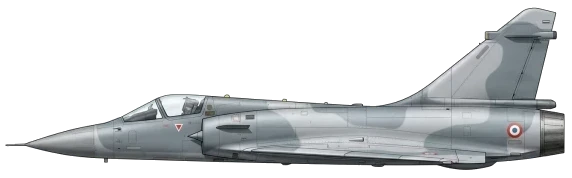
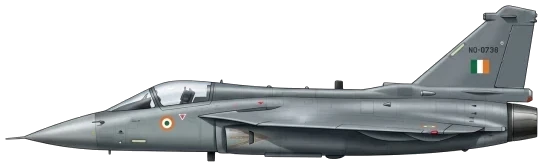
| Mirage 2000 | Tejas | |
|---|---|---|
| Origin country | 🇫🇷 France | 🇮🇳 India |
| Category | Combat Aircraft | Combat Aircraft |
| Manufacturer | Dassault | HAL |
| First flight | 1 March 1978 | 4 January 2001 |
| Year introduced | 1983 | 2015 |
| Number produced | 601 units | 38 units |
| Average unit price | $23 million | $26 million |
| Wing area | 41.0 m² | 38.4 m² |
| Wingspan | 9.1 m | 8.2 m |
| Height | 5.2 m | 4.4 m |
| Length | 14.4 m | 13.2 m |
| Maximum speed | 2336 km/h | 2220 km/h |
| Operational range | 3,335 km | 3,000 km |
| Service ceiling | 18,300 m | 16,000 m |
| Max. takeoff weight | 17,500 kg | 13,500 kg |
| Empty weight | 7,500 kg | 6,560 kg |
| Total thrust | 1 x 9,697 kgf | 1 x 8,600 kgf |
Detailed Comparison
Dassault’s Mirage 2000, developed in the late 1970s, is a 17,500 kg maximum takeoff weight (MTOW) multirole fighter with 601 units built and a 40-year combat record. The HAL Tejas, conceived to replace India's MiG-21 fleet, is a 13,500 kg MTOW light combat aircraft with 38 initial units delivered since 2015. While the Mirage 2000 relies on an aluminum alloy airframe with early fly-by-wire integration, the Tejas utilizes a carbon-fiber composite structure comprising 45% of its weight.
Development and Design
The Mirage 2000 retains Dassault's traditional tailless delta wing, optimized with relaxed static stability and a quadruplex fly-by-wire system to overcome the low-speed handling limitations of earlier Mirages. The Tejas employs a compound delta wing. HAL and the Aeronautical Development Agency prioritized indigenous subsystems, though the failure of the domestic Kaveri engine forced the adoption of the American General Electric F404-GE-IN20. The aircraft's 30-year gestation period delayed its entry into service and forced subsequent variants, like the Mark 1A, to integrate newer components such as AESA radars to remain current.
Specifications and Performances
The Mirage 2000 operates in a heavier weight class, allowing it to carry a higher payload over longer distances.
- The Mirage 2000 reaches 2,336 km/h with a 1,550 km range and an 18,300 m service ceiling.
- The Tejas has a maximum speed of 2,220 km/h and a restricted range of 739 km.
The Tejas has a thrust-to-weight advantage. Its 6,560 kg empty weight paired with the 8,600 kgf GE engine provides higher acceleration than the Mirage's 7,500 kg empty frame powered by the 6,626 kgf SNECMA M53 engine.
Deployment and usage
The Mirage 2000 flew air superiority and ground-attack missions during Operation Desert Storm, NATO operations in the Balkans, and strikes in Afghanistan. The Indian Air Force utilized the Mirage 2000 during the 1999 Kargil War to deliver laser-guided munitions at high altitudes. The Tejas lacks combat deployment. Its operational history consists of domestic exercises like Gagan Shakti 2018 and an international appearance at Desert Flag VIII in 2023. Weapon integration differs strictly: the Mirage 2000 uses integrated MBDA MICA and SCALP missiles, while the Tejas relies on a mixed inventory of Israeli (I-Derby ER, Python-5), Russian (R-73), and indigenous (Astra) munitions.
Conclusion
The Mirage 2000 outperforms the Tejas in long-range strike, endurance, and high-altitude payload delivery. Its 1,550 km range, 17,500 kg MTOW, and combat record make it a capable platform for expeditionary and multirole operations. The Tejas holds a kinematic edge in close-in engagements due to its higher thrust output and lighter airframe, but its 739 km range restricts it to localized air defense. An air force requiring deep strike or prolonged loiter times will select the Mirage 2000, whereas the Tejas functions strictly as a short-range point-defense interceptor.


