SA316 Alouette III vs SA340 Gazelle
SA316 Alouette III vs SA340 Gazelle at a glance — top speed 210 vs 310 km/h, range 540 vs 361 km, max takeoff weight 2,200 vs 2,100 kg, built 2,000 vs 1,775 units.
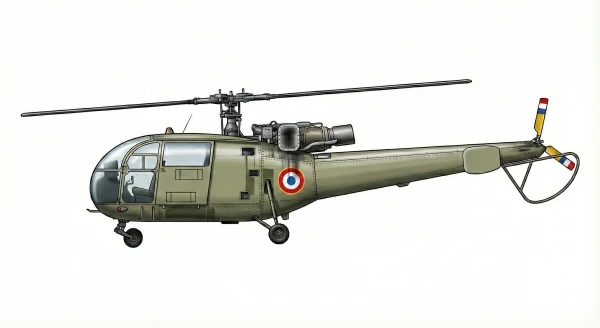
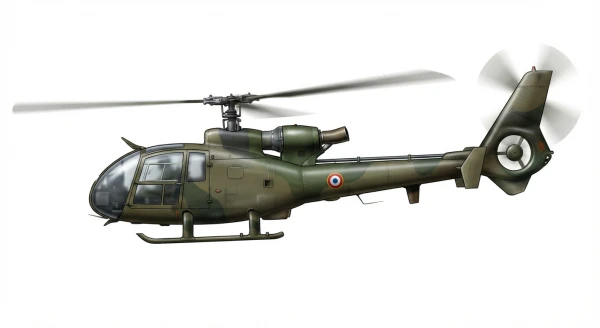
| SA316 Alouette III | SA340 Gazelle | |
|---|---|---|
| Origin country | 🇫🇷 France | 🇫🇷 France |
| Category | Military Helicopters | Military Helicopters |
| Manufacturer | Sud Aviation | Aérospatiale |
| First flight | 28 February 1959 | 7 April 1967 |
| Year introduced | 1961 | 1971 |
| Number produced | 2000 units | 1775 units |
| Average unit price | $1.5 million | $1.7 million |
| Wingspan | 11.0 m | 10.5 m |
| Height | 3.0 m | 3.2 m |
| Length | 10.0 m | 11.9 m |
| Maximum speed | 210 km/h | 310 km/h |
| Operational range | 540 km | 361 km |
| Service ceiling | 3,200 m | 4,450 m |
| Max. takeoff weight | 2,200 kg | 2,100 kg |
| Empty weight | 1,143 kg | 1,009 kg |
| Total thrust | 1 x 713 kW | 1 x 650 kW |
Detailed Comparison
The Sud Aviation SA316 Alouette III and the Aérospatiale SA340 Gazelle illustrate the evolution of French light rotorcraft from multi-role utility transports to specialized high-speed platforms. While the Alouette III prioritized payload and high-altitude reliability for diverse transport duties, the Gazelle introduced aerodynamic refinement and specific anti-tank capabilities, sacrificing cabin volume for speed and agility.
Development and Design
Derived from the Alouette II, the SA316 Alouette III focused on maximizing internal volume and visibility. Its semi-monocoque structure was designed to accommodate up to seven seats or two stretchers, making it a robust utility platform. The design philosophy emphasized simplicity and ruggedness, utilizing the Artouste IIIB turboshaft. Conversely, the SA340 Gazelle marked a technological leap, incorporating the innovative Fenestron shrouded tail rotor to improve safety and reduce acoustic signatures. It was one of the first helicopters to extensively use composite materials and featured a rigid fuselage with a streamlined profile. The Gazelle prioritized aerodynamic efficiency over the Alouette's utilitarian, boxy airframe, reflecting a shift toward survivability through speed.
Specifications and Performance
The performance gap highlights the doctrinal shift between generations. The Gazelle is significantly faster, achieving a maximum speed of 310 km/h, compared to the Alouette III's 210 km/h. This 100 km/h differential makes the Gazelle far more survivable in scout and anti-armor roles. However, the Alouette III utilizes a more powerful powerplant (713 kW vs. 650 kW), supporting a slightly higher Maximum Takeoff Weight (2,200 kg) compared to the Gazelle (2,100 kg). While the Gazelle offers a superior climb rate of 7.7 m/s (nearly double the Alouette's 4.3 m/s) and a higher service ceiling of 4,450 m, the Alouette III offers greater internal capacity, critical for transport and medevac operations where cabin space is paramount.
Deployment and Usage
Operational history defines their distinct niches. The Alouette III excelled in counter-insurgency and "hot and high" environments. Portuguese forces pioneered its use for air assault in Africa, while the Rhodesian Air Force adapted it into the "K-Car" gunship role (20mm cannon) and troop carrier for their Fireforce doctrine. In the Falklands War, Argentine forces utilized the Alouette III for maritime operations, including the invasion of South Georgia.
In contrast, the Gazelle found its primary utility as a dedicated anti-tank and reconnaissance platform. Armed with HOT wire-guided missiles, it served effectively with French and British forces in the Gulf War and the Balkans, utilizing its agility for terrain masking. While the Alouette III was often the workhorse for troop insertion and medevac, the Gazelle operated as a hunter-killer and observation platform, notably serving in British reconnaissance roles during the Falklands conflict.
Conclusion
Ultimately, the SA316 Alouette III remains the superior logistical choice for general utility and troop transport due to its cabin capacity and proven ruggedness in austere conditions. The SA340 Gazelle, however, offers the kinematic performance necessary for survivable reconnaissance and precision anti-armor strikes in contested airspace. The transition from the Alouette to the Gazelle represents a move from broad multi-mission capability to specialized, high-speed tactical application.