SA316 Alouette III vs UH-1 Iroquois "Huey"
SA316 Alouette III vs UH-1 Iroquois "Huey" at a glance — top speed 210 vs 222 km/h, range 540 vs 510 km, max takeoff weight 2,200 vs 4,309 kg, built 2,000 vs 16,000 units.
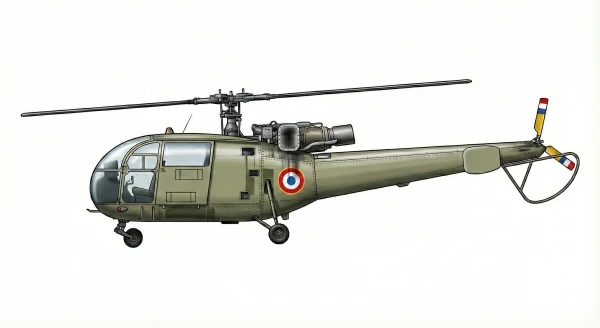
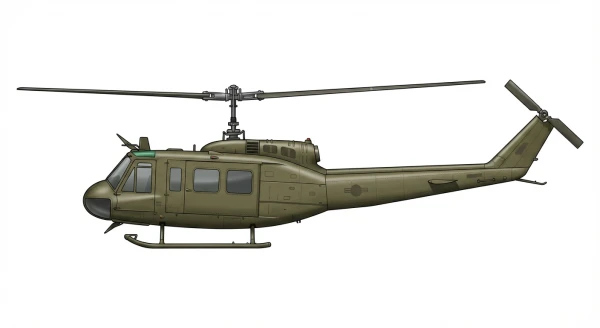
| SA316 Alouette III | UH-1 Iroquois "Huey" | |
|---|---|---|
| Origin country | 🇫🇷 France | 🇺🇸 United States |
| Category | Military Helicopters | Military Helicopters |
| Manufacturer | Sud Aviation | Bell |
| First flight | 28 February 1959 | 22 October 1956 |
| Year introduced | 1961 | 1959 |
| Number produced | 2000 units | 16000 units |
| Average unit price | $1.5 million | $1.3 million |
| Wingspan | 11.0 m | 14.6 m |
| Height | 3.0 m | 4.5 m |
| Length | 10.0 m | 12.7 m |
| Maximum speed | 210 km/h | 222 km/h |
| Operational range | 540 km | 510 km |
| Service ceiling | 3,200 m | 5,910 m |
| Max. takeoff weight | 2,200 kg | 4,309 kg |
| Empty weight | 1,143 kg | 2,087 kg |
| Total thrust | 1 x 713 kW | 1 x 820 kW |
Detailed Comparison
The Sud Aviation SA316 Alouette III and the Bell UH-1 Iroquois emerged during the late 1950s as pivotal platforms in the transition to turbine-powered rotary flight. While the Alouette III focused on aerodynamic efficiency and visibility within the light helicopter category, the UH-1 "Huey" established the medium utility template, becoming the backbone of air mobility doctrine. Both designs prioritized durability and adaptability, securing their longevity well beyond their initial service entry dates of 1961 and 1959, respectively.
Development and Design
The Alouette III evolved from the SE 3120 and Alouette II, leveraging the Turbomeca Artouste turboshaft to create a streamlined airframe. Its design philosophy emphasized pilot visibility and a semi-monocoque structure capable of accommodating seven seats or stretchers. The French engineering focus was on maximizing the efficiency of a light platform, leading to variants like the SA 319B with improved fuel economy. Conversely, the UH-1 was developed to meet a specific U.S. Army requirement for medical evacuation and utility. It featured a robust, all-metal fuselage and a distinctive two-blade teetering main rotor system powered by a Lycoming T53. The Huey’s modular cabin design allowed for rapid reconfiguration between troop transport and medevac roles, establishing a utilitarian standard that influenced subsequent generations of military rotorcraft.
Specifications and Performances
Performance metrics highlight the distinct classifications of these aircraft. The UH-1 operates as a medium-lift platform with a Maximum Takeoff Weight (MTOW) of 4,309 kg, nearly double the Alouette III's 2,200 kg. Despite this mass difference, the engine power gap is relatively narrow in early models, with the Huey’s Lycoming T53 providing 820 kW against the Alouette’s 713 kW Turbomeca Artouste IIIB. Consequently, the Huey offers superior range (510 km) and payload capacity, essential for tactical transport. However, the lighter Alouette III maintains a competitive maximum speed of 210 km/h, closely trailing the Huey’s 222 km/h, demonstrating remarkable aerodynamic efficiency for its lighter frame.
Deployment and Usage
The UH-1 defined the air mobility concept during the Vietnam War, flying approximately 7 million sorties. Its roles ranged from "Slick" troop transports to dedicated gunships armed with M60s, rocket pods, and miniguns. It became the ubiquitous battlefield taxi and ambulance. In contrast, the Alouette III found its niche in specialized environments and asymmetric conflicts. The Rhodesian Air Force adapted it into "K-Car" gunships with side-mounted 20mm cannons for vertical envelopment tactics, while Portugal employed it for air assault in Africa. Unlike the land-centric Huey, the Alouette III saw significant naval service, carrying anti-shipping torpedoes and radar, though the French Navy eventually replaced it due to the risks associated with single-engine operations over water.
Conclusion
Ultimately, the UH-1 Iroquois succeeded through sheer capacity and modularity, becoming the universal standard for battlefield utility and mass transport. The Alouette III, however, excelled through aerodynamic refinement and specialized application in demanding roles such as high-altitude operations and light attack. While modern twin-engine safety requirements have largely retired both from frontline service, the Huey’s legacy lies in mass tactical deployment, whereas the Alouette remains a definitive example of maximizing the potential of a light, single-turbine airframe.