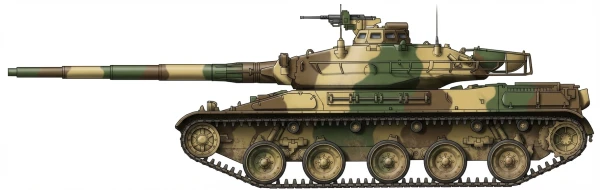
Hispano-Suiza HS-110 multi-fuel 680 hp (510 kW)-720 hp (540 kW)
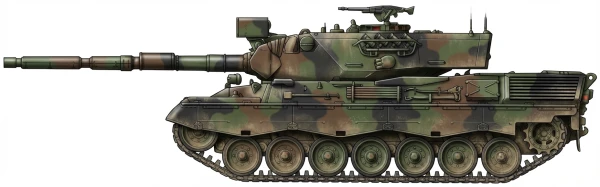
MTU MB 838 MTCA Diesel Engine with 830 hp
Detailed Comparison
Born from the collapsed 1956 Europa-Panzer project, the French AMX-30 and West German Leopard 1 mirror a mid-Cold War doctrine that abandoned heavy armor in favor of mobility. Calculating that contemporary HEAT warheads rendered steel armor obsolete, both GIAT and Krauss-Maffei engineered medium-weight platforms relying on speed and first-round hit probability to survive rather than absorbing kinetic energy.
Development and Design
Following the Franco-German split over production schedules and main armament, Krauss-Maffei delivered the Leopard 1 in 1965, while GIAT fielded the AMX-30 in 1966. The Leopard 1 weighed 42.4 tons and utilized a conventional four-man layout optimized for Central European plains. The AMX-30 was lighter at 36 tons, achieving a lower profile of 2.28 meters versus the Leopard’s 2.7 meters. Both designs accepted thin steel armor—capable of stopping autocannons and shrapnel—operating on the premise that evasion provided better survivability than plating against Soviet anti-tank guided missiles.
Protection and Firepower
Armor on both tanks maxed out around 70mm, leaving them vulnerable to modern infantry anti-tank weapons. The primary divergence lies in armament. The Leopard 1 adopted the British Royal Ordnance L7 105mm rifled gun, establishing a NATO ammunition standard. France opted for the proprietary 105mm Modèle F1, relying on the Obus G—a spin-stabilized HEAT round using internal ball bearings to negate the penetration drop caused by rifling. While the L7 provided broader ammunition compatibility, the AMX-30 integrated a 20mm Modèle F2 coaxial autocannon. This weapon elevated up to 40 degrees, providing a tactical advantage against light armor and low-flying helicopters compared to the Leopard's standard 7.62mm coaxial machine gun.
Mobility and Logistics
Both vehicles reach 65 km/h with a 600 km operational range, achieved through different power-to-weight ratios. The Leopard 1 uses an 830 hp MTU MB 838 diesel, providing high torque and reliability that drove its export across NATO. The lighter AMX-30 used a 680-720 hp Hispano-Suiza HS-110. Early French transmissions suffered from mechanical failures, a flaw rectified in the 1980s with the AMX-30B2 upgrade. The Leopard’s heavier chassis provided a more stable firing platform on the move, while the AMX-30's lower weight eased bridge classification and strategic airlift requirements.
Deployment and Combat Record
The vehicles have faced differing combat environments:
The Leopard 1 deployed to Yugoslavia, Afghanistan, and currently operates in the Russo-Ukrainian War. Ukrainian Leopard 1A5s suffer predictable losses against modern ATGMs and artillery due to thin armor, but utilize their accurate EMES-18 fire control systems for long-range engagements.
The AMX-30 engaged in direct armor combat during the 1991 Gulf War. Qatari AMX-30s destroyed Iraqi T-55s at the Battle of Khafji, validating the French 105mm gun against older Soviet armor.
Conclusion
The Leopard 1 is the more practical platform for sustained, combined-arms mechanized warfare. Its adoption of the L7 gun ensured long-term logistical viability, and the MTU powerplant provided greater mechanical reliability. While the AMX-30’s 20mm coaxial cannon provided localized utility for counter-insurgency or light infantry engagements, the tank’s early transmission flaws and proprietary ammunition constrained its broader use. In modern conflicts, neither chassis survives direct anti-tank fire, but the Leopard 1's integration into the wider NATO supply chain dictates its continued relevance over the AMX-30.
The Leopard 1 is faster with a maximum road speed of 65 km/h compared to the AMX-30's 65 km/h.
Which has longer operational range, the AMX-30 or Leopard 1?
The Leopard 1 has a longer operational range at 600 km compared to the AMX-30's 600 km.
Which is heavier, the AMX-30 or Leopard 1?
The Leopard 1 is heavier at 42.4 tons combat weight compared to the AMX-30's 36.0 tons.
Which is larger, the AMX-30 or Leopard 1?
The Leopard 1 is longer at 9.54 meters compared to the AMX-30's 9.48 meters.
How many crew members do the AMX-30 and Leopard 1 require?
The AMX-30 requires a larger crew of 4 (commander, gunner, loader, driver) compared to the Leopard 1's 4 (commander, driver, gunner, radio operator/loader) crew members.
Which has been built in greater numbers, the AMX-30 or Leopard 1?
The Leopard 1 has been produced in greater numbers with 6,565 units compared to 3,571 units of the AMX-30.
What are the main armaments of the AMX-30 and Leopard 1?
The AMX-30 is armed with 105 mm Modèle F1 tank gun while the Leopard 1 carries 105 mm Royal Ordnance L7 A3 L/52 rifled gun as its main armament.