BMP-2
The BMP-2 is an infantry fighting vehicle introduced by the Soviet Union in 1980, distinguished by its 30mm 2A42 autocannon. Key figures: weight 14.3 t, top speed 65 km/h, range 600 km, built 20,000. In service with 18 armies — India (2,400), Algeria (980), Belarus (906) and 15 others.
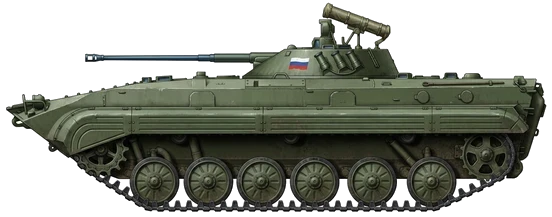
| Sub-type | Infantry Fighting Vehicle |
| Crew | 3 (commander, gunner, driver) + 7 troops personnels |
| Range | 600 km |
| Mass | 14.3 tons |
| Height | 2.45 m (8.0 ft) |
| Width | 3.15 m (10.3 ft) |
| Length | 6.72 m (22.0 ft) |
| Max. speed | 65 km/h (40 mph) |
| Engine | UTD-23 diesel, 300 hp |
| Weapon 1 | 2A42 30mm autocannon |
| Weapon 2 | 9P135M ATGM launcher (9M113 Konkurs) |
| Weapon 3 | PKT 7.62mm coaxial machine gun |
Description
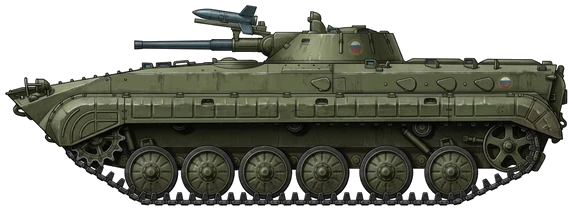
The BMP-2 is an amphibious infantry fighting vehicle developed by the Soviet Union and introduced in the 1980s as a successor to the BMP-1. Development began in 1972 after the armament of the BMP-1, including the 2A28 Grom and the 9M14 Malyutka missile system, was deemed obsolete. Observations from the 1973 Arab-Israeli War confirmed that the earlier design was vulnerable to .50 caliber machine-gun fire and recoilless rifles, while its main gun lacked accuracy beyond 500 meters. Following technical evaluations in Syria in 1974, Soviet designers prioritized an enlarged turret and improved firepower, leading to the adoption of the BMP-2.
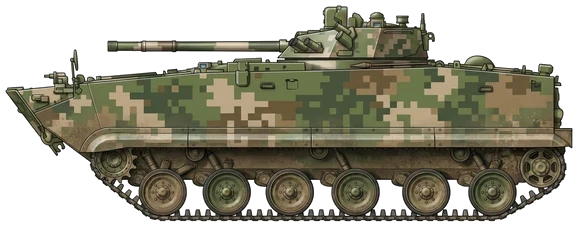
The vehicle is constructed with a welded steel hull and features a two-man turret seating both the commander and the gunner. Its primary armament is the stabilized 2A42 30mm autocannon, which utilizes dual ammunition feeds for armor-piercing and high-explosive rounds. The cannon has a selectable rate of fire and a high elevation angle of 74 degrees, enabling use against helicopters and slow-flying aircraft. For anti-tank capabilities, the vehicle is equipped with a roof-mounted 9P135M launcher capable of firing 9K111 Fagot and 9M113 Konkurs missiles. Secondary armament consists of a coaxial 7.62mm PKT machine gun. The internal layout accommodates a crew of three and seven infantrymen. The driver is positioned at the front left, with the engine compartment to the right.
Mobility is provided by a tracked chassis with amphibious capabilities, using hydrodynamic fairings to generate propulsion in water. The armor provides protection against 23mm armor-piercing rounds on the frontal arc and 7.62mm rounds on the sides. Operational experience in the Soviet-Afghan War led to the BMP-2D variant, which features appliqué steel armor and increased mine protection, though these additions negate amphibious performance. Modernized variants, such as the BMP-2M Berezhok, incorporate improved fire control systems, automatic grenade launchers, and Kornet-M missile launchers.
The BMP-2 is widely exported and operates in several countries across Europe, Asia, and Africa. India produces the vehicle under license as the Sarath and has developed numerous specialized versions, including armored ambulances and reconnaissance vehicles. The BMP-2 has an extensive combat history, including the Soviet-Afghan War, the Iran-Iraq War, and the Gulf War. It has been used by multiple factions in the Syrian Civil War and is deployed by both sides in the Russo-Ukrainian War. Significant numbers have been visually confirmed as lost in recent conflicts. Other operators include Algeria, Angola, Belarus, Kazakhstan, and several former Warsaw Pact nations.
Frequently Asked Questions
What type of vehicle is the BMP-2?
What is the weight of the BMP-2?
What is the maximum speed of the BMP-2?
What is the operational range of the BMP-2?
How many crew members does the BMP-2 require?
How many BMP-2 have been built?
What weapons does the BMP-2 carry?
- SEP 42026 Verified Weight verified against the published specifications
- JUL 272026 Updated Number built added
- MAR 242026 Created Page created: BMP-2