BMP-2 vs BMP-3
BMP-2 vs BMP-3 at a glance — weight 14,300 vs 18,700 kg, top speed 65 vs 72 km/h, range 600 vs 600 km, crew 3 (commander, gunner, driver) + 7 troops vs 3 (commander, gunner, driver) + 7 troopers (+ 2 additional seats).
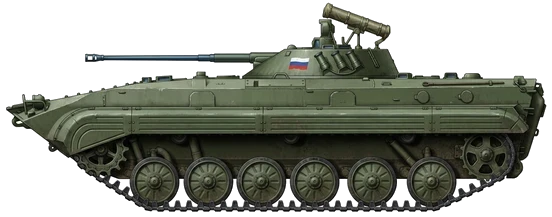
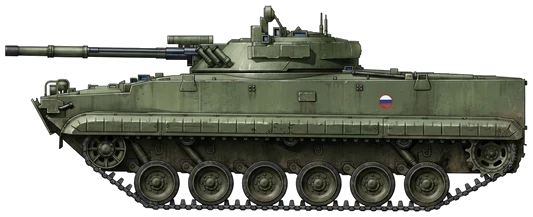
| BMP-2 | BMP-3 | |
|---|---|---|
| Origin country | 🇷🇺 Russia | 🇷🇺 Russia |
| Category | Infantry Fighting Vehicle | Infantry Fighting Vehicle |
| Type | Infantry Fighting Vehicle | Infantry fighting vehicle |
| Manufacturer | Kurganmashzavod | Kurganmashzavod |
| Number produced | 20,000 units | 2,000 units |
| Estimated unit price | $-- million | $3.2 million |
| Combat weight | 14.3 tons | 18.7 tons |
| Maximum speed | 65 km/h | 72 km/h |
| Operational range | 600 km | 600 km |
| Length | 6.72 m | 7.14 m |
| Width | 3.15 m | 3.20 m |
| Height | 2.45 m | 2.40 m |
| Crew | 3 (commander, gunner, driver) + 7 troops | 3 (commander, gunner, driver) + 7 troopers (+ 2 additional seats) |
Detailed Comparison
The Kurganmashzavod BMP-2 utilizes a conventional two-man turret and a 30mm autocannon, optimized for mass production and infantry support. The BMP-3 abandons this layout for an aluminum hull and a 100mm/30mm turret, prioritizing organic fire support. With 20,000 BMP-2s built since 1980 compared to 2,000 BMP-3s since 1987, the two vehicles mark a structural shift in Soviet mechanization strategy.
Development and Design
Following the 1973 Yom Kippur War, Soviet analysts identified the BMP-1's 73mm gun as inadequate. The 1980 BMP-2 addressed this with the high-elevation 2A42 30mm cannon to engage infantry and helicopters. The 1987 BMP-3 derived from the Obyekt 685 light tank, adopting a rear-engine layout. This design forces dismounting infantry to climb over the UTD-29M engine block, a severe ergonomic penalty compared to the BMP-2’s rear doors, in exchange for accommodating a massive central armament complex.
Protection and Firepower
The BMP-3 outweighs the BMP-2 by 4.4 tons and utilizes aluminum alloy supplemented by steel. This gives the BMP-3 frontal resistance against 30mm rounds at 200 meters, whereas the welded-steel BMP-2 stops 23mm rounds. Both vehicles suffer catastrophic ammunition detonations when penetrated.
Armament differences dictate their doctrines:
- BMP-2: Relies on the 30mm 2A42 autocannon and an exposed 9P135M launcher for 9M113 Konkurs ATGMs.
- BMP-3: Combines a 100mm 2A70 rifled gun (firing HE-FRAG and 9M117 Bastion ATGMs) with a coaxial 30mm 2A72 autocannon.
The BMP-3's Sodema sights allow nighttime engagements, while base-model BMP-2s are restricted to active infrared systems unless modernized to the Berezhok standard.
Mobility and Logistics
The BMP-3's 500-hp diesel yields 26.7 hp/ton, driving it to 72 km/h. The BMP-2's 300-hp engine delivers 21 hp/ton and 65 km/h. Both achieve a 600 km range. The BMP-3 uses water-jets for amphibious operations, handling currents better than the BMP-2's track-driven propulsion. Logistically, the BMP-2 is simpler to maintain; the BMP-3's tightly packed rear engine complicates field repairs, and its aluminum hull requires specialized welding.
Deployment and Combat Record
The BMP-2 has operated in Afghanistan, Iraq, Syria, and Ukraine. Its thin side armor forced crews to improvise slat armor in urban combat. The BMP-3 saw combat in Chechnya, Yemen, and Ukraine. In the Russo-Ukrainian War, Russian forces frequently relegate the BMP-3 to indirect fire, using its 100mm gun as a light howitzer rather than risking its explosive ammunition carousel in direct assaults. Both vehicles exhibit low crew survivability against modern FPV drones, leading to severe attrition.
Conclusion
The BMP-3 holds the edge in offensive firepower. Its 100mm gun destroys fortified positions that the BMP-2's 30mm cannon cannot penetrate. However, as an infantry transport, the BMP-2 is the better vehicle. Its standard rear doors allow infantry to dismount rapidly under fire. The BMP-3 forces troops to crawl over a hot engine deck, exposing them to small arms. For operations prioritizing infantry deployment, the BMP-2 remains the superior design, while the BMP-3 functions more effectively as an infantry support tank.