HMMWV (Humvee) vs JLTV
HMMWV (Humvee) vs JLTV at a glance — weight 2,676 vs 10,200 kg, top speed 89 vs 110 km/h, range 480 vs 480 km, crew 4 vs —.
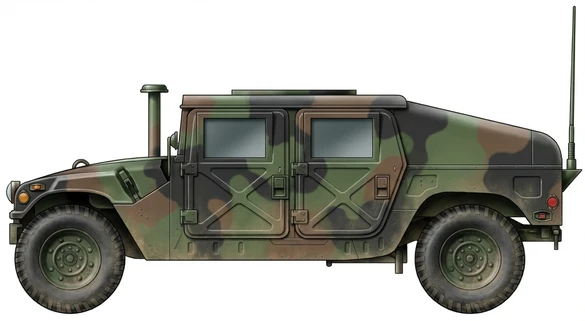
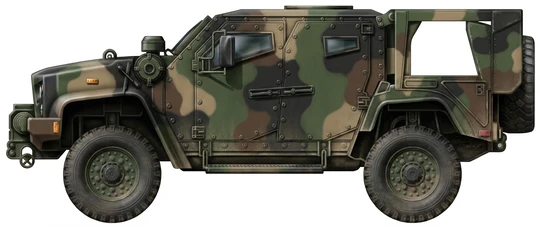
| HMMWV (Humvee) | JLTV | |
|---|---|---|
| Origin country | 🇺🇸 United States | 🇺🇸 United States |
| Category | Protected Mobility Vehicle | Protected Mobility Vehicle |
| Type | Light Utility Vehicle | Light utility/combat multi-role vehicle |
| Manufacturer | AM General | AM General |
| Number produced | 230,000 units | 20,000 units |
| Estimated unit price | $0.2 million | $0.4 million |
| Combat weight | 2.7 tons | 10.2 tons |
| Maximum speed | 89 km/h | 110 km/h |
| Operational range | 480 km | 480 km |
| Length | 4.57 m | 6.20 m |
| Width | 2.16 m | 2.50 m |
| Height | 1.83 m | 2.60 m |
| Crew | 4 | 1 + 3 in individual seats + optional gunner |
| HMMWV (Humvee) | JLTV | |
|---|---|---|
| Main armament | M2HB .50 cal machine gun | M2 Browning .50 Caliber heavy machine gun |
| Secondary weapon | Mk 19 grenade launcher | M153 CROWS II remote weapon system |
| Engine | 6.5L V8 turbo-diesel | 6.6 L Gale Banks Engineering 866T V8 (based on General Motors Duramax L5P) |
Detailed Comparison
At a combat weight of 2.67 tons and a unit cost of $220,000, the AM General HMMWV was engineered in the late 1970s as an unarmored utility replacement for the M151 jeep. Conversely, the 10.2-ton, $399,000 Joint Light Tactical Vehicle (JLTV) emerged from the Iraq War's IED crisis, designed from the onset to merge MRAP-level survivability with tactical mobility.
Development and Design
The HMMWV originated from a 1979 specification for a common multi-role chassis. It relies on a steel frame with a low center of gravity, placing the drivetrain between the boxed frame rails. The JLTV, initiated in 2006, abandoned the light utility concept. Oshkosh built the vehicle around the CORE 1080 crew protection system. The JLTV quadruples the combat weight of the baseline Humvee to accommodate modular A-kit and B-kit armor, integrated energy-absorbing floors, and blast-deflecting hull geometry.
Protection and Firepower
Armor dictates the divergence between these platforms. The baseline HMMWV is unarmored aluminum. Post-2003 adaptations like the M1114, Armor Survivability Kit (ASK), and FRAG kits added hardened steel and ballistic glass, but these bolted-on solutions strained the double-wishbone suspension and failed to mitigate underbody blasts. The JLTV integrates V-hull blast protection at the chassis level. Weaponry is largely identical across both platforms, reliant on the payload rather than the vehicle:
- M2HB .50 caliber machine gun
- Mk 19 grenade launcher
- BGM-71 TOW missile launcher
The JLTV incorporates digital architecture for network connectivity, including the M153 CROWS II and the MADIS short-range air defense system, whereas the HMMWV relies on manual ring mounts or earlier CROWS variants.
Mobility and Logistics
The JLTV reaches 110.0 km/h compared to the HMMWV's 89.0 km/h, propelled by a 6.6-liter Gale Banks V8 turbodiesel. The TAK-4i independent suspension with adjustable ride height yields 50 centimeters of wheel travel, exceeding the HMMWV's capabilities over rough terrain. However, the JLTV's 10.2-ton weight imposes logistical penalties. While both fit inside a C-130 and can be underslung by CH-47 and CH-53E helicopters, the JLTV stresses rotary-wing lift margins in high-altitude or hot-weather conditions. The HMMWV's mechanical simplicity and 230,000-unit production run ensure a global supply chain that outpaces the JLTV's 20,000 units.
Deployment and Combat Record
The HMMWV debuted in the 1989 invasion of Panama and Desert Storm. In Iraq and Afghanistan, its flat bottom concentrated blast energy into the crew cabin, forcing the U.S. to field heavy MRAPs. In Ukraine, up-armored HMMWVs are currently utilized for rapid mechanized assaults and medical evacuation, where losses occur but the vehicles remain readily replaceable. The JLTV saw recent combat with the Israel Defense Forces in Gaza, validating its urban survivability against anti-tank mines and RPGs.
Conclusion
The JLTV is the necessary platform for frontline mechanized infantry and cavalry scouts facing explosive hazards. Its integrated V-hull and active suspension solve the payload and survivability limits of the up-armored HMMWV. However, the HMMWV retains the advantage in rear-echelon logistics, allied military aid, and light infantry support. The JLTV is too heavy for universal utility roles, ensuring the HMMWV remains in global arsenals until 2050, despite the JLTV's protection advantages in direct combat.