Continental AVDS 1790 V-12 Diesel Engine with 1500 hp
Detailed Comparison
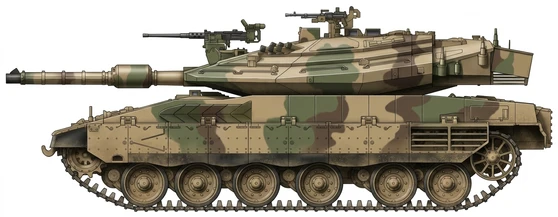
South Korea’s 55-ton K2 Black Panther prioritizes high-mobility maneuver warfare and international exportability, while Israel’s 72-ton Merkava Mk. 4 prioritizes localized urban survivability and crew protection. South Korea engineered the K2 to navigate the mountainous Korean peninsula and secure indigenous production lines to bypass export controls. Israel structured the Merkava around its crew, placing the engine at the front to serve as a ballistic shield against asymmetric threats.
Development and Design
The K2 originated in 1995 to replace the Republic of Korea Army's M48 Patton fleet. Hyundai Rotem utilized a three-man crew and a bustle-mounted autoloader to compress the vehicle's internal volume. The Merkava Mk. 4, unveiled in 2002 by MANTAK, retains a four-man crew with a human loader, assisted by an automated dual-drum revolving magazine. The IDF’s retention of the fourth crew member aligns with combat observations requiring additional manpower for track maintenance, perimeter security, and operation of the tank's internal 60mm mortar.
Protection and Firepower
The K2 mounts a 120mm 55-caliber smoothbore gun firing the KSTAM fire-and-forget top-attack munition to strike thinner roof armor from high trajectories. The Merkava Mk. 4 relies on a 120mm smoothbore capable of firing LAHAT anti-tank missiles.
Defensive architectures diverge sharply:
Merkava Mk. 4: Integrates the Trophy hard-kill active protection system (APS) to physically intercept incoming projectiles.
K2 Black Panther: Utilizes a soft-kill APS (multispectral smoke and radar jamming) alongside MIL-12560H steel and ERA.
The lack of a hard-kill APS on current-production K2s is an operational vulnerability against modern ATGMs and loitering munitions, a gap South Korea is actively addressing with domestic hard-kill development.
Mobility and Logistics
The K2 reaches 70.0 km/h with an operational range of 430 km, powered by a 1,500 hp diesel engine. Its in-arm suspension unit (ISU) allows independent bogie control to tilt the chassis, artificially depressing the gun for hull-down positions in steep terrain. The 72-ton Merkava utilizes a 1,500 hp V12 diesel, topping out at 64.0 km/h with a 500 km range. The K2’s 17-ton weight deficit allows it to cross standard bridges and utilize commercial heavy equipment transporters. The Merkava's mass restricts its logistical footprint to specialized, reinforced infrastructure.
Deployment and Combat Record
The IDF deployed the Merkava Mk. 4 during the 2006 Lebanon War and the 2023–2024 Gaza operations. In Gaza, the Trophy APS routinely intercepted tandem-warhead RPGs and Kornet missiles, forcing adversaries to rely on improvised explosive devices and drone-dropped munitions. The K2 has not entered combat. However, its modularity and production capacity secured a large-scale export contract with the Polish Land Forces, contrasting with Israel’s domestic focus for the Merkava series.
Conclusion
Urban and Asymmetric Warfare: The Merkava Mk. 4 is the superior platform. Its Trophy APS, front-mounted engine, and internal mortar provide a hardened defensive envelope against infantry-borne anti-tank weapons in confined environments.
Conventional Maneuver Warfare: The K2 Black Panther holds the advantage. Its lower combat weight, longer 55-caliber gun, and hydropneumatic suspension allow for rapid operational mobility and hull-down engagements, making it the practical choice for militaries requiring deployable armor across standard European or Asian infrastructure.