K2 Black Panther vs Leopard 2
K2 Black Panther vs Leopard 2 at a glance — weight 55,000 vs 62,500 kg, top speed 70 vs 70 km/h, range 430 vs 340 km, crew 3 vs 4.
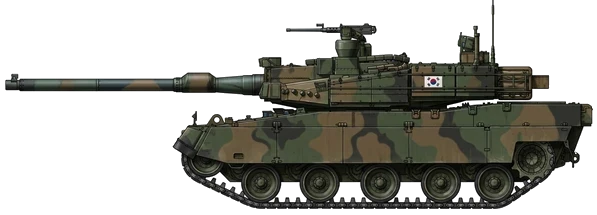
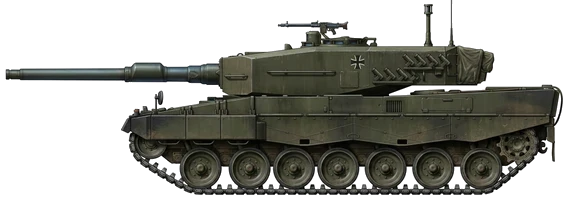
| K2 Black Panther | Leopard 2 | |
|---|---|---|
| Origin country | 🇰🇷 South Korea | 🇩🇪 Germany |
| Category | Main Battle Tank | Main Battle Tank |
| Type | Heavy Main Battle Tank | Heavy Main Battle Tank |
| Manufacturer | Hyundai Precision / Sangyong Heavy Industries | Krauss-Maffei |
| Number produced | 440 units | 3,600 units |
| Estimated unit price | $8.5 million | $29 million |
| Combat weight | 55.0 tons | 62.5 tons |
| Maximum speed | 70 km/h | 70 km/h |
| Operational range | 430 km | 340 km |
| Length | 10.80 m | 9.97 m |
| Width | 3.60 m | 3.76 m |
| Height | 2.40 m | 3.00 m |
| Crew | 3 | 4 |
| K2 Black Panther | Leopard 2 | |
|---|---|---|
| Main armament | 1 120mm gun | Rheinmetall 120 mm L/55 |
| Secondary weapon | K-6 12.7mm machine gun | 7.62 mm MG3A1 or 7.62 mm FN MAG |
| Engine | Diesel Engine with 1500 hp | MTU MB 873 MTCA Diesel Engine with 1500 hp |
Detailed Comparison
The South Korean K2 Black Panther (fielded 2014) and the German Leopard 2 (fielded 1979) represent distinct generations of heavy main battle tank design. While the Leopard 2 was developed to counter Soviet armor on European plains, the K2 was engineered by the Agency for Defense Development specifically for the mountainous terrain of the Korean Peninsula and network-centric warfare.
Development and Design
Hyundai Rotem manufactures the K2, utilizing a three-man crew configuration facilitated by a bustle-type autoloader. This design choice eliminates the human loader, reducing internal volume requirements. Conversely, the Krauss-Maffei-built Leopard 2 operates with a traditional four-man crew and manual loading. The Leopard 2 design has evolved through variants; early models featured vertical turret armor, while the A5 and subsequent versions integrated arrow-shaped appliqué armor. The K2, entering development in 1995, integrated fourth-generation technologies such as non-line-of-sight engagement capabilities from the outset, whereas the Leopard 2 relies on iterative upgrades to its 1970s baseline architecture.
Protection and Firepower
Both platforms utilize a 120 mm smoothbore primary armament. The K2 mounts a CN08 55 caliber gun capable of firing the KSTAM (Korean Smart Top-Attack Munition), a fire-and-forget projectile targeting upper armor. Its fire control system incorporates pulsed Doppler radar for automatic target tracking. The Leopard 2 utilizes Rheinmetall L/44 or L/55 cannons, managed by a digital fire control system with advanced thermal imaging.
Protection on the K2 involves modular MIL-12560H steel, ceramics, ERA, and a soft-kill active protection system (APS). The Leopard 2 relies on spaced multilayer armor; while the turret features ammunition blow-off panels, the secondary hull ammunition storage lacks this isolation mechanism, posing a risk during hull penetration.
Mobility and Logistics
The K2 employs an In-arm Suspension Unit (ISU), allowing individual bogie control to adjust chassis height and tilt. This posture control aids gun elevation in mountainous topography. The Leopard 2 utilizes a standard torsion bar suspension system. Despite a similar 1500 hp output from their diesel engines, the K2 is lighter at 60.63 tons compared to the Leopard 2's 62.5 tons, resulting in a superior operational range of 430 km versus 340 km. Both vehicles possess deep-water fording capabilities; the K2 uses a snorkel system where the chassis takes in water for traction.
Deployment and Combat Record
The Leopard 2 has seen combat in Kosovo, Afghanistan (ISAF), Syria, and the Russo-Ukrainian War. In Afghanistan, it demonstrated resistance to IEDs, while Turkish operations in Syria highlighted vulnerabilities to ATGMs, necessitating armor upgrades. The K2 has not seen active combat but is deployed by the Republic of Korea Army and the Polish Land Forces. The K2 platform also served as the technological base for the Turkish Altay MBT.
Conclusion
The Leopard 2 provides a battle-proven platform with established logistics chains across numerous operator nations, making it suitable for coalition operations in open terrain. The K2 Black Panther offers superior terrain accessibility through its ISU and distinct targeting capabilities via radar and smart munitions. The K2 presents a specialized solution for modernized, terrain-restricted warfare, while the Leopard 2 remains a standard for heavy armor in conventional maneuver warfare.