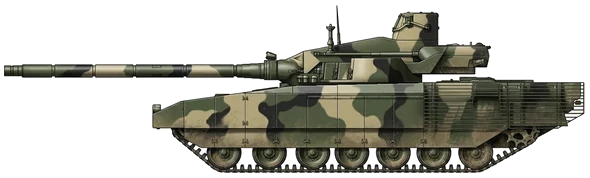
Russia’s T-14 Armata and China’s Type 100 isolate their three-man crews in heavily armored hull capsules beneath unmanned turrets, a structural departure from Cold War-era designs. While Uralvagonzavod relies on heavy armor and a 125mm gun, Baotou Tank Plant’s Type 100 accepts a smaller 105mm caliber and hybrid-electric drive to prioritize signature reduction and anti-drone defense.
Development and Design
The T-14 emerged from the canceled T-95 program, debuting in 2015 as the Object 148 on the Armata Universal Combat Platform. Its development stalled in low-rate initial production, constrained by Western sanctions on electronics and a $4.5 million unit cost. The Type 100 (ZTZ-100), debuting ten years later in 2025, reflects direct observations from the war in Ukraine. Chinese designers integrated hybrid diesel-electric propulsion to enable a low-thermal electric mode and incorporated native command-and-control links for unmanned ground vehicles and aerial drones.
Protection and Firepower
The T-14 mounts a 125mm 2A82-1M smoothbore gun firing Vacuum-1 APFSDS rounds and tube-launched ATGMs. It relies on Malachit dual-ERA and the Afganit active protection system (APS), which utilizes millimeter-wave radar to intercept conventional horizontal anti-tank munitions. The Type 100 adopts an autoloaded 105mm main gun. While Beijing claims advanced propellants achieve parity with 120mm systems, physics dictate a lower kinetic ceiling against heavily armored frontal arcs. Instead, the Type 100 updates its defensive architecture for drone-saturated battlefields:
Two GL-6 APS units with four launchers each, specifically calibrated for top-attack munitions and FPV drones
Four diagonal phased-array radars doubling as an emergency electronic warfare suite
Wearable augmented reality devices streaming 360-degree multi-band imagery to the encapsulated crew
Mobility and Logistics
Both vehicles generate 1,500 hp. The T-14’s 12N360 twin-turbo diesel pushes its 55-ton chassis to 90 km/h. While lighter than 70-ton Western MBTs, the Armata strains standard Russian rail and recovery logistics tailored for 45-ton T-72s. The Type 100’s hybrid powertrain and smaller 105mm gun indicate a strict weight limit, engineered for the structural capacities of bridges and amphibious landing craft in the Indo-Pacific theater.
Deployment and Combat Record
The T-14 underwent limited testing in Syria in 2020 and saw brief, indirect-fire deployment with Russia’s southern battlegroup in Ukraine. Rostec officially withdrew it from direct assault operations in 2024, citing prohibitive loss costs compared to expendable T-90Ms. The Type 100 enters service in 2025 with no combat record, untested outside of controlled People's Liberation Army exercises.
Conclusion
The Type 100 holds the edge in modern combat environments. The T-14 is a stranded asset: an armored breakthrough vehicle too expensive for the Russian military to risk in the attritional combat it was built for. By sacrificing main gun caliber for weight reduction, hybrid stealth, and native counter-UAS integration, the Type 100 provides a logistically viable platform adapted to contemporary top-attack threats, whereas the Armata remains an undeployable parade vehicle.