K2 Black Panther vs T-14 Armata
K2 Black Panther vs T-14 Armata at a glance — weight 55,000 vs 55,000 kg, top speed 70 vs 90 km/h, range 430 vs 500 km, crew 3 vs 3.
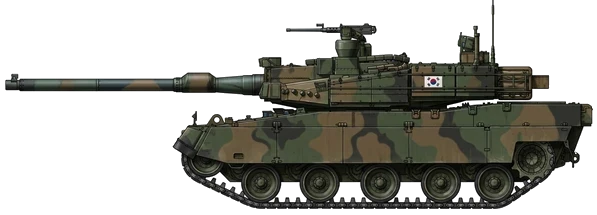
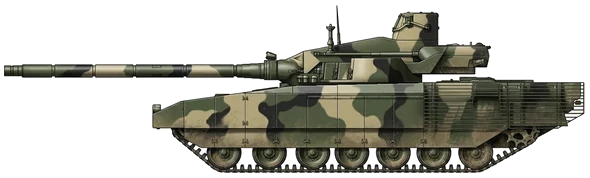
| K2 Black Panther | T-14 Armata | |
|---|---|---|
| Origin country | 🇰🇷 South Korea | 🇷🇺 Russia |
| Category | Main Battle Tank | Main Battle Tank |
| Type | Heavy Main Battle Tank | Main battle tank |
| Manufacturer | Hyundai Precision / Sangyong Heavy Industries | Uralvagonzavod |
| Number produced | 440 units | -- units |
| Estimated unit price | $8.5 million | $4.5 million |
| Combat weight | 55.0 tons | 55.0 tons |
| Maximum speed | 70 km/h | 90 km/h |
| Operational range | 430 km | 500 km |
| Length | 10.80 m | 10.70 m |
| Width | 3.60 m | 3.50 m |
| Height | 2.40 m | 3.30 m |
| Crew | 3 | 3 |
| K2 Black Panther | T-14 Armata | |
|---|---|---|
| Main armament | 1 120mm gun | 2A82-1M 125 mm smoothbore cannon |
| Secondary weapon | K-6 12.7mm machine gun | 12.7 mm Kord machine gun (6P49) |
| Engine | Diesel Engine with 1500 hp | 12N360 Twin Turbo Diesel 1,100 kW (1,500 hp) |
Detailed Comparison
South Korea’s K2 Black Panther and Russia’s T-14 Armata diverge fundamentally in engineering maturity and industrial execution. While the K2 is a serialized production vehicle actively filling out NATO front lines through export agreements, the T-14 remains constrained by Russian industrial bottlenecks, existing primarily as a testbed despite its radical architectural departure from legacy Soviet platforms.
Development and Design
Hyundai Rotem developed the K2 to break reliance on foreign designs, yielding a conventional fourth-generation platform optimized for the Korean peninsula. It incorporates a bustle-type autoloader and a three-man crew in a standard turret. Uralvagonzavod’s T-14 abandons the T-72/90 evolutionary path, moving the crew into an armored hull capsule and utilizing a completely unmanned turret. This design maximizes crew survivability against direct hull strikes but introduces severe situational awareness limitations if the external sensor suites sustain shrapnel damage. Industrial realities separate the two: Seoul has built 440 K2s with localized Polish production underway, whereas the T-14 languishes in limited pre-production.
Protection and Firepower
The T-14 mounts the 125 mm 2A82-1M cannon, designed to fire the Vacuum-1 APFSDS round. Its protection relies on the crew capsule, Malachit dual-ERA, and the Afganit APS, utilizing millimeter-wave radar for hard-kill interception. The K2 operates the CN08 120 mm 55-caliber smoothbore gun, integrating multiple munitions:
- K279 self-sharpening tungsten penetrators for anti-armor engagements
- KSTAM fire-and-forget top-attack projectiles, exploiting the roof armor vulnerabilities demonstrated heavily in Ukraine
- K280 multi-purpose HEAT rounds with proximity fuses
Unlike the T-14's reliance on a theoretically impenetrable capsule, the K2 maintains a balanced survivability profile that does not blind the crew if external optics are destroyed.
Mobility and Logistics
Both vehicles weigh 55.0 tons and utilize 1,500 hp diesel engines, yielding identical power-to-weight ratios of 27.2 hp/ton. The T-14 lists a 90.0 km/h top speed against the K2’s 70.0 km/h. However, the T-14 is powered by the complex 12N360 X-shaped diesel engine, which has documented thermal management issues. The K2 utilizes an in-arm suspension unit (ISU) allowing the chassis to tilt or kneel, manipulating gun elevation and depression for mountainous or urban engagements. The K2's logistical footprint is supported by established supply chains, while the T-14's maintenance burden remains speculative.
Deployment and Combat Record
The K2 forms the mechanized backbone of the Republic of Korea Army and the Polish Land Forces, currently utilized in high-readiness deterrence postures. The T-14 underwent isolated testing in Syria in 2020. During the 2022 invasion of Ukraine, the Russian Ministry of Defense deployed T-14s strictly for indirect fire and rear-echelon evaluation before withdrawing them in 2024. Russian officials cited the $4.5 million unit cost as justification for avoiding direct assault operations, rendering the platform unsuitable for attrition warfare.
Conclusion
The K2 Black Panther is the superior main battle tank because it functions as a deployable, serialized weapon system. The T-14 Armata wins strictly on theoretical crew survivability due to its armored capsule, making it a valuable conceptual testbed. However, a tank that cannot be mass-produced or risked in direct combat holds zero tactical value. The K2 holds the edge in any real-world scenario, offering immediate NATO interoperability, specialized mobility for complex terrain, and the industrial backing to sustain high-intensity operations.