Leopard 2 vs T-14 Armata
Leopard 2 vs T-14 Armata at a glance — weight 62,500 vs 55,000 kg, top speed 70 vs 90 km/h, range 340 vs 500 km, crew 4 vs 3.
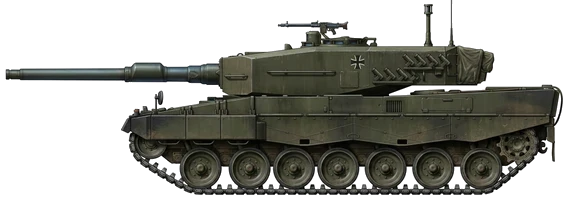
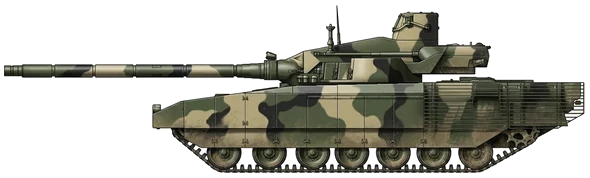
| Leopard 2 | T-14 Armata | |
|---|---|---|
| Origin country | 🇩🇪 Germany | 🇷🇺 Russia |
| Category | Main Battle Tank | Main Battle Tank |
| Type | Heavy Main Battle Tank | Main battle tank |
| Manufacturer | Krauss-Maffei | Uralvagonzavod |
| Number produced | 3,600 units | -- units |
| Estimated unit price | $29 million | $4.5 million |
| Combat weight | 62.5 tons | 55.0 tons |
| Maximum speed | 70 km/h | 90 km/h |
| Operational range | 340 km | 500 km |
| Length | 9.97 m | 10.70 m |
| Width | 3.76 m | 3.50 m |
| Height | 3.00 m | 3.30 m |
| Crew | 4 | 3 |
| Leopard 2 | T-14 Armata | |
|---|---|---|
| Main armament | Rheinmetall 120 mm L/55 | 2A82-1M 125 mm smoothbore cannon |
| Secondary weapon | 7.62 mm MG3A1 or 7.62 mm FN MAG | 12.7 mm Kord machine gun (6P49) |
| Engine | MTU MB 873 MTCA Diesel Engine with 1500 hp | 12N360 Twin Turbo Diesel 1,100 kW (1,500 hp) |
Detailed Comparison
The T-14 Armata utilizes a fourth-generation uncrewed turret configuration aimed at maximizing crew survivability through isolation, whereas the Leopard 2 follows a traditional third-generation layout with a four-person crew and manual loading. While the Russian platform emphasizes automation, active protection, and reduced weight, the German vehicle utilizes established passive armor arrays and a heavier chassis design validated through decades of service.
Development and Design
Developed by Uralvagonzavod following the cancellation of the T-95, the T-14 Armata is built on the Armata Universal Combat Platform. Its primary structural innovation is an internal armored capsule at the hull front, housing the three-man crew separately from the fuel and ammunition. In contrast, the Leopard 2 entered service in 1979 as a successor to earlier West German models. It retains a conventional layout with the commander, gunner, and loader positioned in the turret. Over four decades, the design evolved from vertical turret armor to the angled, arrow-shaped appliqué armor introduced in the A5 and subsequent variants.
Protection and Firepower
The T-14 mounts a 2A82-1M 125 mm smoothbore cannon in an unmanned turret, utilizing an autoloader to fire Vacuum-1 APFSDS rounds and guided missiles like the 3UBK21 Sprinter. Protection relies on composite materials, Malachit dual-explosive reactive armor (ERA), and the Afganit active protection system (APS) designed to intercept incoming munitions. The Leopard 2 employs a Rheinmetall 120 mm smoothbore gun (L/44 or L/55), manually loaded from a turret bustle equipped with blow-off panels to mitigate ammunition detonation risks. Its defense centers on spaced multilayer composite armor, reinforced by modular upgrades and belly protection against mines, though it generally lacks integrated hard-kill APS in standard configurations.
Mobility and Logistics
Weighing 55.0 tons, the T-14 is lighter than the 62.5-ton Leopard 2, contributing to a higher maximum speed of 90.0 km/h compared to the Leopard's 70.0 km/h. Both vehicles utilize 1,500 hp diesel engines—the 12N360 twin-turbo for the T-14 and the MTU MB 873 for the Leopard—but the Russian tank offers a greater operational range of 500 km versus 340 km. The T-14 uses a 12-speed automatic transmission and active suspension, while the Leopard 2 employs a torsion bar system known for deep-water fording capabilities.
Deployment and Combat Record
The Leopard 2 has seen extensive use by over a dozen nations. It first saw action in Kosovo, followed by combat in Afghanistan (ISAF) and Syria. Since 2023, Leopard 2s have engaged in high-intensity offensive operations in Ukraine. Conversely, the T-14 has produced limited numbers. It underwent testing in Syria in 2020 and saw brief usage in Ukraine for indirect fire and assessment, but was withdrawn without participating in direct assault operations due to preservation concerns and unit costs.
Conclusion
The Leopard 2 remains a verified platform for high-intensity warfare, supported by a vast international logistical network and combat data against modern threats. Its manual loading and heavier armor profile favor defensive endurance and sustained fire support. The T-14 represents a shift toward automated survivability and mobility, theoretically superior in range and speed. However, its unproven reliability in direct engagements and limited production numbers currently restrict it to a specialized role rather than the backbone capability provided by the German platform.