M1 Abrams vs T-14 Armata
M1 Abrams vs T-14 Armata at a glance — weight 66,800 vs 55,000 kg, top speed 72 vs 90 km/h, range 426 vs 500 km, crew 4 (commander, gunner, loader, driver) vs 3.
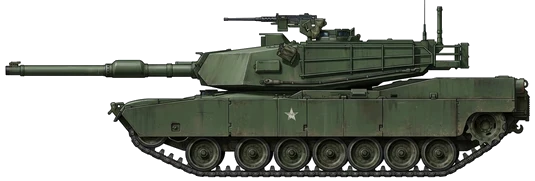
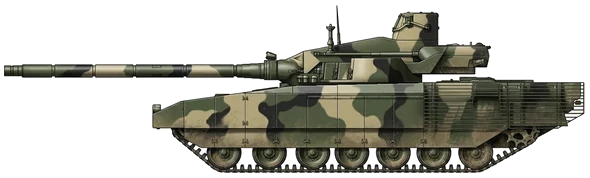
| M1 Abrams | T-14 Armata | |
|---|---|---|
| Origin country | 🇺🇸 United States | 🇷🇺 Russia |
| Category | Main Battle Tank | Main Battle Tank |
| Type | Heavy Main Battle Tank | Main battle tank |
| Manufacturer | General Dynamics Corp. | Uralvagonzavod |
| Number produced | 10,300 units | -- units |
| Estimated unit price | $8.5 million | $4.5 million |
| Combat weight | 66.8 tons | 55.0 tons |
| Maximum speed | 72 km/h | 90 km/h |
| Operational range | 426 km | 500 km |
| Length | 9.77 m | 10.70 m |
| Width | 3.66 m | 3.50 m |
| Height | 2.44 m | 3.30 m |
| Crew | 4 (commander, gunner, loader, driver) | 3 |
| M1 Abrams | T-14 Armata | |
|---|---|---|
| Main armament | 120 mm L/44 M256 smoothbore gun (40 rounds) | 2A82-1M 125 mm smoothbore cannon |
| Secondary weapon | 1 × 0.50 caliber (12.7 mm) M2HB heavy machine gun with 900 rounds | 12.7 mm Kord machine gun (6P49) |
| Engine | Honeywell AGT1500 multi-fuel turbine engine 1,500 shp (1,120 kW) | 12N360 Twin Turbo Diesel 1,100 kW (1,500 hp) |
Detailed Comparison
The Russian T-14 Armata and American M1 Abrams utilize fundamentally different design architectures reflecting their respective generations. The T-14, entering service in 2024, employs a fourth-generation layout with an unmanned turret and isolated crew capsule. The M1 Abrams, in service since 1980, retains a traditional third-generation configuration with a manned turret and manual loading for the commander, gunner, and loader. While the Abrams has been produced in quantities exceeding 10,000 units, the T-14 exists only in limited numbers.
Development and Design
General Dynamics Land Systems (originally Chrysler Defense) developed the M1 Abrams to replace the M60, prioritizing crew survivability and mobility. It incorporated a multi-fuel turbine engine and Chobham composite armor. The T-14 Armata, manufactured by Uralvagonzavod, emerged from the Object 148 project after the cancellation of the T-95. Built on the Armata Universal Combat Platform, its primary structural deviation is the placement of the three-man crew in an internal armored capsule at the hull front, physically separated from the fuel and ammunition to increase survivability probabilities in the event of armor penetration.
Protection and Firepower
The T-14 mounts a 2A82-1M 125 mm smoothbore cannon fed by an autoloader, capable of firing Vacuum-1 APFSDS rounds and guided missiles like the 3UBK21 Sprinter. Its protection suite integrates Malachit dual-explosive reactive armor (ERA) and the Afganit active protection system (APS), which uses radar to intercept incoming projectiles. The M1 Abrams utilizes a manually loaded 120 mm L/44 M256 smoothbore gun. Its passive defense relies on composite armor, upgraded in later variants with depleted uranium layers. While the T-14 relies on hard-kill APS and radar-absorbing materials for stealth, the M1 relies on heavy armor mass and blowout panels to vent ammunition explosions away from the crew.
Mobility and Logistics
The M1 Abrams is powered by a Honeywell AGT1500 turbine engine generating 1,120 kW (1,500 hp). This powerplant provides high torque but results in high fuel consumption, limiting range to 426 km. Its combat weight of 66.8 tons restricts transport across certain bridges and terrain. The T-14 uses a 12N360 twin-turbo diesel engine (1,100 kW) within a lighter 55.0-ton chassis. This configuration allows a superior maximum speed of 90.0 km/h compared to the Abrams' 72.0 km/h, and an extended operational range of 500 km. The T-14's active suspension system is designed to improve firing stability on the move.
Deployment and Combat Record
The M1 Abrams has seen extensive combat during the Gulf War, Iraq War, and operations in Afghanistan and Yemen. In the Russo-Ukrainian War, Ukrainian forces deploy the M1A1SA variant. The T-14 Armata has limited operational history. Following field tests in Syria, the vehicle saw restricted use by Russia's southern battlegroup in Ukraine for indirect fire and command assessments. Russian defense officials confirmed in 2024 that the T-14 was withdrawn from the frontline and not used in direct assault roles due to the financial risk associated with its $7.1 million unit cost.
Conclusion
The M1 Abrams represents a verified heavy armor capability with established logistics chains and combat effectiveness in high-intensity conflicts. Its design prioritizes passive protection and immediate firepower through a larger crew. The T-14 Armata offers a theoretical advantage in mobility, automation, and crew safety via its capsule design. However, the Abrams remains the standard for force projection due to production volume and reliability, while the T-14 currently functions as a specialized, high-cost asset rather than a ubiquitous main battle tank.