T-54 / T-55 / TM-800 vs T-62 / TR-580 / Tiran
T-54 / T-55 / TM-800 vs T-62 / TR-580 / Tiran at a glance — weight 36,500 vs 40,000 kg, top speed 50 vs 50 km/h, range 400 vs 450 km, crew 4 vs 4.
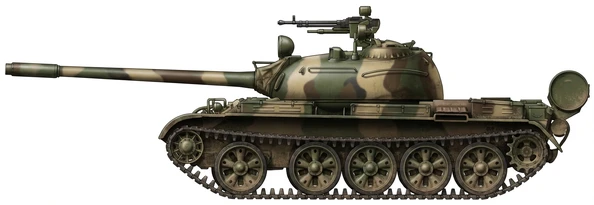
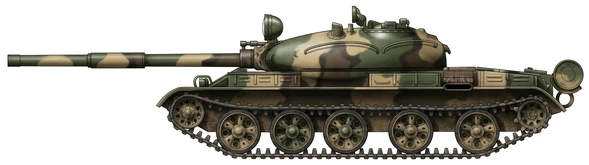
| T-54 / T-55 / TM-800 | T-62 / TR-580 / Tiran | |
|---|---|---|
| Origin country | 🇷🇺 Ex-USSR | 🇷🇺 Ex-USSR |
| Category | Main Battle Tank | Main Battle Tank |
| Type | Medium Main Battle Tank | Medium Main Battle Tank |
| Manufacturer | Malyshev HMB Plant | Malyshev HMB Plant |
| Number produced | 16,532 units | 6,142 units |
| Estimated unit price | $0.2 million | $0.3 million |
| Combat weight | 36.5 tons | 40.0 tons |
| Maximum speed | 50 km/h | 50 km/h |
| Operational range | 400 km | 450 km |
| Length | 9.00 m | 9.00 m |
| Width | 3.27 m | 3.30 m |
| Height | 2.40 m | 2.39 m |
| Crew | 4 | 4 |
| T-54 / T-55 / TM-800 | T-62 / TR-580 / Tiran | |
|---|---|---|
| Main armament | 1 D-10T2S 100mm rifled barrel (34 shells) gun | 1 2A20 Sheksna 115mm smoothbore barrel (40 shells) gun |
| Secondary weapon | 1 NSV 12.7mm machine gun (200 rounds) | 1 PKT 7.62mm coaxial machine gun (2500 rounds) |
| Engine | Diesel Engine with 690 hp | V-55-5 V-12 Diesel Engine with 580 hp |
Detailed Comparison
The T-54/55 series and the T-62 are Soviet-era medium tanks that transitioned Warsaw Pact armored doctrine into the Cold War. The T-54/55 established a baseline with a 100mm rifled gun, while the T-62 responded to Western armor upgrades by mounting a 115mm smoothbore gun on an elongated chassis.
Development and Design
The T-54 and T-55 emerged to replace the T-34 and T-44, with the T-55 integrating the PAZ NBC protection system for tactical nuclear environments. When Western Centurion and M48 tanks fielded thicker armor, the 100mm rifled gun lost its penetrative edge. The OKB-520 design bureau developed the T-62 in 1961 as a countermeasure. To fit the 115mm U-5TS weapon, engineers widened the turret ring and lengthened the hull, shifting the vehicle's center of gravity and eliminating the T-55's distinctive front road-wheel gap.
Protection and Firepower
The T-62's primary upgrade is the 115mm smoothbore gun, which fires APFSDS rounds capable of defeating early Cold War NATO armor. The T-54/55’s 100mm D-10T2S rifled gun struggled against those specific targets.
Base armor on both platforms relies on cast steel turrets and rolled homogeneous hull plates. Neither vehicle utilizes blowout panels, leading to low crew survivability upon penetration due to internal ammunition detonation. To survive modern battlefield threats, both tanks require modular upgrades:
- Explosive reactive armor (ERA) blocks like Kontakt-1
- Laser rangefinders and thermal optics
- Appliqué armor packages, such as the T-62M's BDD modules
Mobility and Logistics
Both vehicles reach 50.0 km/h utilizing torsion bar suspensions. The T-54/55 weighs 36.5 tons and, with a 690 hp diesel engine, achieves a higher power-to-weight ratio than the 40.0-ton T-62 powered by a 580 hp V-12 diesel. This yields superior acceleration and soft-ground performance for the T-55. The T-62's heavier hull and lower engine output stress its drivetrain, increasing maintenance requirements compared to the mechanically simpler T-54/55.
Deployment and Combat Record
Syrian and Egyptian forces operated both types during the 1973 Yom Kippur War; Israel later modified captured units into the Tiran series. Iraqi T-62s engaged Iranian armor in the 1980s and Coalition forces in 1991, suffering massive losses against modern thermal optics and kinetic munitions. In the Russo-Ukrainian War, both militaries employ reactivated T-55s and T-62M/MVs. Rather than serving as frontline maneuver assets, they operate as mobile pillboxes or indirect assault guns, providing fire support from standoff ranges to evade FPV drones and ATGMs.
Conclusion
The T-62 holds the edge in direct armored engagements strictly due to the kinetic penetration of its 115mm smoothbore gun. However, for asymmetric warfare and infantry support, the T-55 is the superior platform. Its lighter weight, 690 hp engine, and lower maintenance overhead make it a highly efficient motorized assault gun. The T-62’s heavier, underpowered chassis provides zero survivability advantage against modern top-attack munitions and drones, rendering its specific anti-armor optimizations largely obsolete in contemporary combat.