T-64 vs T-72
T-64 vs T-72 at a glance — weight 38,000 vs 44,500 kg, top speed 70 vs 60 km/h, range 500 vs 500 km, crew — vs —.
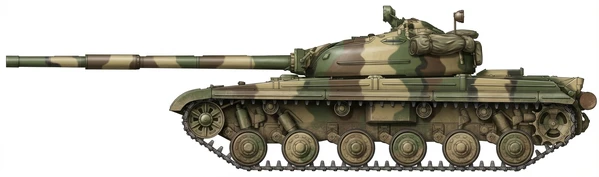
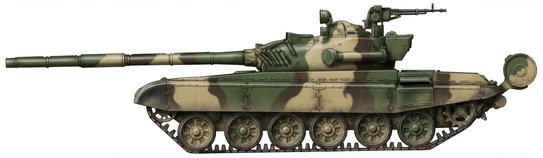
| T-64 | T-72 | |
|---|---|---|
| Origin country | 🇷🇺 Ex-USSR | 🇷🇺 Ex-USSR |
| Category | Main Battle Tank | Main Battle Tank |
| Type | Medium Main Battle Tank | Medium Main Battle Tank |
| Manufacturer | Malyshev HMB Plant | Malyshev HMB Plant |
| Number produced | 13,000 units | 25,000 units |
| Estimated unit price | $-- million | $2 million |
| Combat weight | 38.0 tons | 44.5 tons |
| Maximum speed | 70 km/h | 60 km/h |
| Operational range | 500 km | 500 km |
| Length | 9.22 m | 9.73 m |
| Width | 3.60 m | 3.59 m |
| Height | 2.17 m | 2.23 m |
| Crew | 3 (driver, commander, gunner) | 3 (commander, gunner, driver) |
Detailed Comparison
The T-64 and T-72 share a 125mm main armament, a three-man crew, and a carousel-style autoloader, yet they occupy entirely different tiers in Soviet and post-Soviet armored doctrine. The T-64 emerged in 1966 as a complex platform restricted to domestic units in critical zones, while the T-72 arrived in 1973 as a mass-production model designed for scale, lower unit cost, and global export.
Development and Design
The T-64 was the first Soviet tank to integrate composite armor and an autoloader, reducing the crew to three and capping combat weight at 38.0 tons. It utilized the 5TDF opposed-piston diesel engine, which allowed a compact hull but demanded rigorous maintenance. Uralvagonzavod developed the 44.5-ton T-72 specifically because the T-64's engine and suspension proved too complex and expensive for mass deployment. The T-72 reverted to a derivative of the V-2 engine series and implemented a simpler, more mechanically forgiving suspension system.
Protection and Firepower
Both tanks rely on the 125mm 2A46 series smoothbore gun. Differences in ammunition handling impact survivability:
- The T-64 utilizes the MZ autoloader, storing propellants vertically around the turret ring.
- The T-72 uses the AZ autoloader, storing propellants horizontally on the hull floor.
This ammunition storage layout remains a fatal design vulnerability in both platforms, causing catastrophic secondary explosions upon hull penetration, as widely documented in Chechnya, Syria, and Ukraine. Early T-64s held a base armor advantage, but late-model T-72s (such as the B3) eclipsed older T-64s through the integration of Relikt explosive reactive armor (ERA) and Sosna-U thermal imaging systems. Ukrainian T-64BV modernizations counter this by mounting Nizh ERA, designed to defeat tandem warheads.
Mobility and Logistics
The T-64's 850 hp 5TDFM engine achieves a top speed of 70.0 km/h compared to the base T-72's 60.0 km/h, though modernized T-72B3Ms equipped with 1,130 hp engines alter this ratio. Logistics distinctly favor the T-72. The T-64 requires specialized maintenance infrastructure and highly trained mechanics to service its opposed-piston powerplant. The T-72’s conventional V-block diesel engine is mechanically simpler, facilitating rapid field repairs and easier training for conscript or export operator forces.
Deployment and Combat Record
Moscow withheld the T-64 from the export market, assigning it primarily to the Group of Soviet Forces in Germany. It saw no combat until the 1992 Transnistria War. Today, it operates primarily as Ukraine's domestic MBT. Conversely, the USSR exported the T-72 to over 40 nations. Its combat record includes the 1982 Lebanon War, the Iran-Iraq War, Desert Storm, and Chechnya. In the Russo-Ukrainian War, both platforms suffer high attrition rates from top-attack munitions like FGM-148 Javelins and FPV drones, exposing their shared lack of roof protection.
Conclusion
The T-72 is the optimal vehicle for mass mobilization and export markets, where ease of maintenance and supply chain scale dictate operational tempo. Its mechanical reliability makes it the definitive choice for armies relying on conscript forces or lower-tier logistical support. The T-64 operates better as a localized platform for nations like Ukraine that possess the specific engineering infrastructure to sustain its demanding opposed-piston engine. The T-64 matches the T-72 in raw combat power, but the T-72's combination of baseline firepower and logistical simplicity makes it the better platform for prolonged, high-attrition wars.