M1 Abrams vs T-72
M1 Abrams vs T-72 at a glance — weight 66,800 vs 44,500 kg, top speed 72 vs 60 km/h, range 426 vs 500 km, crew — vs —.
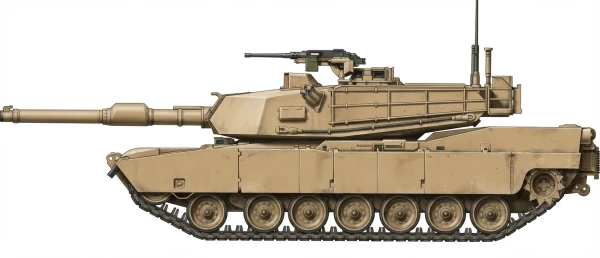
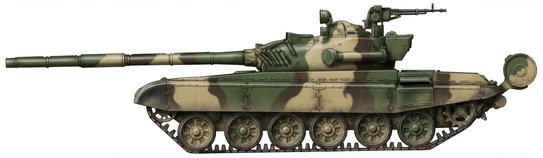
| M1 Abrams | T-72 | |
|---|---|---|
| Origin country | 🇺🇸 United States | 🇷🇺 Ex-USSR |
| Category | Main Battle Tank | Main Battle Tank |
| Type | Heavy Main Battle Tank | Medium Main Battle Tank |
| Manufacturer | General Dynamics Corp. | Malyshev HMB Plant |
| Number produced | 10,300 units | 25,000 units |
| Estimated unit price | $8.5 million | $2 million |
| Combat weight | 66.8 tons | 44.5 tons |
| Maximum speed | 72 km/h | 60 km/h |
| Operational range | 426 km | 500 km |
| Length | 9.77 m | 9.73 m |
| Width | 3.66 m | 3.59 m |
| Height | 2.44 m | 2.23 m |
| Crew | 4 (commander, gunner, loader, driver) | 3 (commander, gunner, driver) |
| M1 Abrams | T-72 | |
|---|---|---|
| Main armament | 120 mm L/44 M256 smoothbore gun (40 rounds) | 125 mm 2A46M-5 smoothbore gun |
| Secondary weapon | 1 × 0.50 caliber (12.7 mm) M2HB heavy machine gun with 900 rounds | 7.62 mm PKT coax. machine gun |
| Engine | Honeywell AGT1500 multi-fuel turbine engine 1,500 shp (1,120 kW) | V-92S2F (T-72B3 & T-72B3M) 1,130 hp (840 kW) |
Detailed Comparison
The T-72, introduced in 1973 by the Soviet Union, and the American M1 Abrams, fielded in 1980, constitute the primary heavy armor for numerous nations. While the T-72 functions as a lighter, mobilization-focused tank built in mass quantities (25,000 units) with a unit cost of $1.2 million, the M1 Abrams operates as a heavier, technically complex platform with a smaller production run (10,300 units) and a unit cost of roughly $10 million.
Development and Design
Conceived at Uralvagonzavod as Object 172, the T-72 evolved from the T-64 to provide a cost-effective alternative with improved engine reliability. It utilizes a three-person crew layout, enabled by an automated loading system that stores ammunition in a carousel at the hull bottom. In contrast, General Dynamics developed the M1 Abrams following the MBT-70 program cancellation. Entering service in 1980, the M1 prioritized crew survivability and advanced sensors, retaining a four-person crew (human loader) and incorporating compartmentalized ammunition storage with blowout panels to direct secondary explosions outward.
Protection and Firepower
The T-72 mounts a 125 mm 2A46M-5 smoothbore gun capable of firing ATGM munitions. Protection relies on composite armor supplemented by Explosive Reactive Armor (ERA). However, the internal ammunition carousel presents a structural vulnerability to catastrophic detonation upon hull penetration. The M1 Abrams utilizes the 120 mm L/44 M256 smoothbore gun (upgraded from the original 105 mm). Its protection utilizes Chobham composite armor, later reinforced with depleted uranium layers. The Abrams integrates advanced fire control systems, including the Commander's Independent Thermal Viewer on later variants, contrasting with the infrared illuminators found on earlier T-72 models.
Mobility and Logistics
Weighing 44.5 tons, the T-72 utilizes a V-92S2F diesel engine (1,130 hp), allowing a maximum speed of 60 km/h and deep wading capabilities via snorkel. Its lighter footprint facilitates rail transport and bridge crossing in Eastern European infrastructure. The M1 Abrams is substantially heavier at 66.8 tons, powered by a Honeywell AGT1500 multi-fuel turbine (1,500 hp). While this engine supports a higher top speed of 72 km/h, it reduces operational range to 426 km compared to the T-72's 500 km and increases fuel logistics requirements due to high consumption rates at idle.
Deployment and Combat Record
The T-72 has seen action in the Lebanon War, Chechen Wars, and Syrian Civil War. In the 1991 Gulf War, Iraqi T-72s sustained heavy losses against coalition armor. The M1 Abrams debuted in the Gulf War, maintaining a high exchange ratio against Soviet-era armor. Both platforms are currently active in the Russo-Ukrainian War, where modern anti-tank weapons and drone warfare have challenged conventional protection schemes for both vehicles.
Conclusion
The T-72 provides a logistical advantage for large-scale maneuvering forces requiring lower maintenance overhead and adherence to lower bridge weight limits. The M1 Abrams delivers superior kinetic protection, fire control, and crew survivability, favoring direct engagements where supply lines can support its high fuel consumption and maintenance demands.