Mi-35M
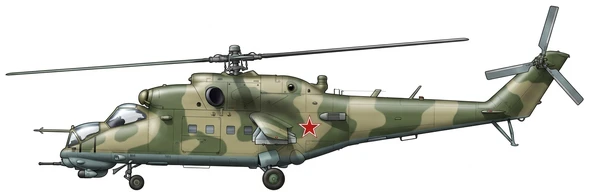
Soviet twin-engine helicopter gunship and low-capacity troop transport, introduced in the 1970s, used globally for close air support and transport operations. Key figures: top speed 320 km/h, range 450 km, service ceiling 5,750 m, max takeoff weight 12,000 kg.
| Crew | 3–4 |
| Length | 17.5 m (57.4 ft) |
| Wingspan | 17.2 m (56.4 ft) |
| Height | 6.5 m (21.3 ft) |
| Wing area | 227 m² (2443.4 sqft) |
| Empty weight | 8,500 kg (18,739 lbs) |
| Max. takeoff weight | 12,000 kg (26,455 lbs) |
| Powerplant | 2 × turboshafts Klimov VK-2500 1,790 kW each |
| Maximum speed | 320 km/h (199 mph) |
| Operational range | 450 km (280 mi) |
| Service ceiling | 5,750 m (18,865 ft) |
| Climb rate | 15.0 m/s (49.2 ft/s) |
- Anti-Tank 9M17 Phalanga
- Anti-Tank 9K114 Shturm
- Air-to-Air Short-Range R-60
- Air-to-Air Short-Range R-60M
- Gun Pod GUV-8700
- Gun Pod UPK-23-250
- Rocket Pod UB-16
- Rocket Pod UB-32
- Rocket Pod B-8V20
- Unguided Bomb S-24
- Unguided Bomb 100 kg bomb
- Unguided Bomb 250 kg bomb
- Unguided Bomb 500 kg bomb
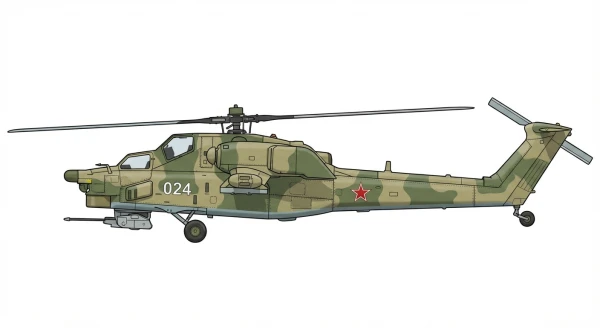
Description
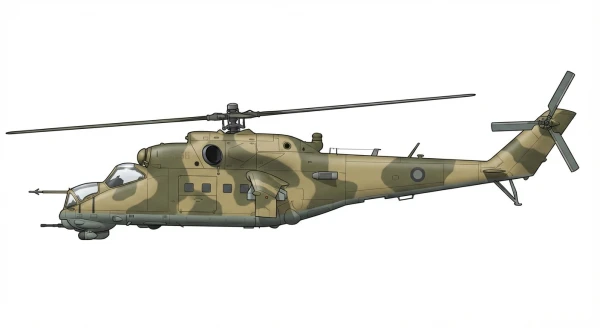
The Mil Mi-35M is a Russian attack helicopter and troop transport manufactured by Mil Moscow Helicopter Plant. Designated by NATO as the "Hind E", the Mi-35 series represents an export derivative of the Soviet Mi-24 helicopter family. The aircraft functions as an armed gunship capable of providing direct ground support and transporting up to eight troops.
Development
Development of the core V-24 design began in the early 1960s under head designer Mikhail Mil to combine battlefield transport with heavy direct fire support. The prototype conducted its first free flight on 19 September 1969, leading to official state acceptance of the base series in 1972. Export variants received the Mi-35 designation, with the upgraded Mi-35M model produced for domestic and foreign military customers.
Design
The aircraft features two top-mounted turboshaft engines driving a 17.3-meter five-blade main rotor and mid-mounted stub wings that generate lift at high speeds. Structural protection includes a titanium-armored cockpit tub, ballistic-resistant windscreens, and titanium main rotor blades capable of withstanding 12.7 mm rounds. The flight control surfaces and dynamic systems incorporate an asymmetrical tail boom to offset torque and unload the tail rotor during flight.
Armament
The Mi-35M is armed with a chin-mounted flexible twin-barrel 23 mm GSh-23L autocannon supplied with 450 rounds. Wing pylons carry up to 2,400 kg of external stores, including B-8V20 launchers for 80 mm S-8 rockets, UPK-23-250 gun pods, 9K114 Shturm anti-tank guided missiles, and free-fall bombs weighing up to 500 kg.
Operational History
Iraq ordered 34 Mi-35M helicopters in 2013, taking initial deliveries in November 2013 to execute strikes against insurgent positions in al-Anbar province. Pakistan acquired four Mi-35Ms in 2018, operating them from Quetta Cantonment for counter-insurgency support in Balochistan during actions in 2022. Russian forces deployed the Mi-35M during the 2022 invasion of Ukraine, where multiple aircraft were shot down by shoulder-launched air defense missiles.
Variants
- Mi-35M: Modernized export attack variant armed with a flexible twin-barrel GSh-23L autocannon.
- Mi-35: Standard export designation for armed derivatives of the Mi-24V series.
- Mi-25: Early export derivative based on the Mi-24D and designated Hind D by NATO.
- Mi-24P: Production variant equipped with a fixed side-mounted twin-barrel 30 mm GSh-30K autocannon.
- Mi-24D: Production variant featuring a tandem cockpit and a flexible 12.7 mm Yak-B heavy machine gun.
Frequently Asked Questions
What type of aircraft is the Mi-35M?
What is the maximum speed of the Mi-35M?
What is the range of the Mi-35M?
When did the Mi-35M first fly?
What is the service ceiling of the Mi-35M?
- AUG 62026 Created Page created: Mi-35M