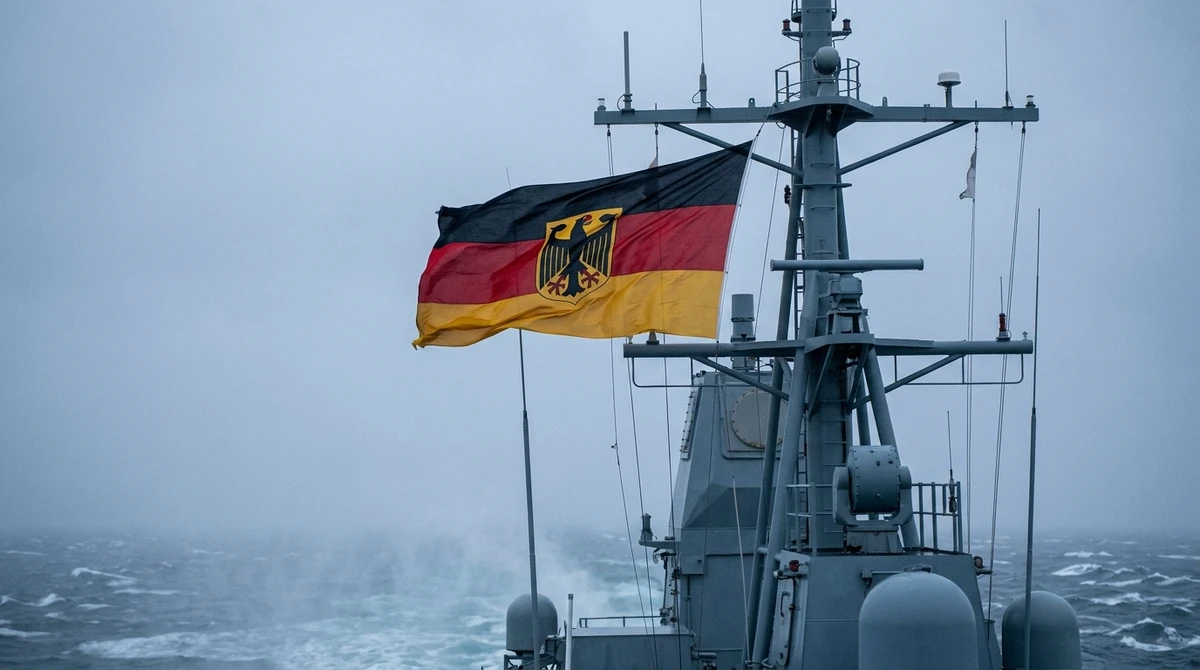
The Baden-Württemberg-class frigates are a series of four vessels built for the German Navy by ARGE F125, a joint venture of ThyssenKrupp and Lürssen. The Baden-Württemberg class has the heaviest displacement of any frigate class worldwide and replaced the F122 Bremen class. Ordered on 26 June 2007 for approximately €2.2 billion, the frigates are designed for stabilization, crisis management, and special forces support rather than high-intensity naval combat. Consequently, the ships were built without a vertical launching system, medium- or long-range surface-to-air missiles, and anti-submarine torpedoes. An April 2007 contract with Finmeccanica secured the Otobreda 127 mm Vulcano main guns and light gun turrets, fulfilling German countertrade obligations stemming from Italy's purchase of Type 212 submarines. Plans to equip the frigates with 155 mm MONARC guns or naval GMLRS rocket launchers were abandoned due to navalization difficulties.
The Baden-Württemberg class incorporates stealth features developed from the Brandenburg-class, Sachsen-class, and Braunschweig-class designs to minimize radar, infrared, and acoustic signatures. The frigates utilize a combined diesel-electric and gas propulsion system to support deployments of up to two years away from homeports. For survivability, the design employs a "two island" principle that duplicates critical systems across two distinct pyramidal deckhouses. These structures house the distributed fixed-array antennas of the Cassidian TRS-4D active electronically scanned array radar.
Standard armament includes the 127 mm Otobreda Vulcano main gun, two 27 mm MLG 27 autocannons, five remote-controlled 12.7 mm Hitrole-NT machine gun turrets, and two manual 12.7 mm heavy machine guns. Air defence is limited to two 21-cell RIM-116 Rolling Airframe Missile Block II launchers, while offensive capabilities rely on eight RGM-84 Harpoon anti-ship missiles. Non-lethal equipment includes water cannons and searchlights. In December 2024, a feasibility study was approved to integrate the IRIS-T SLM air defence system. A demonstrator was tested aboard the lead ship during the Maritime Firing Exercise 2025, and Diehl announced plans in June 2026 to install two upper-deck launchers with 16 IRIS-T SLM missiles each. Additionally, a €250 million budget was approved in November 2025 to develop the FüWES-M combat system, which will integrate the Aegis International Fire Control Loop with Lockheed Martin Canada's CMS330 tactical interface.
The lead ship, Baden-Württemberg, was laid down in November 2011 and launched in December 2013. During initial trials, the vessel exhibited a persistent 1.3-degree list to starboard, exceeded its design weight, and suffered software errors in its operations room. The BAAINBw subsequently rejected the ship and returned it to the builder, delaying its commissioning until June 2019. The remaining vessels—Nordrhein-Westfalen, Sachsen-Anhalt, and Rheinland-Pfalz—were all delivered by January 2022. The lead frigate reached full operational capability by mid-2023 and undertook a global deployment in 2024 alongside the support ship Frankfurt am Main.