Astros II
Summary
| Origin country | 🇧🇷 Brazil |
| Category | Multiple Launch Rocket System |
| Sub-type | Self-propelled multiple rocket launcher |
| Manufacturer | Avibras |
Technical specifications
| Range | 300 km |
| Weapon 1 | SS-AV-40G 180 mm GPS-guided rocket |
| Weapon 2 | SS-150 450 mm rockets |
| Weapon 3 | AVMT-300 cruise missile |
| Weapon 4 | SS-80G 300 mm GPS-guided rocket |
Historical operators
Profile of Astros II
Description
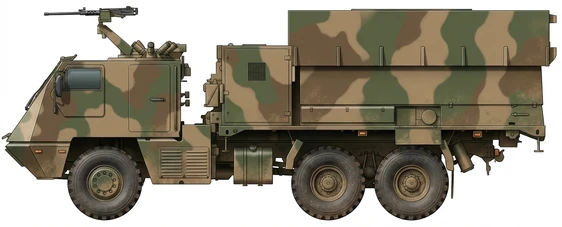
The Astros II (Artillery SaTuration ROcket System) is a Brazilian self-propelled multiple rocket launcher produced by Avibras. It was developed using the Tectran VBT-2028 6×6 all-terrain vehicle, which utilized a Mercedes-Benz 2028 truck chassis. The system entered service with the Brazilian Army in the early 1990s.
The platform employs a modular design capable of firing rockets with calibers ranging from 127 mm to 450 mm. A full system consists of a battalion-level command vehicle (AV-VCC) and three batteries. Each battery contains battery-level command vehicles (AV-PCC), radar fire control vehicles (AV-UCF), universal multiple rocket launchers (AV-LMU), ammunition resupply vehicles (AV-RMD), field repair workshops (AV-OFVE), and mobile weather stations (AV-MET). All vehicles in the system are transportable by C-130 Hercules aircraft. Ammunition resupply vehicles carry up to two complete reloads for the launchers. The vehicle armor consists of light composite material designed to protect against small-arms fire.
The Mk6 version, also designated Astros 2020, uses Tatra 815-7 4×4 and 6×6 chassis. This iteration features an improved armored cabin, digital communications, and navigation systems. It incorporates the Rheinmetall Air Defence Fieldguard 3 Military Measurement System for tracking, replacing the earlier Contraves Fieldguard system. The Mk6 is designed for integration with SS-AV-40G and SS-150 GPS-guided rockets, the AV-TM 300 cruise missile, the MANSUP anti-ship missile, and fiber-optic guided multi-purpose missiles (FOG MPM/MLM).
The Astros II is operated by the Brazilian Army and Marine Corps. It has been exported to several countries, including Saudi Arabia, Malaysia, Indonesia, Qatar, and Bahrain. Iraq operated the system and produced a licensed version designated the Sajeel-60. Angola procured the system during the 1990s.
The system has seen combat in multiple conflicts. The Iraqi Army used the Astros II during the Gulf Wars. During the 1991 Gulf War, Saudi Arabia deployed the system against Iraqi positions. The Angolan military employed the launcher against UNITA guerrillas. More recently, Indonesia has acquired the Mk6 variant in multiple batches. Spain has evaluated the system for potential acquisition, and Ukrainian interest in the platform was reported in 2022.