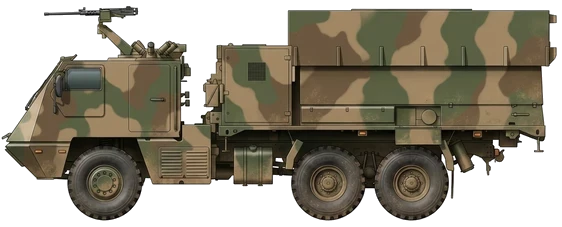
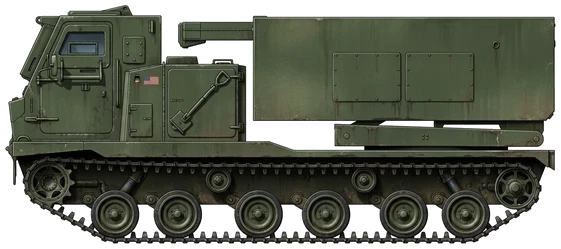
12 roquettes M26 227mm. avec 644 charges M77 par roquette
Secondary weapon
SS-150 450 mm rockets
--
Engine
--
Cummins VTA-903T V8 Turbo-Diesel Engine with 500 hp
Detailed Comparison
The American M270 MLRS mounts standardized 227mm and ATACMS pods on a tracked Bradley-derivative chassis, while Brazil's Astros II utilizes commercial heavy truck chassis to deploy an array of rockets ranging from 127mm to 450mm. Produced in massive numbers (1,450 units) to counter Soviet massed artillery, the M270 became the standard NATO heavy rocket system. Avibras produced 270 Astros II units, capturing Middle Eastern and non-aligned markets prioritizing lower acquisition costs over heavy armor.
Development and Design
The U.S. Army initiated the M270 program in the 1970s to match Soviet rocket artillery densities. Lockheed Martin mounted the M269 launcher-loader on the tracked M993 carrier, yielding a self-contained 25.1-ton platform. Avibras developed the Astros II in the 1980s around a wheeled Tectran VBT-2028 (Mercedes-Benz 2028) 6×6 chassis. Unlike the self-contained M270, the Astros II dictates a sprawling battery footprint, requiring separate radar (AV-UCF) and command (AV-VCC) vehicles to coordinate the launchers. The modern Mk6 iteration migrated to Tatra 815-7 chassis and integrates Rheinmetall’s Fieldguard 3 measurement system.
Protection and Firepower
The M270 encases its three-man crew in a 7039 aluminum cab to withstand artillery fragments during counter-battery exchanges, with M270A1 and A2 upgrades adding heavier armor. Its integrated winch system manually loads two pods containing either 12 227mm GMLRS rockets or two ATACMS missiles. The Astros II uses light composite armor, leaving crews vulnerable to shrapnel, but trades this protection for caliber flexibility. Depending on the loaded pod, it fires:
127mm SS-30 rockets (32 tubes)
180mm SS-40G guided rockets (16 tubes)
300mm SS-80G guided rockets (4 tubes)
450mm SS-150 rockets or AV-TM 300 cruise missiles (Mk6 variant)
Mobility and Logistics
Tracked propulsion gives the M270 greater cross-country mobility in mud and snow, powered by a 500 hp Cummins V8. This imposes high fuel consumption and necessitates heavy equipment transporters for operational movement. The Astros II prioritizes strategic mobility and lower operating costs. Because it mounts on a commercial truck chassis, the launcher and its support vehicles self-deploy over highway networks and fit inside C-130 Hercules aircraft. The M270 requires larger C-17 or C-5 airlifters.
Deployment and Combat Record
Both systems debuted in combat during the 1991 Gulf War. U.S. and British M270s targeted Iraqi troop concentrations and SAM sites. In Ukraine, M270s engage Russian logistics and air defense assets with GMLRS, proving highly survivable due to tracked shoot-and-scoot capabilities. The Astros II saw use by both sides in 1991—by Saudi forces and as the Iraqi-licensed Sajeel-60. Angolan forces employed it against UNITA, and Saudi Arabia deployed the system during its intervention in Yemen.
Conclusion
The M270 is the superior system for peer-state mechanized warfare. Its armored cab provides necessary survivability against counter-battery fragments, and its tracked chassis keeps pace with armored columns in degraded terrain. The Astros II is the logical choice for expeditionary forces or militaries operating on limited budgets. Its C-130 transportability, commercial truck logistics, and ability to fire multiple rocket calibers from a single platform suit regional conflicts where rapid airborne deployment matters more than heavy armor.
The M270 MLRS is faster with a maximum road speed of 72 km/h compared to the Astros II's 0 km/h.
Which has longer operational range, the Astros II or M270 MLRS?
The M270 MLRS has a longer operational range at 483 km compared to the Astros II's 300 km.
Which is heavier, the Astros II or M270 MLRS?
The M270 MLRS is heavier at 25.2 tons combat weight compared to the Astros II's 0.0 tons.
Which is larger, the Astros II or M270 MLRS?
The M270 MLRS is longer at 6.55 meters compared to the Astros II's 0.00 meters.
How many crew members do the Astros II and M270 MLRS require?
Both the Astros II and M270 MLRS require a crew of 3.
Which has been built in greater numbers, the Astros II or M270 MLRS?
The M270 MLRS has been produced in greater numbers with 1,450 units compared to 270 units of the Astros II.
What are the main armaments of the Astros II and M270 MLRS?
The Astros II is armed with SS-AV-40G 180 mm GPS-guided rocket while the M270 MLRS carries 12 roquettes M26 227mm. avec 644 charges M77 par roquette as its main armament.