Bionix
Singaporean tracked infantry fighting vehicle in service since 1997, the first armoured vehicle designed in Southeast Asia, fielded in 25 mm, 40/50 and Bionix II standards. Key figures: weight 23 t, top speed 70 km/h, range 400 km, built 800. In service with 1 army — Singapore (800).
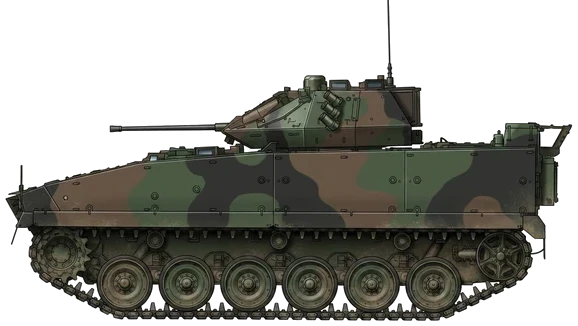
| Sub-type | Infantry fighting vehicle |
| Crew | 3 (commander, gunner, driver) + 7 troops personnels |
| Range | 400 km |
| Mass | 23.0 tons |
| Height | 2.6 m (8.5 ft) |
| Width | 2.7 m (8.9 ft) |
| Length | 5.9 m (19.4 ft) |
| Max. speed | 70 km/h (43 mph) |
| Engine | Detroit Diesel 6V 92TA, 475 hp (550 hp turbocharged) |
| Weapon 1 | Mk44 Bushmaster II 30 mm cannon (Bionix II) |
| Weapon 2 | M242 Bushmaster 25 mm cannon (Bionix 25) |
| Weapon 3 | 7.62 mm coaxial machine gun |
| Weapon 4 | 40 mm automatic grenade launcher and 12.7 mm HMG (Bionix 40/50) |
Description
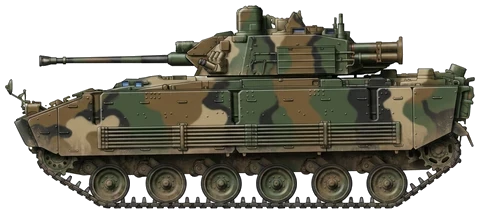
The Bionix (BX) is a family of tracked armoured fighting vehicles developed jointly by Singapore's Defence Materiel Organisation (now the Defence Science and Technology Agency) and Singapore Technologies Automotive (now ST Engineering). It was the first armoured vehicle designed indigenously in Southeast Asia.
Development originated in the mid-1980s from a requirement to supplement the Singapore Army's M113 armoured personnel carriers and to operate alongside the AMX-13 and AMX-13 SM1 light tanks. A market survey evaluating the Warrior, the M2/M3 Bradley and the Marder concluded that no off-the-shelf design met the Army's requirements, and local development was chosen both for that reason and to build up domestic defence industry capability. Design priorities were mobility and agility, low weight, amphibious capability, and protection and firepower suited to Pacific rim terrain, including rubber plantations and roads and bridges not built for heavy vehicles. Work began in 1988. The first experimental vehicle, XV1, was conceptualised in August 1989 and rolled out in January 1990, followed by XV2 and XV3 in December 1990 and March 1991. Testbeds followed in 1993, and prototyping concluded in 1995. The type was commissioned on 26 March 1997, when ST Automotive received a S$2.5 billion production contract. The first vehicles entered service with the 42nd Battalion, Singapore Armoured Regiment, in July 1999.
The hull and turret are of all-welded steel with modular MEXAS passive armour; add-on spaced passive armour can be fitted. The layout places the driver at the front left, the power pack at the front right, the turret centrally and the troop compartment at the rear, accessed by a power-operated ramp. The Detroit Diesel engine is coupled to an L-3 HMPT-500EC hydromechanical transmission with David Brown final drives, and the integrated power pack can be removed in under 15 minutes. The engine compartment has automatic fire detection and dry-powder suppression. The driver uses a steering wheel and two pedals, with three day periscopes and an image-intensification periscope for night driving. The turret traverses 360° under all-electric digital control, with the gunner on the right and commander on the left; both can lay and fire the armament. Air conditioning and NBC protection are not fitted as standard.
The first production model, the Bionix 25, carried a 25 mm Bushmaster cannon and two 7.62 mm machine guns; production ran from September 1997 to 2001. The Bionix 40/50 substitutes a cupola-mounted 40 mm automatic grenade launcher and 12.7 mm machine gun combination and carries a larger dismount section. The Bionix II, developed by DSTA and ST Engineering, mounts the 30 mm Bushmaster II cannon with improved armour, a digital Battlefield Management System, a dual-axis stabilised day/night thermal sighting system, an eye-safe laser rangefinder and mine protection; many were converted from Bionix 25 vehicles. It began trials with a company of 41 SAR in 2005 and was declared operationally ready in October 2006, with 42 SAR the first fully equipped battalion.
Specialised variants include an armoured recovery vehicle, an armoured vehicle-launched bridge spanning up to 22 metres, and the Trailblazer counter-mine vehicle with mine flail and pneumatic lane-marking system. A remote-weapon-station version was entered unsuccessfully in the US Interim Armored Vehicle competition in 2000, losing to the LAV III. Studies to mount a 120 mm turret on a lengthened Bionix chassis were abandoned; Singapore acquired refurbished Leopard 2A4 tanks instead. The Singapore Army remains the sole operator.
Frequently Asked Questions
What type of vehicle is the Bionix?
What is the weight of the Bionix?
What is the maximum speed of the Bionix?
What is the operational range of the Bionix?
How many crew members does the Bionix require?
How many Bionix have been built?
What weapons does the Bionix carry?
- SEP 42026 Verified Weight verified against the published specifications
- AUG 292026 Created Bionix page created, covering the Bionix 25, 40/50 and Bionix II standards