Marder
Introduced by West Germany in 1971, the Marder is an infantry fighting vehicle featuring a 20 mm autocannon and a rear ramp for troop dismounting. Key figures: weight 35 t, top speed 65 km/h, range 500 km, built 2,100. In service with 6 armies — Germany (362), Chile (180), Ukraine (140) and 3 others.
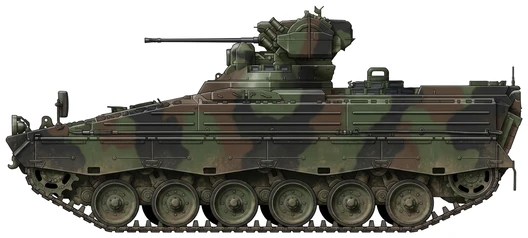
| Sub-type | Infantry fighting vehicle |
| Crew | 3 + 6 passengers personnels |
| Range | 500 km |
| Mass | 35.0 tons |
| Max. speed | 65 km/h (40 mph) |
| Engine | MTU MB 833 Ea-500 six-cylinder liquid-cooled sequentially turbocharged diesel engine |
| Weapon 1 | 20 mm Rheinmetall MK 20 Rh202 autocannon |
| Weapon 2 | 7.62 mm MG 3 machine gun |
| Weapon 3 | MILAN anti-tank guided missile launcher |
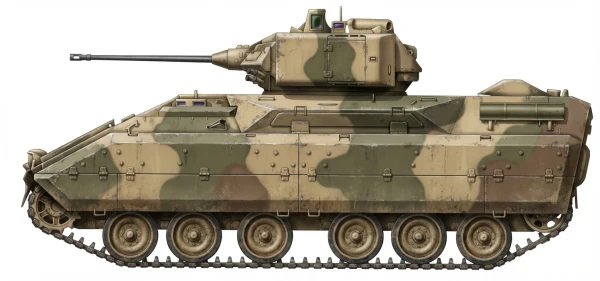
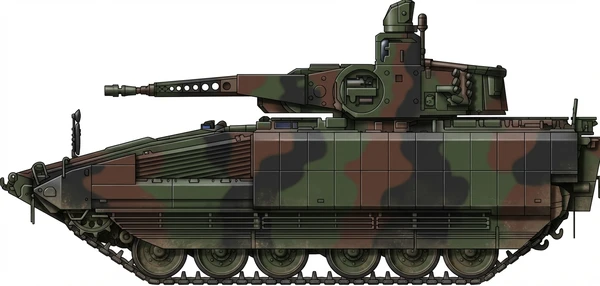
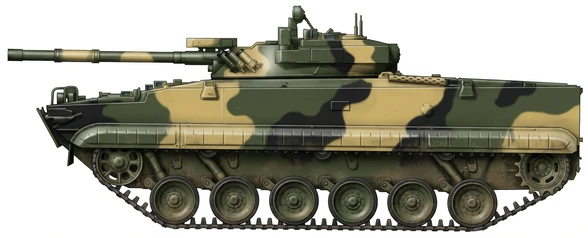
Description
Development of the Marder tracked infantry fighting vehicle began in January 1960 to replace the Schützenpanzer Lang HS.30 for West German Panzergrenadiere units. Initial development contracts were awarded to two groups—Rheinstahl and a consortium of Henschel Werke and MOWAG—before Rheinstahl was selected as the prime contractor. Following pre-production testing, the vehicle was officially named the Marder in 1969, and the first production models were delivered to the West German Army in May 1971. In 1985, the platform was redesignated Marder 1 due to the development of the Marder 2 project. Modernization programs introduced night vision equipment, thermal optics, and turret-mounted MILAN anti-tank guided missiles. The Marder 1A3 upgrade package incorporated additional armor against autocannons and bomblets, while the 1A5 variant added enhanced mine protection. The vehicle is gradually being replaced in German service by the Puma.
The Marder utilizes an all-welded steel hull layout with the driver at the front left, the engine at the front right, a central two-man turret, and a rear compartment for dismounted infantry fitted with a rear exit hatch. Frontal armor originally resisted 20 mm armor-piercing discarding sabot rounds, with later modifications increasing protection against 30 mm autocannon fire and top-attack cluster bomblets. Primary armament consists of a 20 mm Rheinmetall MK 20 Rh202 autocannon and a coaxial 7.62 mm MG 3 machine gun. Early variants featured a remote-controlled rear-deck machine gun and side gun ports, but these were removed in later modernizations to simplify production and accommodate additional armor. The vehicle is powered by a liquid-cooled sequentially turbocharged diesel engine mated to a four-speed planetary transmission, utilizing a torsion bar suspension and Diehl tracks. It can ford water obstacles when fitted with a preparation kit.
The vehicle has been operated by Germany and exported to several countries, including Chile, Indonesia, and Ukraine. Argentina utilizes the VCTP variant built on the Marder chassis, while Brazil previously operated an air-defense derivative. The Marder saw combat during the German deployment in Afghanistan, engaging Taliban forces in Kunduz Province in 2009 and participating in Operation Halmazag in 2010. It was also deployed during NATO peacekeeping operations in Kosovo. Donated German vehicles were integrated into Ukrainian service during the Russian invasion of Ukraine, seeing action with the 82nd Air Assault Brigade during the 2023 counteroffensive.
Frequently Asked Questions
What type of vehicle is the Marder?
What is the weight of the Marder?
What is the maximum speed of the Marder?
What is the operational range of the Marder?
How many crew members does the Marder require?
How many Marder have been built?
What weapons does the Marder carry?
- SEP 42026 Verified Weight verified against the published specifications
- AUG 32026 Updated Crew added
- AUG 22026 Created Page created: Marder