BM-30 Smerch
Summary
| Origin country | 🇷🇺 Russia |
| Category | Multiple Launch Rocket System |
| Sub-type | Heavy self-propelled 300 mm multiple rocket launcher |
| Manufacturer | Splav State Research and Production Enterprise |
Technical specifications
| Crew | 4 members personnels |
| Range | 90 km |
| Weapon 1 | 300mm rockets (9M55 or 9M528) |
| Weapon 2 | 12-round launch tube cluster |
Historical operators
Profile of BM-30 Smerch
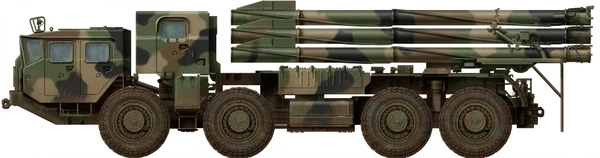
Description
The BM-30 Smerch, also designated 9K58 or 9A52-2 Smerch-M, is a heavy self-propelled 300 mm multiple rocket launcher developed in the Soviet Union. Development occurred in the early 1980s to provide a system capable of engaging personnel, armored formations, artillery batteries, and command posts. Western intelligence first identified the system in 1983, assigning it the designation MRL 280mm M1983. It entered service with the Soviet Army in 1989. Russia began a replacement program using the Tornado-S variant in 2018.
The system architecture includes the launch vehicle, 9M55 or 9M528 rockets, the 9T234-2 transloader, and the 1K123 Vivary automated fire control equipment. The 9A52-2 launch vehicle carries a 12-tube cluster for solid-fuelled projectiles and is mounted on the MAZ-543M or MAZ-79111 chassis. Specialized variants include the 9A52-2T on a Tatra 10×10 chassis, the airmobile 9A52-4 on a KamAZ-6350, and an Arctic version utilizing the DT-30PM tracked vehicle. The 9A54 Tornado-S upgrade integrates a digital fire control system and GLONASS receiver. The 9A52-2 utilizes automated systems for cabin-based laying, autonomous azimuth determination, and navigation. It can fire a 12-round salvo in 38 seconds, and rockets are available with ranges of 70 and 90 km.
The BM-30 is operated by several countries, including Algeria, Armenia, Azerbaijan, Belarus, India, Kazakhstan, Kuwait, Syria, Turkmenistan, the United Arab Emirates, and Venezuela. It remains in service with both Russia and Ukraine, having been passed to successor states following the dissolution of the Soviet Union. Combat deployment began in 2014 during the Syrian Civil War and the conflict in eastern Ukraine. Russian forces used the system during the 2015 intervention in Syria. In 2020, both Armenian and Azerbaijani forces employed the Smerch during the Nagorno-Karabakh conflict. During the 2022 Russian invasion of Ukraine, the system was used in the Battle of Kharkiv, where 11 rockets were reportedly fired between 27 and 28 February, and in strikes from Belgorod. Visual evidence has confirmed the destruction of several Russian BM-30 units during the conflict.