BM-30 Smerch vs M142 HIMARS
BM-30 Smerch vs M142 HIMARS at a glance — weight 43,700 vs 16,250 kg, range 850 vs 480 km, crew 4 members vs 3 (commander, second in command, driver).
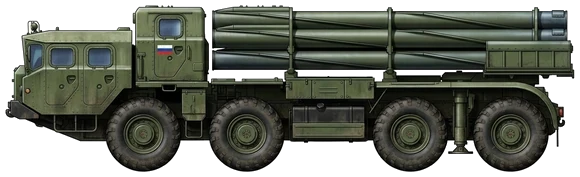
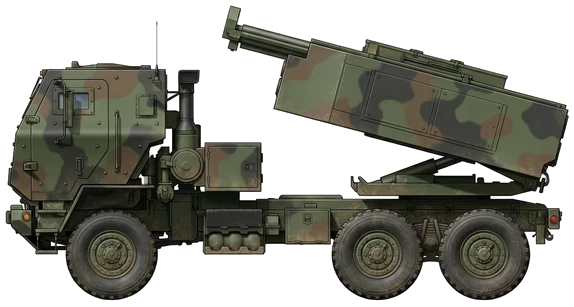
| BM-30 Smerch | M142 HIMARS | |
|---|---|---|
| Origin country | 🇷🇺 Russia | 🇺🇸 United States |
| Category | Multiple Launch Rocket System | Multiple Launch Rocket System |
| Type | Heavy self-propelled 300 mm multiple rocket launcher | Light multiple rocket launcher |
| Manufacturer | Splav State Research and Production Enterprise | Lockheed Martin |
| Number produced | 550 units | 750 units |
| Estimated unit price | $-- million | $4.9 million |
| Combat weight | 43.7 tons | 16.3 tons |
| Maximum speed | -- km/h | 94 km/h |
| Operational range | 850 km | 480 km |
| Length | -- m | 6.94 m |
| Width | -- m | 2.44 m |
| Height | -- m | 3.18 m |
| Crew | 4 members | 3 (commander, second in command, driver) |
| BM-30 Smerch | M142 HIMARS | |
|---|---|---|
| Main armament | 300mm rockets (9M55 or 9M528) | 6 x GMLRS rockets or 2 x PrSM missiles or 1 x ATACMS missile |
| Secondary weapon | 12-round launch tube cluster | -- |
| Engine | -- | Caterpillar 3116 ATAAC 6.6L diesel, 330 hp |
Detailed Comparison
Developed to saturate grid squares, the Soviet-designed BM-30 Smerch relies on a 12-tube 300mm cluster to blanket large areas. The US-built M142 HIMARS was engineered for target isolation and rapid displacement, trading volume of fire for precision-guided munitions and strategic mobility via airlift.
Development and Design
The BM-30 Smerch entered service in 1989 to destroy armored formations and artillery batteries across wide fronts. Mounted on a MAZ-543M heavy chassis, it requires a separate 9T234-2 transloader for its 300mm rockets. The M142 HIMARS originated from a requirement for a lighter counterfire asset after the Gulf War proved the tracked M270 too heavy for rapid airlift. Mounted on a wheeled FMTV 5-ton truck chassis, HIMARS carries a single interchangeable launch pod. This eliminates the need for a dedicated transloader vehicle; the crew reloads the system autonomously using a crane integrated into the launcher.
Protection and Firepower
Smerch fires a 12-round salvo of 9M55 or 9M528 rockets in 38 seconds out to 90 km. Base variants lack satellite guidance, utilizing inertial navigation and submunitions for area effect. Russia’s Tornado-S modernization program integrates GLONASS to close the precision gap. HIMARS fires six Guided Multiple Launch Rocket System (GMLRS) rounds or a single Army Tactical Missile System (ATACMS) missile. While it carries half the rocket volume of a Smerch, its GPS/INS guidance guarantees single-meter accuracy. Smerch offers minimal armor for its 4-man crew. HIMARS provides its 3-man crew with a sapphire-laminated glass and polycarbonate armored cab, defending against fragmentation and small arms.
Mobility and Logistics
At 16.25 tons, HIMARS fits inside a C-130 aircraft, enabling immediate airlift. It reaches 94 km/h with an operational range of 480 km. Smerch weighs over 40 tons combat-loaded and requires railways or heavy transporters for strategic movement. On the ground, the Smerch's 8x8 chassis navigates mud efficiently, but its 12-meter length severely limits urban concealment. HIMARS executes fire missions and displaces within minutes. Smerch's reload cycle requires aligning a transloader crane with individual launch tubes, exposing the system to counter-battery fire for 20 to 30 minutes.
Deployment and Combat Record
Both systems are deployed in the Russo-Ukrainian War. Smerch has bombarded Kharkiv and eastern Ukraine, functioning as an area-denial weapon against troop concentrations. HIMARS entered Ukraine in 2022 and targeted Russian logistics hubs, command posts, and ammunition dumps.
- Russian forces actively hunt HIMARS using Lancet drones and Iskander missiles, forcing Ukrainian crews to employ wooden decoys.
- Ukrainian HIMARS strikes pushed Russian supply depots beyond the 85km GMLRS range, disrupting front-line resupply.
- Combat data indicates degradation in HIMARS GPS accuracy due to Russian electronic warfare, forcing reliance on baseline inertial guidance.
Conclusion
HIMARS holds the edge in modern, network-centric warfare. Its modular pod system, C-130 transportability, and ATACMS integration allow forces to dismantle enemy logistics and displace before retaliatory fire arrives. Smerch delivers greater payload mass against exposed formations, but its sluggish reload cycle, heavy logistical footprint, and reliance on area-fire make it highly vulnerable in environments dominated by pervasive drone surveillance and rapid kill chains.