2A18 (D-30)
Summary
| Origin country | 🇷🇺 Russia |
| Category | Towed Artillery |
| Sub-type | Howitzer |
| Manufacturer | Artillery Plant No 9 |
Technical specifications
| Range | 15 km |
| Mass | 3.2 tons |
| Max. speed | 60 km/h (37 mph) |
| Weapon 1 | 122-mm howitzer |
| Weapon 2 | HEAT shell |
| Weapon 3 | HE shell |
| Weapon 4 | rocket-assisted projectile ammunition |
Historical operators
Profile of 2A18 (D-30)
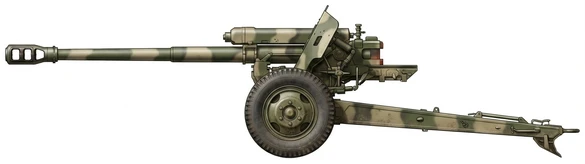
Description
Development of the 2A18 (D-30) began in the 1950s at Artillery Plant No. 9 in Sverdlovsk under the direction of Fëdor Fëdorovich Petrov. Designed as a successor to the M-30 howitzer and the M1942 field gun, the D-30 entered Soviet service in the early 1960s. The design provides fire support to tank and motor rifle regiments, focusing on both indirect fire and direct-fire anti-tank capabilities.
The howitzer is characterized by a three-legged mobile mount that provides 360-degree traverse. For transport, the stabilizer legs are clamped together and the barrel serves as the trail, towed by a linkage fixed to the muzzle. The weapon features an above-barrel recoil system and a high-efficiency muzzle brake. It utilizes a semi-automatic vertical sliding block breech and fires separate-loading ammunition with variable propelling charges. Sighting equipment consists of a direct-fire anti-tank telescope and a panoramic periscopic indirect-fire sight. The ammunition suite includes high-explosive, smoke, illumination, and chemical projectiles, along with HEAT rounds for anti-tank use and rocket-assisted projectiles. To transition to a firing position, a hand-operated hydraulic jack lowers the mounting while the wheels are raised, allowing the stabilizer legs to be spread and spiked to the ground.
The D-30 is widely exported and remains in service with dozens of armed forces globally. It has been used in numerous conflicts, including the Iran-Iraq War and the war in Afghanistan. While no longer manufactured in former Soviet states, production continues in countries such as China, Egypt, and Serbia. The gun's barrel assembly is also utilized in the 2S1 Gvozdika self-propelled howitzer. Several nations have developed local self-propelled variants; Syria and Egypt mounted the gun on T-34 tank hulls, Algeria utilizes a truck-mounted version, and China operates wheeled and tracked variants. Western forces have also used the D-30 to train partner militaries in Central Asia. The weapon is used by both state militaries and various non-state actors in regional conflicts.