M110 Howitzer
Summary
| Origin country | 🇺🇸 United States |
| Category | Self-Propelled Artillery |
| Sub-type | Self-Propelled Howitzer |
| Manufacturer | Pacific Car and Foundry / BMY |
| Number built | 1023 units |
Technical specifications
| Crew | 5 (section chief, driver, gunner, 2 ammunition handlers) + 8 support personnels |
| Range | 30 km |
| Mass | 28.4 tons |
| Height | 3.145 m (10.3 ft) |
| Width | 3.149 m (10.3 ft) |
| Length | 7.467 m (24.5 ft) |
| Max. speed | 55 km/h (34 mph) |
| Engine | Detroit Diesel 8V-71T, 405 hp |
| Weapon 1 | M2A2 203mm howitzer |
Historical operators
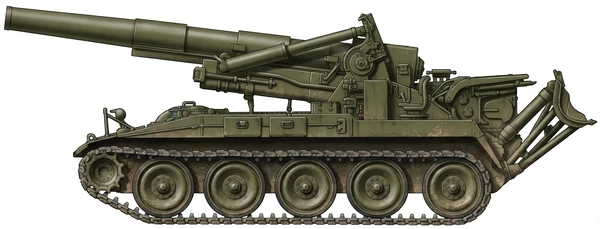
Profile of M110 Howitzer
Description
The M110 is an American 8-inch (203 mm) self-propelled howitzer consisting of an M115 howitzer mounted on a purpose-built chassis. It entered service with the United States Army in 1963 to provide general support, counter-battery fire, and suppression of enemy air defenses. The system underwent several upgrades during its service life. The M110A1, introduced in 1977, featured a longer M201 series barrel to increase range. The final version, the M110A2, added a double muzzle brake and was often produced by refitting existing M110s or M107 175 mm self-propelled guns. The United States eventually retired the system in 1994, replacing it with the M270 multiple launch rocket system.
The M110 utilizes a hydraulically operated rammer to chamber projectiles, though the mechanism required crews to lower the barrel and was prone to mechanical failure. Trained crews could substitute the hydraulic system with a manual steel rammer to achieve two to four rounds per minute for short periods. The typical rate of fire is three rounds per two minutes at maximum speed and one round per two minutes during sustained fire. The platform fires various munitions, including M106 high-explosive, M650 rocket-assisted, and M509 improved conventional munitions, as well as M426 Sarin gas and M422A1 atomic projectiles. Range varies from 10.4 miles to 16 miles with standard projectiles, extending to 19 miles with rocket-assisted rounds. Surplus M110 barrels were also used to manufacture GBU-28 laser-guided bombs during the Gulf War.
The howitzer was used by the United States during the Vietnam War and later by the U.S. Army and Marine Corps during Operation Desert Shield and Operation Desert Storm. The British Army's 32nd Regiment Royal Artillery also deployed the M110A2 during the Gulf War. In the Middle East, Israel utilized the system during the Yom Kippur War and the 1982 Siege of Beirut. Iran employed its M110s during the Iran–Iraq War. Turkey has operated M110A2 systems against the Kurdistan Workers' Party and during military interventions in Syria.
The M110 is currently operated by several countries, including Bahrain, Cyprus, Greece, Egypt, Iran, Jordan, Morocco, Pakistan, Taiwan, and Turkey. Former operators include Belgium, Germany, Israel, Italy, Japan, South Korea, South Vietnam, the Netherlands, Spain, and the United Kingdom. In October 2025, reports indicated that Greece was considering the transfer of M110A2 systems and ammunition to Ukraine via the Czech Republic.