Airbus A321
European narrow-body commercial passenger jet, recognized for global use since 1990s, employed extensively by major airlines. Key figures: top speed 871 km/h, range 5,930 km, service ceiling 12,000 m, max takeoff weight 78,000 kg, unit price $120M, built 2,917. In service with 2 air forces as of 2026 — India (4), Germany (3).
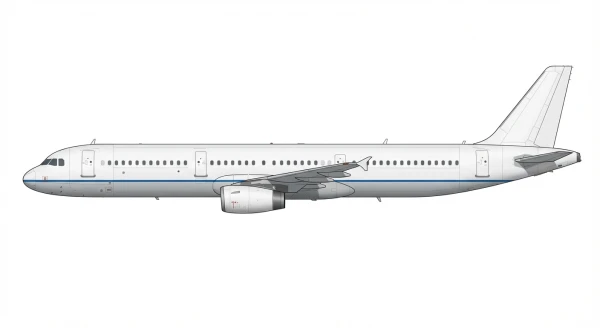
| Length | 37.6 m (123.3 ft) |
| Wingspan | 34.1 m (111.9 ft) |
| Height | 11.8 m (38.6 ft) |
| Wing area | 122.6 m² (1319.7 sqft) |
| Empty weight | 42,600 kg (93,917 lbs) |
| Max. takeoff weight | 78,000 kg (171,960 lbs) |
| Powerplant | 2 × turbofans CFM International CFM56-5A1 11,340 kgf each |
| Maximum speed | 871 km/h (541 mph) |
| Operational range | 5,930 km (3,685 mi) |
| Service ceiling | 12,000 m (39,370 ft) |
| Takeoff distance | 2,090 m (6,857 ft) |


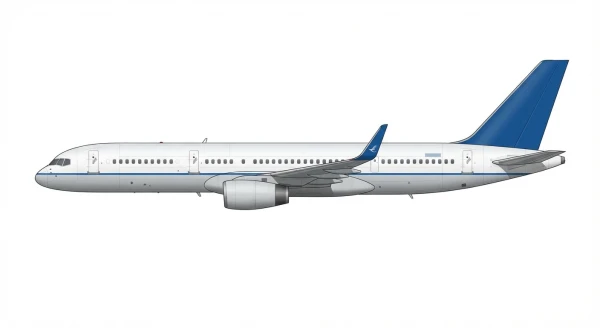
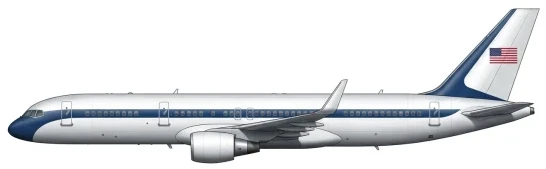
Description
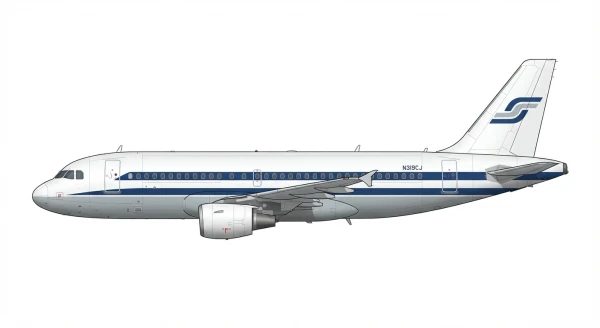
The Airbus A321 is a narrow-body, twin-engine short- to medium-range airliner produced by Airbus, the stretched derivative of the A320 and the largest member of the A320 family. Assembled in Hamburg, Toulouse, Mobile and Tianjin, it entered service with Lufthansa in January 1994 and seats 185 to 244 passengers. It shares a common type rating with all other A320-family variants. As of June 2025, 3,536 had been delivered and 3,453 were in service, with a further 5,312 A321neo aircraft on firm order. A maritime patrol derivative, the A321 MPA, is under development for the French Navy.
Development
Launched on 24 November 1988 after commitments for 183 aircraft from 10 customers, the type was initially known as the Stretched A320, A320-500 and A325. The prototype F-WWIA first flew on 11 March 1993 with IAE V2500 engines; a second aircraft with CFM56-5B turbofans followed in May 1993. Lufthansa and Alitalia ordered 20 and 40 aircraft respectively, taking their first deliveries on 27 January and 22 March 1994. Final assembly was carried out in Germany, a first for Airbus, on a second line at Hamburg that later built the A318 and A319. Airbus raised $480 million on the bond market plus $180 million from the European Investment Bank and private investors. Over 30 years, maximum takeoff weight grew 20% from 83 t on the -100 to 101 t on the A321XLR, and range doubled from 2,300 to 4,700 nmi. By 2019, 4,200 had been ordered, including 2,400 neos.
Design
The A321 is a low-wing cantilever monoplane with retractable tricycle landing gear, two wing-pylon-mounted turbofans and a conventional tail with a single vertical stabiliser. The fuselage was lengthened by a 4.27 m plug ahead of the wing and a 2.67 m plug behind it, making it 6.94 m longer than the A320; the A320 overwing window exits were converted to door exits and repositioned. Double-slotted flaps and trailing-edge modifications raised wing area from 124 m² to 128 m². The centre fuselage and undercarriage were reinforced for a 9,600 kg weight increase. Engines are the CFM56 or V2500 in the 133–147 kN class, with LEAP-1A or PW1000G on neo variants.
Armament
The A321 MPA carries an internal weapons bay in an underfloor ventral gondola behind the wing, housing anti-submarine torpedoes and FMAN/FMC anti-ship and cruise missiles. Its Thales sensor suite includes an AESA search radar, passive and active sonobuoys, a tail-mounted magnetic anomaly detector, electronic support measures and self-protection systems.
Operational History
More than 100 operators fly the type, American Airlines and Delta Air Lines holding the largest fleets at 302 and 203 aircraft. The A321-200 entered service with Monarch Airlines in April 1997, the A321neo with Virgin America in May 2017, the A321LR with Arkia in November 2018 and the A321XLR with Iberia on 30 October 2024. As of August 2019, 32 accidents and incidents had occurred, including six hull losses or criminal occurrences with 377 fatalities.
Variants
- A321-100: Original variant with 83,000 kg MTOW and no additional fuel tanks; about 90 built.
- A321-200: Higher-thrust engines, strengthened structure and up to two 2,990 L rear hold tanks for 93,000 kg MTOW; first flight December 1996.
- A321neo: LEAP-1A or PW1000G engines and sharklets for 15% better fuel burn; first flight 9 February 2016, certified 15 December 2016.
- A321LR: 97 t MTOW A321neo-ACF with up to three auxiliary tanks and 4,000 nmi range at 206 seats.
- A321XLR: 101 t MTOW with permanent rear centre tank, strengthened landing gear and modified flaps for 4,700 nmi range.
Frequently Asked Questions
What type of aircraft is the Airbus A321?
What is the maximum speed of the Airbus A321?
What is the range of the Airbus A321?
When did the Airbus A321 first fly?
How many Airbus A321 have been built?
Which countries operate the Airbus A321?
How much does a Airbus A321 cost?
What is the service ceiling of the Airbus A321?
- AUG 302026 Updated Description updated
- AUG 52026 Updated Powerplant updated in a site-wide editorial pass
- JUL 272026 Updated Name updated
- APR 72026 Updated Sources and cross-references refreshed
- JAN 122026 Updated Range updated in a site-wide editorial pass