Buccaneer
British carrier-borne attack aircraft, notable for service in the Cold War, extensively deployed in Gulf War operations. Key figures: top speed 1,040 km/h, range 3,700 km, service ceiling 12,200 m, max takeoff weight 28,000 kg, unit price $2.5M, built 211.
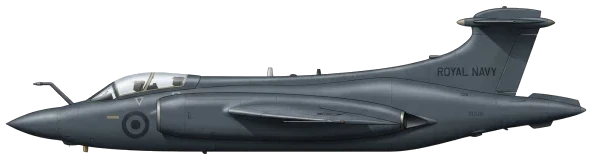
| Crew | 2 (pilot, observer) |
| Length | 19.3 m (63.4 ft) |
| Wingspan | 13.4 m (44.0 ft) |
| Height | 5.0 m (16.3 ft) |
| Wing area | 47.8 m² (514.7 sqft) |
| Empty weight | 14,000 kg (30,865 lbs) |
| Max. takeoff weight | 28,000 kg (61,729 lbs) |
| Powerplant | 2 × turbofans Rolls-Royce RB.168 Spey Mk 101 10,070 kgf each |
| Ejection seat | Martin-Baker Mk 6 |
| Maximum speed | 1040 km/h (646 mph) |
| Operational range | 3,700 km (2,299 mi) |
| Service ceiling | 12,200 m (40,026 ft) |
- Air-to-Surface AS.30
- Air-to-Surface AS.37 Martel
- Air-to-Air Short-Range Raytheon AIM-9 Sidewinder
- Air-to-Surface Sea Eagle
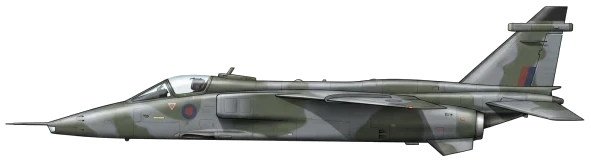
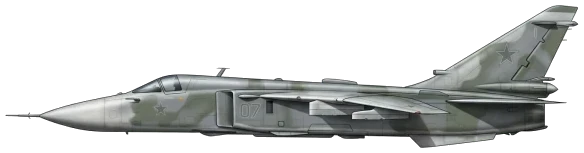
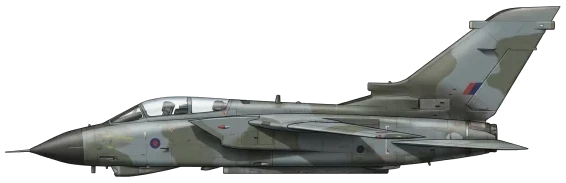
Description
The Blackburn Buccaneer was designed in response to the Soviet Union's introduction of the Sverdlov class cruisers. The Royal Navy opted for a carrier-capable attack aircraft capable of low-level strikes to exploit the radar horizon, minimizing detection. Blackburn Aircraft at Brough initially designed and produced the aircraft; later, it became known as the Hawker Siddeley Buccaneer after Blackburn joined the Hawker Siddeley Group. Specification NA.39, issued in June 1952, called for a two-seat aircraft with folding wings, capable of flying at 550 knots at sea level, with specific combat radius requirements and an 8,000-pound weapons load. Blackburn's Project B-103, designed by Barry P. Laight, won the tender in July 1955. The first prototype flew on April 30, 1958, from RAE Bedford, and the Buccaneer S.1 entered Fleet Air Arm service in January 1963. Initial S.1 models, powered by de Havilland Gyron Junior turbojets, were assessed as underpowered, leading to the development of the Buccaneer S.2 with Rolls-Royce Spey engines, providing 40% more thrust. Hawker Siddeley announced the S.2 production order in January 1962.
Design
The Buccaneer featured design elements tailored for its role, including area-rule fuselage contouring to reduce transonic drag and a large air brake forming the tail-cone. Much of the airframe was machined from solid castings to ensure structural integrity during low-level, high-speed operations. Aided by a flight control computer for auto-stabilization and autopilot functions, the aircraft also used boundary layer control (BLC), "blowing" high-pressure engine air over wing surfaces and the horizontal stabilizer to improve low-speed performance during landings and take-offs, negating the need for slats. The nose cone could be rotated 180 degrees to reduce the aircraft's length for carrier storage. Electrical systems were supported by dual busbars, with three independent hydraulic systems offering redundancy.
Armament
The Buccaneer was designed as a maritime nuclear strike aircraft, initially intended to carry the nuclear air-to-surface missile codenamed Green Cheese. Following the cancellation of this weapon, the unguided 2,000-pound (900 kg) Red Beard nuclear weapon, previously developed for the English Electric Canberra, was adopted. Red Beard, with an explosive yield in the 10 to 20 kiloton range, was housed on a special bomb bay door designed to minimize aerodynamic buffet. The bomb bay could alternatively accommodate a 2,000-litre (440 imp gal; 530 US gal) ferry tank, a photo-reconnaissance package of six cameras, or a cargo container. Additionally, the Buccaneer featured four underwing hard points, each capable of carrying 1,000-pound (450 kg) bombs, missiles, fuel tanks, or flares, with later developments incorporating wing-mounted electronic warfare and laser designator pods. Early conventional anti-ship missions utilized unguided bombs and rockets. Later Buccaneers were adapted to carry missiles capable of striking enemy ships from a distance, including the Anglo-French Martel missile and the Sea Eagle missile, the latter having a range five times greater than the Martel AJ 168. The aircraft had no guns fitted. The total external payload was up to 12,000 lb (5,443 kg), with a 4,000 lb (1,814 kg) internal capacity.
Operational History
The Buccaneer entered service with the Fleet Air Arm (FAA) in January 1963, replacing the Supermarine Scimitar in the naval attack role. In 1965, it was cleared for nuclear weapons delivery, including Red Beard and WE.177 bombs. Naval aircrews flying the Buccaneer S.1 reported notable flying qualities and slower landing speeds compared to contemporary aircraft. S.2 aircraft took part in a mission to show a military presence over British Honduras (now Belize) in 1972, for deterrence. The Buccaneer also participated in patrols and exercises in the North Sea. Following the retirement of the last of the Royal Navy's large aircraft carriers in 1979, the Buccaneer's strike role transferred to the British Aerospace Sea Harrier, and the aircraft were transferred to the RAF. Buccaneers saw combat action in the 1991 Gulf War, designating targets for other aircraft and dropping laser-guided bombs. The South African Air Force (SAAF) employed Buccaneers in the South African Border War, conducting attacks upon SWAPO guerilla camps.
Variants
Main Variants:
-
Buccaneer S.1: The first production model powered by de Havilland Gyron Junior 101 turbojet engines for the Fleet Air Arm.
-
Buccaneer S.2: An improved version of the S.1, fitted with Rolls-Royce Spey turbofan engines for enhanced performance.
-
Buccaneer S.2A: Former Royal Navy S.2 aircraft reworked for service with the Royal Air Force.
-
Buccaneer S.2B: A variant of the S.2 for RAF squadrons, capable of carrying Martel anti-radar or anti-shipping missiles.
-
Buccaneer S.50: A variant for the South African Air Force, featuring manually folded wings and optionally equipped with Bristol Siddeley 605 rocket engines for assisted takeoff from airfields.
Frequently Asked Questions
What type of aircraft is the Buccaneer?
What is the maximum speed of the Buccaneer?
What is the range of the Buccaneer?
When did the Buccaneer first fly?
How many Buccaneer have been built?
Which countries operate the Buccaneer?
How much does a Buccaneer cost?
What is the service ceiling of the Buccaneer?
- AUG 52026 Updated Powerplant updated in a site-wide editorial pass
- AUG 12026 Updated Manufacturer updated
- JUL 232026 Updated Sources and cross-references refreshed
- APR 72026 Updated Sources and cross-references refreshed
- JAN 242026 Updated Thrust updated