An-71 Madcap
Soviet tactical airborne early warning and control aircraft, developed in the 1980s for overland support of tactical air operations. Key figures: top speed 650 km/h, service ceiling 10,800 m, max takeoff weight 32,100 kg, built 3.
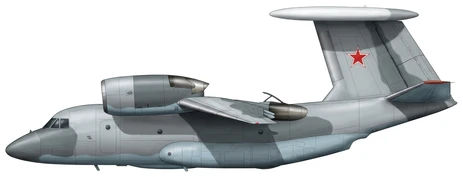
| Crew | 6 |
| Length | 23.5 m (77.1 ft) |
| Wingspan | 31.9 m (104.6 ft) |
| Height | 9.2 m (30.2 ft) |
| Empty weight | 19,760 kg (43,563 lbs) |
| Max. takeoff weight | 32,100 kg (70,768 lbs) |
| Powerplant | 2 × turbofans Progress D-436K 7,505 kgf each |
| Maximum speed | 650 km/h (404 mph) |
| Service ceiling | 10,800 m (35,433 ft) |
Description
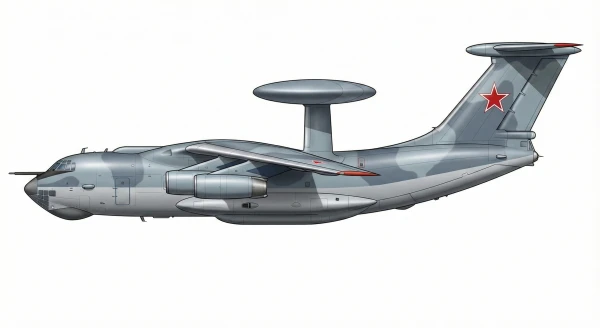
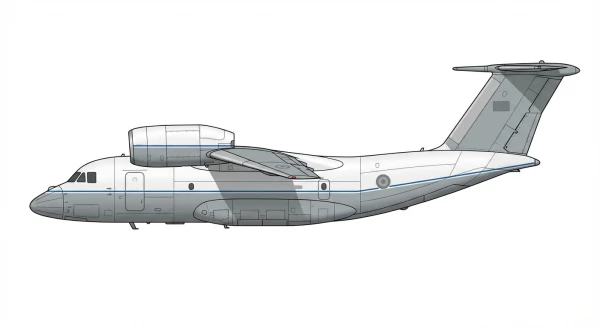
The Antonov An-71 (NATO reporting name: Madcap) is a Soviet airborne early warning and control (AWACS) aircraft developed from the An-72 transport for the VVS-FA (Frontal Aviation) forces of the Soviet Air Force. Intended to direct tactical air operations overland, the aircraft never entered operational service, and development was terminated after three prototypes were produced. The type is known for its configuration featuring a radar rotodome mounted on top of a broad-chord, forward-swept vertical stabilizer.
Development
The An-71 program was initiated to provide tactical AWACS support specifically for Soviet Frontal Aviation, distinguishing its operational role from the strategic interceptor-support roles of the Tu-126 and A-50. The first prototype completed its maiden flight on 12 July 1985. Development was halted at the prototype stage with three aircraft built, and the program was formally cancelled following the fall of the Soviet Union due to unresolved technical issues with the radar system. In 2010, one surviving prototype was transferred to the Ukraine State Aviation Museum for display.
Design
The aircraft's design modifies the baseline An-72 transport airframe with a redesigned rear fuselage and a forward-swept, broad-chord tail fin supporting the radar rotodome. The interior cargo bay was converted to house internal electronic systems and six operator stations. Power is provided by two Progress D-436K turbofan engines, yielding a cruise speed of 530 km/h, a maximum speed of 650 km/h, and a service ceiling of 10,800 m. The primary sensor is the Vega-M Kvant search radar, which was designed to track up to 400 targets simultaneously at ranges up to 370 km.
Operational History
Due to the cancellation of the project, the An-71 accumulated no operational record or military deployments. In the early 2000s, Ukraine conducted unsuccessful export negotiations to sell an An-71 to India for US$200 million.
Variants
- An-75: A proposed naval variant modified for aircraft carrier operations featuring underwing-mounted engines and structural redesigns, which was cancelled by Soviet Naval Aviation prior to construction.
Frequently Asked Questions
What type of aircraft is the An-71 Madcap?
What is the maximum speed of the An-71 Madcap?
When did the An-71 Madcap first fly?
How many An-71 Madcap have been built?
Which countries operate the An-71 Madcap?
What is the service ceiling of the An-71 Madcap?
- AUG 62026 Created Page created: An-71 Madcap