C-123 Provider
American twin-engine military transport of the 1950s, used by the US Air Force and allied air forces for tactical airlift, defoliation spraying and covert operations in Southeast Asia. Key figures: top speed 367 km/h, range 5,279 km, max takeoff weight 27,216 kg, built 307.
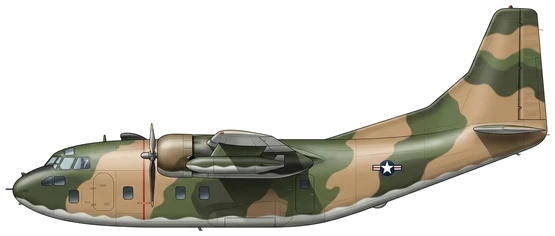
| Crew | 4 |
| Length | 23.2 m (76.2 ft) |
| Wingspan | 33.5 m (110.0 ft) |
| Height | 10.4 m (34.1 ft) |
| Wing area | 113.6 m² (1222.8 sqft) |
| Empty weight | 16,042 kg (35,367 lbs) |
| Max. takeoff weight | 27,216 kg (60,001 lbs) |
| Powerplant | 2 × radial piston engines Pratt & Whitney R-2800-99W Double Wasp 1,864 kW each |
| Maximum speed | 367 km/h (228 mph) |
| Operational range | 5,279 km (3,280 mi) |
Description
The Fairchild C-123 Provider is an American military transport designed by Chase Aircraft and built by Fairchild for the United States Air Force. It served with the USAF, Air Force Reserve, Air National Guard, U.S. Coast Guard and several foreign air forces. During the Vietnam War it delivered supplies, evacuated wounded, inserted agents behind enemy lines and sprayed Agent Orange. The last examples in U.S. military service retired in the early 1980s.
Development
The design began as the Chase XCG-20 (MS-8 Avitruc) all-metal assault glider. Two powered versions followed in the early 1950s. The XC-123 had two Pratt & Whitney R-2800-23 radials. The XC-123A had four J47-GE-11 turbojets in two pods and was the USAF's first jet-powered transport. It could not operate from short, rough strips, offered no practical speed gain and had reduced range, so only one was built.
Chase lacked production capacity, and by 1953 the owner of Kaiser-Frazer had bought a majority share. Two airframes were completed at the Willow Run plant before a pricing scandal ended his involvement, and both were scrapped. Fairchild Engine and Airplane then took over production of the C-123B. Chase built five C-123Bs and Fairchild built 302.
Stroukoff built the YC-123D (1954), which had boundary layer control, and the YC-123E (1955), which had Pantobase amphibious gear. In 1979 Mancro converted one Royal Thai C-123B to Allison T56-A-7 turboprops as the C-123T. Thailand abandoned the programme in 1981. The C-123 is the only type to have flown as a glider and under piston, jet and turboprop power.
Design
The C-123K has two 2,500 hp R-2800-99W radials and two underwing General Electric J85-GE-17 turbojets of 2,850 lbf each, plus anti-skid brakes and larger wheels. It carries 60 passengers, 50 litters or 24,000 lb of cargo. Maximum takeoff weight is 60,000 lb and maximum speed is 228 mph at 10,000 ft. Take-off run is 1,167 ft. The Coast Guard's HC-123B carried additional radar equipment for search and rescue.
Special mission aircraft carried additional equipment. The "Duck Hook" aircraft had ATIR and BSTR ECM, ASN-25 Doppler navigation and APN-153 terrain-following radar. The Black Spot conversion had LLLTV, FLIR and a laser rangefinder, housed in a nose lengthened by over 50 inches.
Armament
E-Systems converted two C-123Ks under Project Black Spot, which was part of Operation Shed Light. These aircraft could carry BLU-3/B or BLU-26/B bomblets (using ADU-253/B and ADU-272/B adapters) or CBU-68/B cluster bombs.
Operational History
The first C-123s in South Vietnam belonged to the Special Aerial Spray Flight and began Ranch Hand defoliation at the end of 1961. In 1968 the type resupplied Khe Sanh during the three-month siege. The 14th Special Operations Wing flew C-123 flare ships under the call-sign Candle. Black Spot aircraft deployed to Osan in South Korea, then to South Vietnam and Ubon in Thailand, in 1968–69.
From 1962 the CIA supplied C-123Bs to Air America and to Taiwan's 34th Squadron, the "Black Bats". Det. 12, 1131 Special Activities Squadron flew 4,000 classified missions between June 1966 and May 1968. On 5 October 1986 an SA-7 shot down a Corporate Air Services C-123 supplying the Contras over Nicaragua.
The Coast Guard flew HC-123Bs on search and rescue from 1958 to 1971. After Vietnam, AFRES and ANG units took over the fleet, and the 302nd Tactical Airlift Wing flew the last UC-123Ks for insect-control missions. Export operators included Venezuela, Saudi Arabia, South Vietnam, Cambodia, Laos, the Philippines, South Korea, Thailand and El Salvador. In 2010 the USAF shredded its remaining surplus C-123Ks over dioxin contamination.
Variants
- C-123B: Production model with two R-2800-99W engines and accommodation for 61 troops or 50 stretchers.
- C-123J: C-123B fitted with wingtip J44-R-3 boosters and retractable skis for Greenland and Alaska operations.
- C-123K: C-123B converted with underwing J85 boosters and larger wheels; 183 were converted.
- UC-123K: C-123K converted for Ranch Hand defoliation; 34 were converted.
- NC-123K/AC-123K: Two aircraft converted under Project Black Spot for night attack with sensors and bomblet dispensers.
Frequently Asked Questions
What type of aircraft is the C-123 Provider?
What is the maximum speed of the C-123 Provider?
What is the range of the C-123 Provider?
When did the C-123 Provider first fly?
How many C-123 Provider have been built?
Which countries operate the C-123 Provider?
- SEP 302026 Created Page created: C-123 Provider