Br.1150 Atlantic
French twin-turboprop maritime patrol aircraft built by the SECBAT consortium, in service from 1965 for anti-submarine warfare with France, West Germany, Italy, the Netherlands and Pakistan. Key figures: top speed 650 km/h, range 9,075 km, max takeoff weight 43,500 kg, built 87.
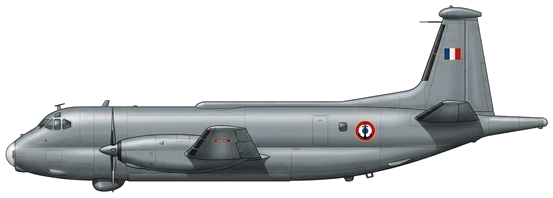
| Crew | 12 |
| Length | 31.8 m (104.2 ft) |
| Wingspan | 36.3 m (119.1 ft) |
| Height | 11.3 m (37.2 ft) |
| Wing area | 120.3 m² (1295.3 sqft) |
| Empty weight | 24,000 kg (52,911 lbs) |
| Max. takeoff weight | 43,500 kg (95,901 lbs) |
| Powerplant | 2 × turboprops Rolls-Royce Tyne RTy.20 Mk 21 4,222 kW each |
| Maximum speed | 650 km/h (404 mph) |
| Operational range | 9,075 km (5,639 mi) |
| Endurance | 18 hours |
- Air-to-Surface AS.12
- Air-to-Surface AS.37 Martel
- Torpedo L4
- Torpedo Mk 44
- Torpedo Mk 46
- Depth charges Mk 54
- Naval mines
- Nuclear NATO-provided nuclear bombs (Italian aircraft)
Description
The Breguet Br.1150 Atlantic is a twin-turboprop long-range maritime patrol aircraft designed by Breguet Aviation of France and built by the multinational SECBAT consortium. Developed to a 1958 NATO requirement to replace the Lockheed P2V Neptune, it entered service in 1965. Its primary roles were anti-submarine and anti-surface warfare. It was operated by France, Germany, Italy, the Netherlands and Pakistan, and a small number were converted for ELINT/SIGINT work.
Development
NATO issued a specification in 1958 for a long-range maritime patrol aircraft to replace the P2V Neptune. Breguet's Br 1150 was selected as the winner at the end of that year. The Société d'Étude et de Construction de Breguet Atlantic (SECBAT) was formed to develop and build it.
The first prototype flew at Toulouse on 21 October 1961. The second flew on 25 February 1962 and crashed on 19 April 1962, killing all three on board. Two pre-production aircraft with a longer fuselage followed in February 1963 and September 1964.
In 1963 France ordered 40 aircraft and Germany ordered 20, with deliveries running from 1965 to 1968. The production line had closed by the time the Netherlands ordered nine and Italy eighteen. This second batch was delivered between 1972 and 1974. Dassault later acquired the design through its merger with Breguet in the 1970s.
Design
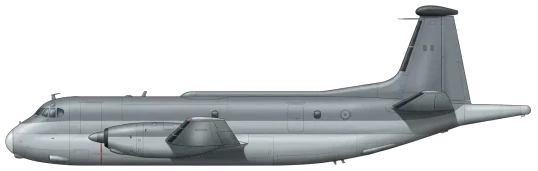
The Atlantic is a mid-wing monoplane designed specifically for the maritime patrol role rather than adapted from an existing type. It has a "double-bubble" fuselage. The upper lobe contains the pressurised crew compartment. The lower lobe holds a 9 m (27 ft 6 in) weapons bay, with sonobuoy tubes aft of it.
Search radar is housed in a retractable radome under the fuselage, and a magnetic anomaly detector is mounted in a tail boom. Power comes from two Rolls-Royce Tyne turboprops. The airframe is built entirely of aluminium, and corrosion from the maritime operating environment has reportedly been a persistent problem. Secondary roles include search and rescue, mine laying and detection, and long-range maritime surveillance.
Armament
Weapons are carried in the unpressurised internal bay. Typical loads were:
- up to eight homing torpedoes (L4, Mk 44, later Mk 46), or
- 12 depth charges, naval mines or conventional bombs.
Underwing pylons could carry AS.12 and later AS.37 Martel missiles.
The aircraft was also cleared to drop search-and-rescue equipment. German Atlantics usually carried only Mk 46 torpedoes and flew unarmed in their final years of service. Italian Atlantics were periodically armed with NATO-provided nuclear bombs.
Operational History
In 1987, during Opération Épervier against Libyan forces in Chad, France used a SIGINT Atlantic as an airborne headquarters. Communications it intercepted were decoded and translated to support strikes. France retired the original model in 1996.
Germany's Marineflieger received 20 Atlantics, five of which were converted to ELINT aircraft based at Nordholz. During the Cold War these flew over the Baltic and along the East German border, often with American and British intelligence personnel aboard. In the 1990s they monitored the UN embargo of Yugoslavia and flew reconnaissance during the 1999 Kosovo War. Germany replaced its maritime patrol Atlantics with ex-Dutch P-3 Orions in the mid-2000s; the last German Atlantic flight took place in July 2010.
The Netherlands chose the Atlantic over the P-3 Orion in a selection process during which Lockheed was alleged to have paid bribes. Three of its nine aircraft were lost in accidents between 1973 and 1981. On 15 January 1981, one aircraft ditched west of the Inner Hebrides while shadowing the Soviet carrier Kiev, and three crew drowned. The type was grounded in 1981 and later replaced by the P-3.
Italy's 18 aircraft were flown by Air Force and Navy pilots under Navy command; the last were retired in September 2017 and replaced by the ATR 72MP.
Pakistan acquired three ex-French Navy Atlantics in the 1970s. On 10 August 1999, Indian Air Force MiG-21s shot down a Pakistan Navy Atlantic near the border with an R-60 missile, killing 16 in what became known as the Atlantique incident. Pakistan retired its remaining aircraft in September 2012.
A French Atlantic crashed into Royal Aircraft Establishment offices during the 1968 Farnborough Air Show, killing six people.
Variants
- Br.1150 Atlantic: Original production maritime patrol aircraft built by SECBAT for France, Germany, Italy and the Netherlands.
- ELINT Atlantic: Five German aircraft converted for signals intelligence, planned to be replaced by the cancelled EuroHawk UAV.
- Atlantique 2 (ATL2): Updated version authorised in 1978 with new radar, sonar processing, tactical computer and FLIR; 28 were built for the French Navy.
- Atlantique 3: Proposed 1990s upgrade with a two-crew glass cockpit and Allison AE2100H engines; it was never built.
Frequently Asked Questions
What type of aircraft is the Br.1150 Atlantic?
What is the maximum speed of the Br.1150 Atlantic?
What is the range of the Br.1150 Atlantic?
When did the Br.1150 Atlantic first fly?
How many Br.1150 Atlantic have been built?
Which countries operate the Br.1150 Atlantic?
- SEP 302026 Created Page created: Br.1150 Atlantic