CP-107 Argus
Canadian long-range maritime patrol and anti-submarine aircraft derived from the Bristol Britannia, introduced in 1958 and retired in 1981, powered by four Wright Turbo-Compound radial engines. Key figures: top speed 507 km/h, range 9,495 km, service ceiling 7,620 m, max takeoff weight 71,214 kg, built 33.
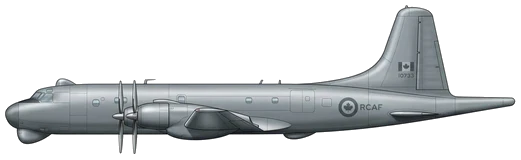
| Crew | 15 |
| Length | 40.4 m (132.4 ft) |
| Wingspan | 43.4 m (142.3 ft) |
| Height | 12.4 m (40.7 ft) |
| Wing area | 192.8 m² (2075.3 sqft) |
| Empty weight | 36,741 kg (81,000 lbs) |
| Max. takeoff weight | 71,214 kg (157,000 lbs) |
| Powerplant | 4 × piston engines Wright R-3350 Turbo-Compound 2,759 kW each |
| Maximum speed | 507 km/h (315 mph) |
| Operational range | 9,495 km (5,900 mi) |
| Endurance | 26 hours |
| Service ceiling | 7,620 m (25,000 ft) |
- Torpedo Mark 30
- Torpedo Mark 43
- Torpedo Mark 44
- Torpedo Mk 46
- Depth bomb Mark 54
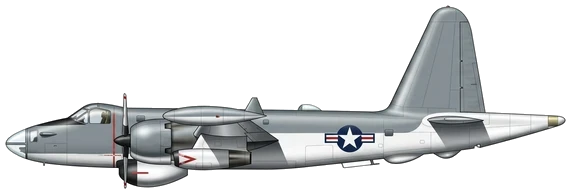
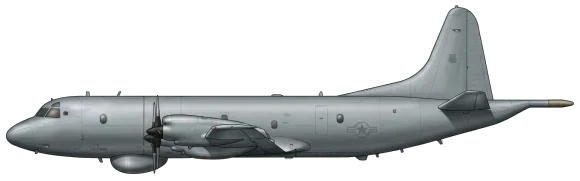
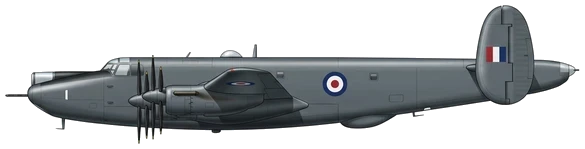
Description
The Canadair CP-107 Argus (company designation CL-28) is a four-engine maritime patrol and anti-submarine warfare (ASW) aircraft designed and manufactured by Canadair for the Royal Canadian Air Force (RCAF). Derived from the Bristol Britannia airliner but powered by piston engines, it entered RCAF service in 1958. It served through the Cold War with Maritime Air Command, and later with the Canadian Forces' Maritime Air Group and Air Command, until 1981. The Argus is known for its long-endurance patrol capability.
Development
In 1949 Canadair proposed the CL-29, a North Star variant, to replace the RCAF's maritime Avro Lancasters. The RCAF's 1952 specification called for a larger aircraft. It rejected a Lockheed Constellation variant for inadequate low-speed handling. It preferred a Bristol Britannia derivative, despite concerns over its servo-tab controls, provided the aircraft was developed in Canada. Canadair offered the Britannia-based CL-28, which was accepted, and the cheaper CL-33, a "fat Lancaster" comparable to the Avro Shackleton.
Work began in April 1954. The CL-28, initially called the "Britannia MR", was then the largest aircraft built in Canada. Seven aircraft took part in the test programme, each assigned to specific areas such as controls and stability, cold weather, structures and weapons. In July 1960 an Argus completed hot weather trials at Eglin AFB, Florida. Production totalled 33 aircraft: 13 Mk.1 and 20 Mk.2.
Design
The Argus retained the Britannia's wings, tail surfaces and landing gear, converted to American materials, dimensions and standard parts. These were reinforced for prolonged low-altitude flight using locally developed metal-to-metal bonding. It was the first aircraft to use titanium structurally on a large scale, and structural plastic insulated the fin top for sensors. Canadair designed a new unpressurised fuselage with two 18 ft (5.5 m) bomb bays fore and aft of the wing. Four 3,700 hp Wright R-3350 Turbo-Compound radials replaced the Proteus turboprops because of their lower fuel consumption; the Napier Nomad was also considered.
Sensors comprised:
- AN/APS-20 or ASV-21 search radar
- Jezebel sonobuoy analyser
- Tail-boom MAD
- AN/ALR-8 direction finding
- AN/APA-74 radar pulse identification
- AN/ASR-3 exhaust trail indicator
- Explosive echo ranging
- 70-million-candlepower searchlight
The crew of 15 had four bunks and a galley for patrols averaging 18 hours. Endurance was about 26½ hours with full armament, range 5,900 mi (9,500 km) and maximum speed 315 mph (507 km/h).
Armament
The bomb bays held up to 8,000 lb (3,600 kg), including:
- Mark 30, Mark 43 mod 0, Mark 44 and Mark 46 torpedoes
- 350 lb Mark 54 depth bombs
- Sonobuoys
- Mark 400 SUS charges
- LUU-2/B flares
Mines were never trialled. External stores up to 3,800 lb (1,700 kg) were possible, and AGM-12B Bullpup missiles and 2.75 in FFAR rockets were trialled but not used operationally.
Operational History
The Argus replaced the last Lancasters and the interim Lockheed Neptunes. It equipped Nos. 404 and 405 Squadrons at Greenwood, No. 415 at Summerside, a further maritime patrol squadron at Comox and training units. In 1968 the 32 surviving aircraft were renumbered from 207XX to 107XX. On 1–2 October 1959 an Argus set a Canadian military record for unrefuelled flight: slightly over 31 hours, including 4,570 mi (7,350 km) from Ohakea, New Zealand, to Barbers Point, Hawaii.
On 23 March 1965, Argus 20727 struck the sea during a night exercise near Puerto Rico, killing all 16 aboard. On 31 March 1977, Argus 20737 crashed landing at CFB Summerside and struck a parked Electra; three crew died. The last mission was flown on 24 July 1981, and the CP-140 Aurora replaced the type.
Variants
- Argus Mk.1 (CL-28-1): Initial version with AN/APS-20 radar in a chin radome; 13 built (20710–20722).
- Argus Mk.2 (CL-28-2): Version with British ASV-21 radar, a smaller nose radome, revised electronics and a dorsal ECM antenna; 20 built (20723–20742).
Frequently Asked Questions
What type of aircraft is the CP-107 Argus?
What is the maximum speed of the CP-107 Argus?
What is the range of the CP-107 Argus?
When did the CP-107 Argus first fly?
How many CP-107 Argus have been built?
Which countries operate the CP-107 Argus?
What is the service ceiling of the CP-107 Argus?
- OCT 12026 Created Page created: CP-107 Argus